Amy Schumacher’s first job was at the checkout at Joe O’Malia’s grocery store. The lessons she remembers are ordinary enough to fit on a shift schedule: arrive on time, work hard, keep a good attitude, treat people decently. A supermarket is an efficient place to discover that a business has customers. They tend to stand directly in front of you.
Today, Schumacher is chief executive of The Heritage Group, an Indianapolis business whose interests run through construction materials, specialty chemicals and environmental work. The setting has changed considerably. The usefulness of those early lessons, in her own telling, has survived. The industries now under her leadership offer another kind of tangible work.
Her role carries a particular complication. She represents the fourth generation of the Fehsenfeld family’s leadership. A family business hands its next leader a collection of assets, relationships and expectations. The name arrives already attached. The future remains a job to be done.
Before the portfolio, a business to build
Schumacher studied civil engineering at Purdue, graduating in 1997. Her education also includes an education degree from Purdue and graduate management study at MIT Sloan. It is a combination with two distinct subjects: how things work, and how people learn. Both belong somewhere in the life of an industrial business, even when the organization chart gives them separate offices.
From 1998 to 2003, she worked as a consultant at Accenture. She then took on work within the Heritage family of businesses, including growth projects. In 2005 she became a board trustee. Those dates give her career a useful prehistory. Her experience inside the group began before the better-known founding chapter.
That chapter opened in 2008 with Monument Chemical. Schumacher founded the specialty chemicals business and led it as president and CEO for eight years. During that period, it developed from an Indianapolis-based operation into a business with operations in the United States and Europe.
There is a difference in scale between running one company and being responsible for a collection of them. At Monument, the work had a specific industrial home. When she became president of The Heritage Group in 2016, and CEO in 2020, the field of responsibility widened. The chemical-business chapter remained part of the experience she brought with her.
Chemical
as president
CEO role
“progress over perfection”AMY SCHUMACHER · ON SUSTAINABILITY
The family tree has an industrial branch
The Heritage Group began in 1930, when Schumacher’s great-grandfather, John E. Fehsenfeld, launched the business as Crystal Flash. Her grandfather, Fred M. Fehsenfeld Sr., helped develop its petroleum and chemical interests. Her father, Fred M. Fehsenfeld Jr., is another part of the leadership history. The generations are unusually visible in this story.
The industries can initially look like an assortment. Schumacher has described their development as a sequence of adjacent opportunities: construction and materials led toward environmental work, which led toward refining, which led toward chemicals. The connection was built over time. A family tree, in this instance, comes with a process diagram.
That history helps explain why scientific experience matters to her account of the business. The group’s research organization gives its companies a shared resource for technical problems. Investing in an unfamiliar market becomes a more concrete proposition when someone nearby knows how to test a material or investigate a process.
It also puts a useful constraint on the idea of reinvention. A new activity can draw on an old capability. The question for a leader is where that connection is strong enough to support a business, and where enthusiasm still needs more work.
A battery’s second career
In August 2023, Schumacher stood at Cirba Solutions’ Lancaster, Ohio, expansion event with company leaders and U.S. Energy Secretary Jennifer Granholm. The photograph includes hard hats and shovels, the traditional accessories of an industrial promise. The project behind the ceremony was a battery recycling expansion.
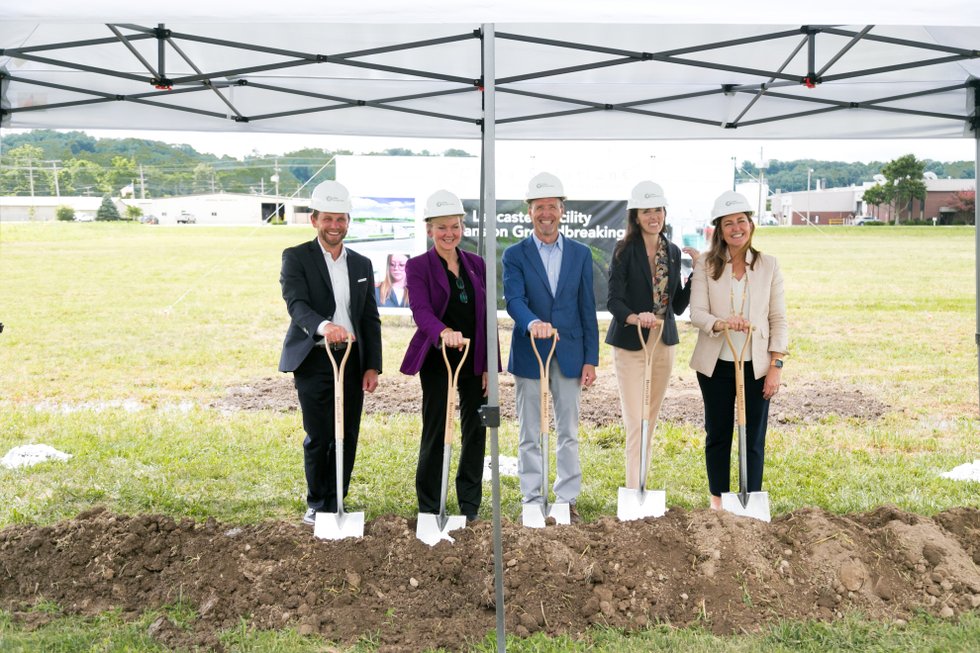
The announced expansion exceeded $200 million, with more than $82 million in Department of Energy support. Its plans included a hydrometallurgical process to recover battery-grade metal salts from used lithium-ion batteries and manufacturing scrap. Lithium, nickel, cobalt and manganese were among the materials targeted.
These were plans announced for a particular project at a particular time. Their relevance to Schumacher’s story is the kind of investment they represent: industrial knowledge applied to a changing supply chain. The activity involves collecting materials, processing them and preparing recovered inputs for another use. Each step needs a working operation behind it.
- CollectUsed batteries
and production scrap - RecoverProcess materials
into metal salts - ReturnSupply inputs for
battery manufacturing
Conceptual pathway described in Cirba’s 2023 expansion announcement.
The appeal of the loop is easy to draw. Building the businesses that make it work takes a different sort of patience. The diagram is helpful precisely because it shows how many separate jobs sit inside a phrase as compact as battery recycling.
The people who do the work
Schumacher’s grandfather gave her a piece of advice she still repeats: “bet on your people - they will amaze you and themselves!” She identifies seeing colleagues succeed as a favorite part of leadership. In a group of industrial businesses, that preference has practical implications. Technical knowledge is carried by people, as well as recorded in systems.
A public example came in January 2023, when Sibel Selcuk returned to lead Heritage Research Group as executive vice president. Selcuk had worked in the group’s research organization and later held global research and strategy responsibilities at Monument Chemical. Her appointment connected experience in the laboratory with experience inside an operating company.
For Schumacher, choosing Selcuk was an expression of confidence in a colleague’s technical knowledge and leadership. For the wider organization, it placed someone familiar with both parts of the business in charge of a shared research capability. A promotion can tell a useful story about what an employer values.
There is an outside view, too. Cirba CEO David Klanecky has spoken about Schumacher as a leader whose use of her time he admires. The observation directs attention to the daily work of being a chief executive. A calendar, for all its modest appearance, is one place where priorities become visible.
Roads bring the conversation home
Schumacher’s engineering background has a literal connection to the ground beneath the business. In February 2024, around 200 industry participants gathered at The Heritage Group’s Indianapolis headquarters for a Future of Roads event. The discussion brought together infrastructure trends, funding, startups and technology.
In her opening remarks, she emphasized sustainability, difficult problems and infrastructure quality. Roads are a useful setting for that combination. Any promising change has to meet the demands of an actual surface, an actual project and the people responsible for delivering it. The public conversation eventually has to arrive on site.
Her participation in the Women of Asphalt forum at World of Asphalt in 2019 offered another view of the industry. The panel considered how women can thrive in asphalt work. It placed her alongside people with research, project engineering and operational experience. The subject was an industry’s people, as well as its materials.
Continuity requires new appointments
In 2026, The Heritage Group acquired FORTA, which makes fiber reinforcement products for concrete and asphalt. The acquisition extended the group’s construction and materials interests. Later that year, FORTA named Bruce J. Christensen CEO, succeeding retiring chief executive Peter Ferris.
Schumacher’s explanation of the choice emphasized integrity, team building and shared values alongside Christensen’s industry experience. He brought a career spanning construction materials, chemicals and technical leadership. Here was another decision in which a materials business and a people decision arrived together.
The sequence is a reminder that patient ownership is full of present-tense work. Companies enter a portfolio. Leaders retire. Successors take responsibility. A long horizon does not remove these decisions; it gives them consequences that may continue well beyond the person making them.
The next generation needs a place to start
Schumacher’s connection to Purdue continues through its Engineering Advisory Council. When the university announced a School of Sustainability Engineering and Environmental Engineering in 2025, she endorsed the link between classroom preparation and practical industrial problems. The school brought together fields that sit close to the group’s own work.
Her story also includes the family’s enthusiasm for education closer to home: science camp for employees’ children, organized with The Children’s Museum of Indianapolis, and college scholarships. These are specific ways of giving younger people a starting point. Curiosity benefits from somewhere to go.
For young adults deciding on a direction, she favors the advice “commit and see.” Do the homework, choose a path, then work at it. It is a brisk answer to the temptation to keep every possible future available. Eventually, a possible future requires someone to begin.
Asked about Indiana, she mentions its seasons, sports, the race in May and August sweet corn. It is a pleasantly local list for someone whose working life reaches across borders. Indianapolis is both a base for industrial decisions and a place with a calendar of its own.
In a 2025 conversation about enduring value, Schumacher described the ambition to build businesses the group would be happy to retain indefinitely. That ambition gives her career its longer clock. The operating chapter, the appointments and the investments all sit inside it. What the next generation inherits will depend on what this one makes useful enough to keep.
Continue the conversation
Read, listen and watch Amy Schumacher discuss her work.
- The Heritage Group and Amy Schumacher on LinkedIn
- Creating Enduring Value - BCG Henderson Institute interview
- Progress Over Perfection - sustainability Q&A
- Watch: Amy Schumacher on public speaking
- The family enterprise’s approach to innovation - Indianapolis Business Journal
- FORTA’s August 2026 leadership announcement
- Heritage on LinkedIn · Instagram · X