Before Kyle Larkin was responsible for a construction company, he was responsible for a notebook full of things he wanted to build. His father, who worked with computers in Silicon Valley, had encouraged him to get his ideas onto paper. Years later, when college choices arrived, that notebook returned to the conversation. A skateboard ramp and a bicycle made from PVC were among its proposals. Few career assessments come with such specific material requirements.
Larkin’s mother helped find a construction management program. He went to California Polytechnic State University in San Luis Obispo. The childhood projects offered an early clue; the professional education would give the inclination a discipline. As he later put it, “I wanted to be outside.”
He graduated in 1996 and joined Granite that year, beginning as an estimator in Reno, Nevada. Becoming its chief executive would take another twenty-five years. That interval is the useful part of his story. It contains the jobs that put a construction business into focus, one responsibility at a time.
The long education in Reno
An estimator occupies an interesting position in construction: close to a project that has yet to happen. Quantities, prices and assumptions must become a proposal that other people can execute. The plans may be tidy. The consequences of misunderstanding them rarely are. It is a sensible place to begin learning how an ambitious drawing becomes an obligation.
Larkin’s early Granite assignments included project engineering and project management. From 2004 to 2008, he was chief estimator in the Reno area; from 2008 to 2011, manager of construction. Those roles sit on different sides of the same promise. One helps determine what a company can offer. The other helps deliver what it has offered.
His next appointment widened the frame. Between 2011 and 2014, he served as president of Intermountain Slurry Seal, a Granite subsidiary. Then came the Nevada regional manager position, followed by senior leadership of the California group in 2017. By 2019, his remit covered construction and materials operations. In February 2020, he became executive vice president and chief operating officer.
The progression gave him repeated changes of scale without requiring a change of employer. A job, a subsidiary, a region and a company each demand a different view of performance. Following that route helps explain the operator behind the title. His résumé is unusually legible as a series of widening circles.
At the time of his COO appointment, then-CEO James Roberts singled out Larkin’s knowledge of Granite and his ability to develop and empower teams. That endorsement is revealing because it joins two requirements often discussed separately: understanding the business and helping other people run it. A company cannot put its chief executive on every job site. Eventually, competence has to travel through other people.
A company older than its chief executive
Granite appointed Larkin president in September 2020. On June 3, 2021, the board named him CEO and added him as a director. Michael McNally became board chair during the same transition. The appointments put a longtime operating executive into a role that also demanded attention to governance, capital and the company’s wider direction.
The handover followed a difficult reporting period. Granite had investigated earlier Heavy Civil Group reporting and experienced delayed financial statements. Assembling the senior team became a priority in the leadership transition. Larkin inherited a business with substantial experience and a recent reminder that operational performance and confidence in the numbers belong together.
Then the company turned one hundred. January 4, 2022 marked a century since Granite’s founding as a small construction operation on California’s Central Coast. Most new CEOs receive a set of targets. Larkin also received a centennial. History is an excellent conversation starter, though it has never been known to complete tomorrow’s work schedule.
In his anniversary letter, he addressed employees, clients, suppliers, subcontractors and communities in turn. The organization he described depended on all of them. He connected its continued relevance to understanding what clients and communities needed. That is a practical account of longevity: a construction company survives through relationships that must be renewed with each piece of work.
“It’s all about relationships.”
Kyle Larkin
Getting the risk into the room
One of the more consequential changes during Larkin’s leadership concerns how projects are arranged before construction begins. Granite has emphasized collaborative delivery, including progressive design-build and construction manager/general contractor arrangements. These give the builder a place in planning earlier, when decisions can still change the work rather than merely explain a problem that has already arrived.
In discussing the approach in 2024, Larkin described reviewing larger best-value projects in smaller work packages and examining them through workshops. The appeal is straightforward. A complicated undertaking contains many opportunities for assumptions to go wrong. More opportunities to review those assumptions can help the owner and builder address risk together.
By the second quarter of 2024, Granite classified 42% of its backlog as best value. That figure belongs to that particular reporting period, but it gives the shift a useful scale. The change was substantial enough to show up in the mix of work waiting to be done.
There is a human dimension to the contract language. Owners and contractors have to talk through problems, agree on responsibilities and understand what each package requires. The legal arrangement sets the conditions for those conversations. Anyone who has watched a minor misunderstanding become an expensive argument can appreciate the attraction of discussing it earlier.
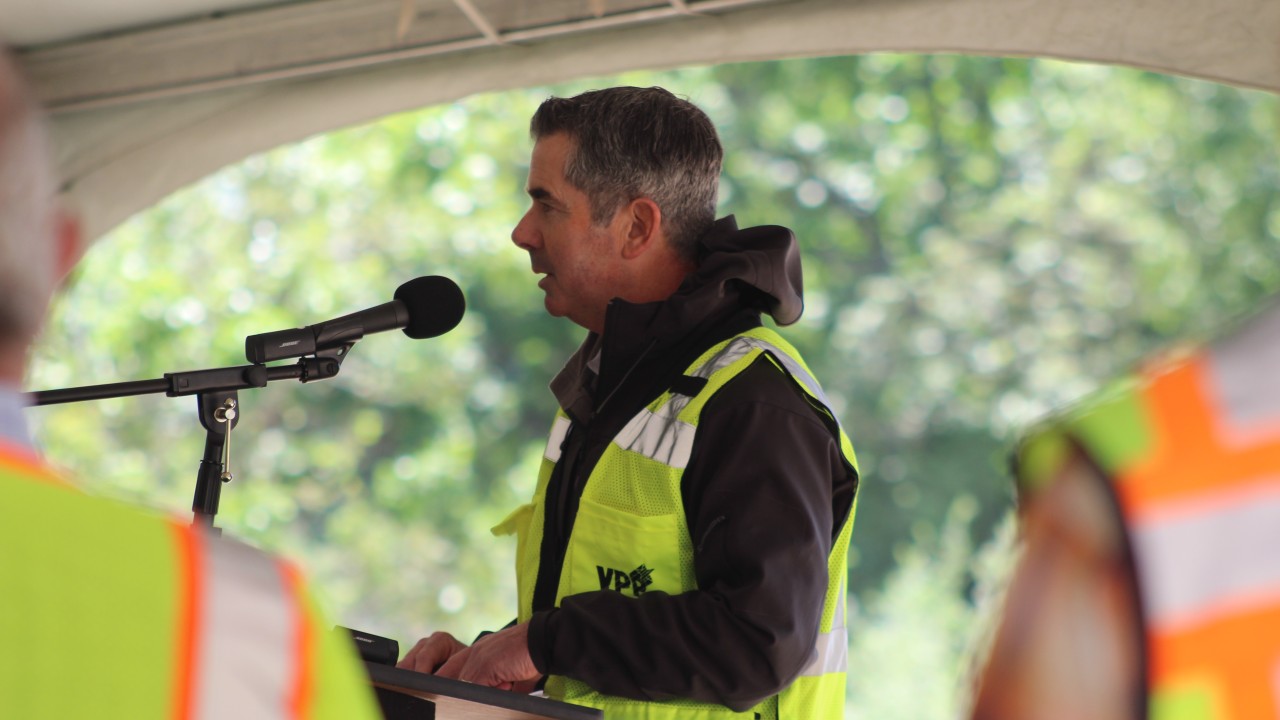
Larkin’s public activity also puts him among the people doing the work. In May 2025, he described joining more than 300 participants at Granite’s American River Bridge Rehabilitation Project in Sacramento. Caltrans, subcontractors, vendors and other construction partners attended. The gathering made the network around a project visible: a bridge has many more contributors than the name on a contract.
A map made of quarries and crews
The other part of Granite’s direction is unusually tangible. Its home-market strategy connects construction operations with materials businesses in the regions where it works. A quarry supplies aggregate. An asphalt plant turns inputs into paving material. Construction crews use those products, while outside customers can buy them too. Vertical integration is a rather grand phrase for bringing related capabilities within the same business.
Granite’s expansion in the mid-South began with its 2023 acquisition of Lehman-Roberts and Memphis Stone & Gravel. Dickerson & Bowen followed in 2024. The sequence matters because a regional platform can be strengthened through additions as well as established through a single transaction. Geography supplies the logic that a list of acquisition names can conceal.
In August 2025, Granite announced the completed purchases of Warren Paving and Papich Construction for a combined $710 million, subject to customary adjustments. Warren added a Mississippi River and Gulf Coast network, including aggregate distribution and barges. Papich strengthened the California Central Coast and Central Valley business with construction operations and materials assets.
Combined purchase price for Warren Paving and Papich Construction, subject to closing adjustments.
The assets make the strategy easier to picture than the terminology does. Warren’s network brought 168 owned and leased barges. Papich’s purchase included a gravel mine, two quarries and two asphalt plants. These are businesses whose usefulness depends on where they are, what they can supply and which projects or customers they can reach.
In April 2026, Granite extended its Utah platform by acquiring Kenny Seng Construction. The acquired company brought earthwork, concrete, utility installation, transportation and materials capabilities. Granite described approximately $150 million in annual revenue and about one million tons of annual materials production. Here again, the proposition combined the people who build with the assets supplying part of what they build with.
Completing a deal creates a new operating assignment. Schedules, equipment, customer relationships and local leadership still have to fit together. Larkin’s earlier experience running a subsidiary and a region is relevant context for that work. His own career passed through organizational units of the kind Granite is now bringing into a larger system.
The arithmetic of the next chapter
The results offer both momentum and complications. For the first quarter of 2026, Granite reported revenue of $912 million, up from $700 million a year earlier, alongside a net loss of $42 million. Rising revenue and a loss can occupy the same statement. Growth earns attention; the costs and timing of delivering it deserve a place beside the headline.
Company revenue, rounded. Reporting periods end June 30.
By the second quarter, revenue reached $1.46 billion, compared with $1.13 billion in the corresponding 2025 period. Committed and Awarded Projects, Granite’s measure of its project portfolio, stood at $7.4 billion. Granite also reported a $278 million quarterly net loss, driven by a $360 million non-operating loss on convertible debt transactions. Materials margins faced pressure from severe weather in the Southeast and quarry development costs. Physical businesses retain a tiresome habit of encountering physical conditions.
Larkin’s July 2026 outlook described opportunities beyond traditional highways and bridges, including federal work, rail and transit, and data center site development. Those are stated areas of expansion, rather than promises of completed results. They also widen the practical questions facing the company: which work to pursue, where to supply it, and how to deliver it.
The young person with a materials list has become an executive responsible for a business containing materials producers. It is a pleasing connection, with twenty-five years of operating assignments between the first estimating job and the CEO appointment. Larkin’s story gives those intermediate years their due. The road to the corner office had quite a few stops, and much of its interest lies in what each stop required him to learn.