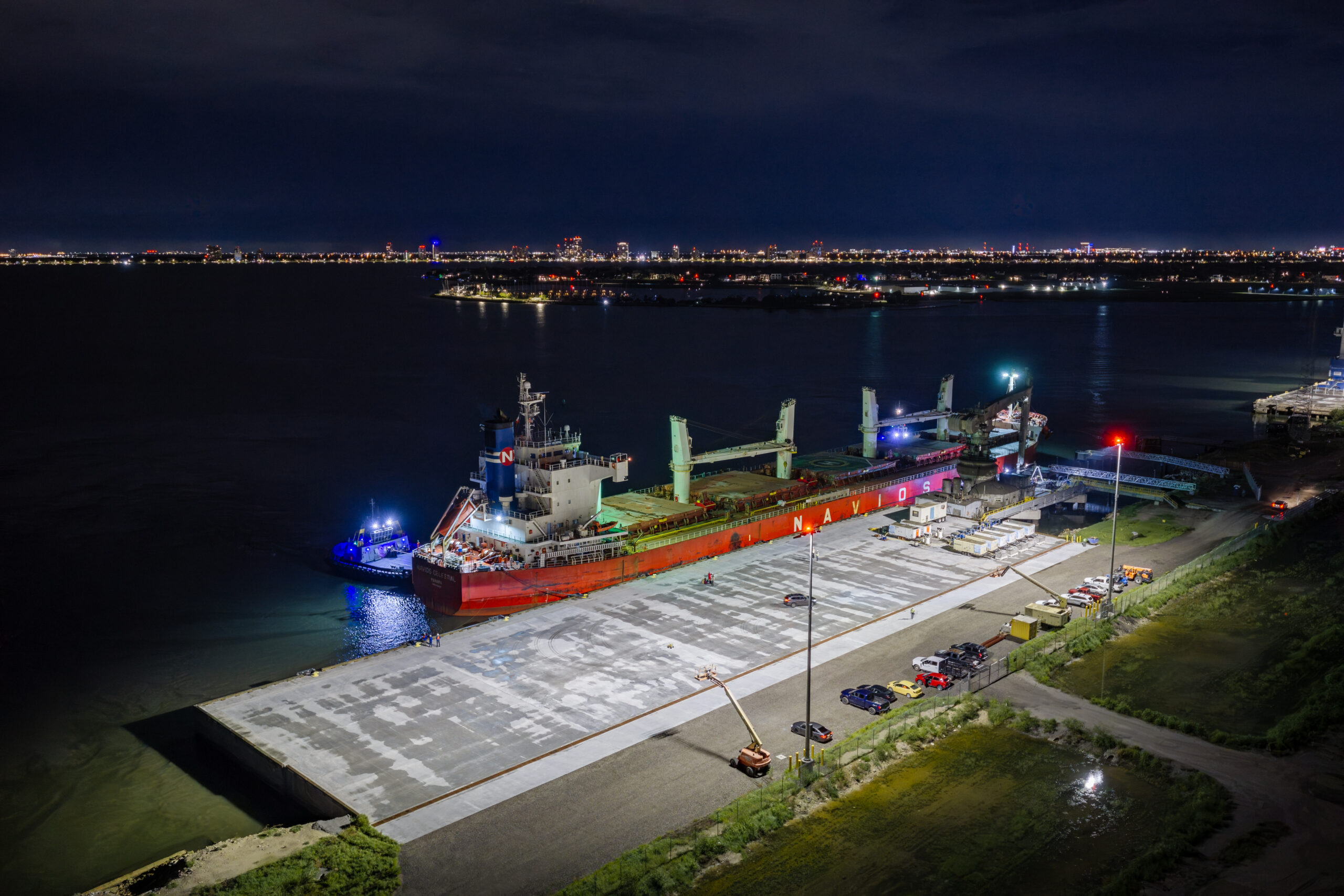
At Port Tampa Bay, Titan America supplied about 5,000 cubic yards of specialized concrete for a new berth. The berth sits beside Titan’s own cement import terminal. A company that sells construction materials helped build the infrastructure that brings its materials ashore. There is something pleasingly circular about this. There is also a useful clue to how the business works: follow the concrete backward, and eventually you find a port, a kiln, a quarry, and a decision about distance.
- The business: cement, concrete, aggregates, block and processed fly ash.
- The bet: connect production and delivery along the East Coast.
- The test: make the network pay, even when a plant or shipment falters.
01 / The map is part of the product
Titan America serves the people who turn drawings into buildings: concrete producers, contractors, developers and infrastructure teams. Cement binds; aggregates provide bulk; ready-mixed concrete combines ingredients for placement. Concrete block arrives as manufactured masonry. Different products, different jobs, one persistent requirement: the right material must reach the right place.
That requirement shapes the economics. Heavy materials are costly to transport relative to their value. A network of nearby plants, quarries and terminals can matter as much as a clever formula. Titan sells materials and supports customers with mix design, technical advice and delivery coordination. Its ready-mix portfolio includes demanding applications such as underwater placement and deep foundations.
assetsStone + sand
the mixCement + concrete
materialsTerminals + trucks
the projectThe customer
Additional inputs: imported cementitious materials + processed fly ash
This is vertical integration in work boots. Large competitors, including Cemex and Heidelberg Materials, also combine production with distribution. Titan’s particular proposition is its East Coast arrangement of assets, especially in Florida, the Mid-Atlantic and metropolitan New York/New Jersey. A buyer comparing suppliers should compare the route to the site alongside the quote.
02 / A $310 million geography lesson
In January 2026, Titan announced an agreement to buy Keystone Cement for $310 million. It completed the acquisition on May 1. Keystone brought Pennsylvania production and 990,000 short tons of annual clinker capacity. Clinker is the kiln-produced intermediate used to make cement. The existing plant could connect with Titan’s Essex and Roanoke operations rather than stand alone.
The cost explains the choice. At closing, CEO Bill Zarkalis described existing capacity as attractive compared with expensive new industrial development. Buying an operating asset offers a different starting point from building one. Titan’s subsequent target is at least $30 million in annual run-rate synergies by 2029. That is a management objective, with integration work still between the purchase and the payoff.
“We see substantial value creation potential through capacity growth, operational improvements and integration with our Essex and Roanoke Cement operations.”
Bill Zarkalis · Keystone announcement · January 2026
03 / The money has two destinations
Titan entered public markets in February 2025, trading as TTAM. Its initial offering comprised 24 million shares at $16: $384 million gross. But 15 million were existing shares sold by its parent. Nine million were new shares issued by Titan America. The company received approximately $136.8 million after underwriting discounts and commissions, before other offering expenses. The distinction matters whenever an IPO is described as money raised.
For 2025, Titan reported $1.664 billion in revenue and $185.4 million in net income. Net capital expenditures reached $163.3 million. Those figures describe a business with substantial reinvestment needs: physical capacity, maintenance and distribution absorb real money. Public-market access adds another financing channel to a company built around industrial assets.
Same scale, USD millions. Capital spending equals approximately 88% of net income; this is a size comparison, not a cash-flow reconciliation.
04 / A better mix needs permission
Material innovation has its own delivery problem: getting a product accepted for the job. In April 2026, Titan announced transportation-department approvals for TriForce blended cement in Florida, Virginia and North Carolina. For infrastructure buyers, meeting the specification is a commercial gate. A promising material has to pass through it.
Another route runs through ProAsh. Titan’s Separation Technologies business processes fly ash for use in concrete. Properly engineered mixes can gain workability and durability while replacing some cement. Recovering useful material also offers an alternative to disposal. The appeal is practical: a concrete ingredient must earn its place through performance, consistency and compatibility with the intended application.
05 / Please feed the printer
June 2026 brought xForm3D, a patented printable-concrete family. Titan announced Standard for general automated construction, Marine for marine and underwater applications, and RMX for ready-mix delivery using larger aggregates. The product is the material going through the equipment. Its proposed advantages include automated placement and less reliance on traditional formwork.
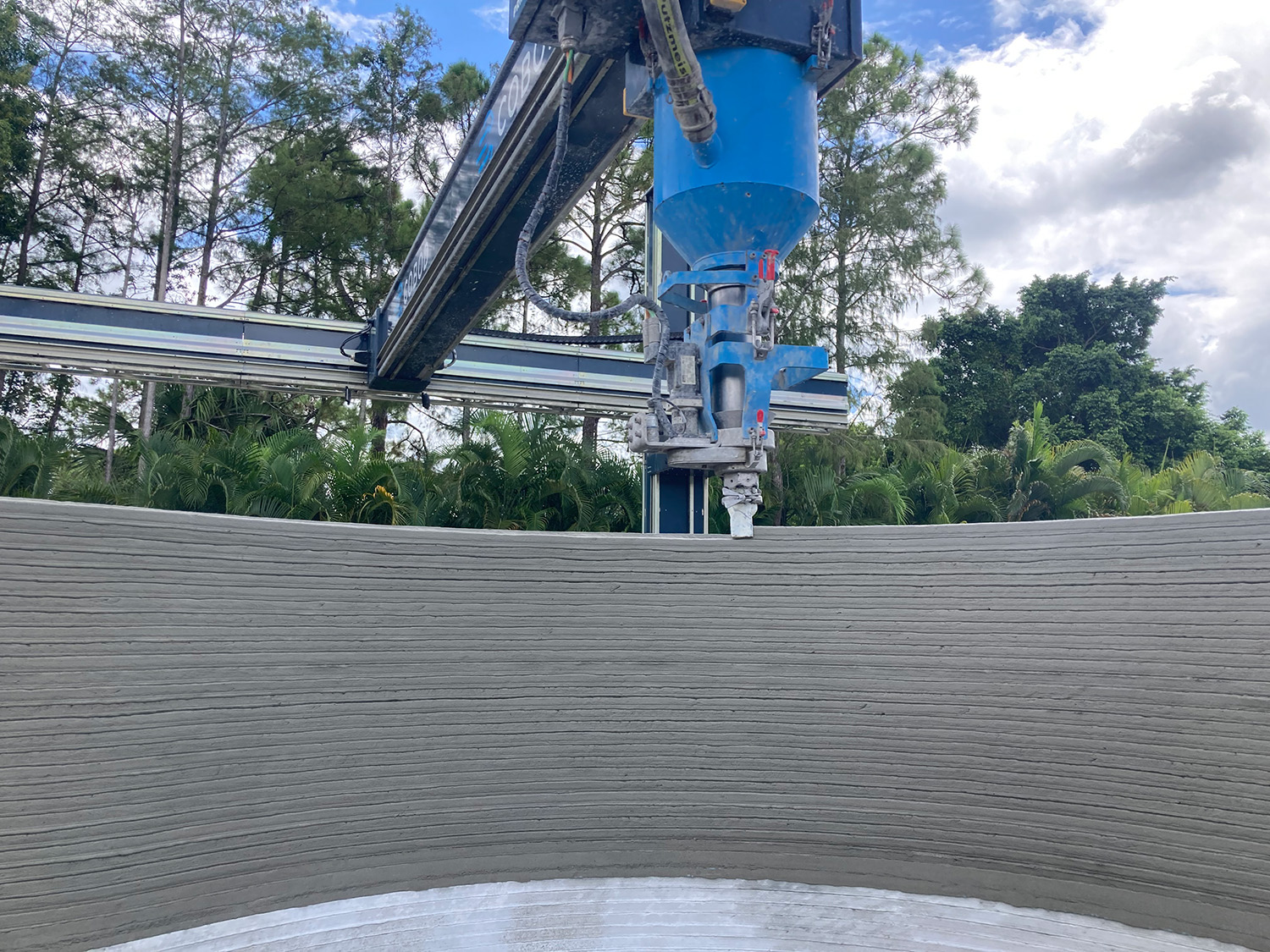
Titan also opened a South Florida Innovation Hub to bring customers, suppliers, universities and startups into development. Pairing material specialists with the people placing the material is a sensible experiment. Commercial success will depend on whether those new methods fit actual projects, approvals and budgets. A launch establishes availability; it does not establish universal savings.
06 / The network still needs a backup
The second quarter of 2026 supplied a less photogenic lesson. Extended Pennsuco maintenance and temporary cement-import disruptions affected Florida. Titan incurred extra costs sourcing cement and aggregates from third parties. Owning multiple links in the chain did not prevent a weak link from becoming expensive.
The people operating that network are part of the equation. Titan’s stated values emphasize care, candor, learning and keeping commitments. Those are company promises, but the underlying question is concrete enough: can a producer coordinate production, dispatch and technical support when a customer’s schedule changes? Its digital program addresses some of that operating complexity through real-time production optimization, spare-parts inventory analysis and predictive maintenance. The interesting measure of such tools is whether equipment runs reliably and materials arrive as planned. Efficiency on a dashboard becomes useful when someone at the job site can depend on it.
The useful idea to copy is the discipline of connecting material choice with supply planning. Ask about approved mixes, plant coverage, delivery windows and alternatives during an outage. That approach is most useful where the network reaches the project and the materials meet its requirements. Outside those conditions, a closer supplier or different specification may win. At Tampa, the logic is visible in concrete: improve the place where materials arrive, and you improve the route to everything built afterward.