The useful thing about a road is that some of its ingredients may already be lying underneath it. On the roughly 30-kilometer Tit Mellil-Berrechid motorway, Holcim Maroc supplied a hydraulic binder called Valosol. Its purpose: help turn existing ground into a usable foundation, reducing the need to bring in fresh aggregate. A cement company had found a way to make the ground do more of the work.
- Holcim Maroc sells cement, concrete and the expertise to use them.
- Its technical edge connects local materials, testing and industrial delivery.
- Lower resource use matters only when the finished structure performs.
That is a useful place to begin with this business. Cement is easy to picture as an anonymous powder sold by the tonne. Holcim Maroc wants the conversation to include what happens after delivery: how a mix behaves, what a project consumes and whether the contractor can depend on the result. The interesting product is sometimes a better decision.
01 / The business of being nearby
The company’s industrial footprint helps explain its position. It lists seven cement plants, three grinding centers, nineteen concrete plants and a mortar factory across Morocco. Its buyers include contractors, distributors, property developers and manufacturers of precast concrete. Engineers and architects also matter: they help specify what gets bought before the purchasing department enters the discussion.
The business earns money by making and selling materials, supplying ready-mix concrete and providing associated services. A small building contractor and a major infrastructure project can both buy from the same industrial system, although their specifications and delivery problems differ. For either customer, a material that arrives consistently is easier to plan around.
Consider Agadir-Souss. The plant, launched in 2021, required an investment of MAD 3 billion and added annual cement capacity of 1.6 million tonnes. Its stated purpose included getting closer to southern customers. By 2022 it was also supporting seaborne exports to partners in sub-Saharan Africa. Geography here becomes part of the product: a factory’s location changes the markets it can serve.
Agadir-Souss plant investment
02 / A recipe earns its place
Holcim Maroc’s catalogue is organized around different jobs. ECOPlanet covers lower-carbon cement formulations. ECOPact addresses lower-carbon concrete. Agilia is self-compacting; Artevia provides decorative finishes; DYNAMax serves demanding structural applications; Hydromedia is permeable. Tector mortars handle tasks including masonry, tile fixing and repair. These are different answers to different site problems.
The company describes ECOPact as offering at least 30 percent less embodied carbon than ordinary Portland-cement concrete. That comparison needs care. It is a product-family claim against a specified reference, not a promise that any building using it cuts its whole-life emissions by 30 percent. Buyers still need the chosen mix’s performance, environmental evidence and suitability for their project.
Valosol makes the same commercial logic particularly visible. Developed with Autoroutes du Maroc, it treats local materials rather than assuming they must be replaced. The potential benefit combines fewer transported inputs with useful engineering performance. The sensible buying question becomes: what does the completed road require? A price per tonne can answer only part of that.
local soil
binder
road layer
03 / The laboratory beside the kiln
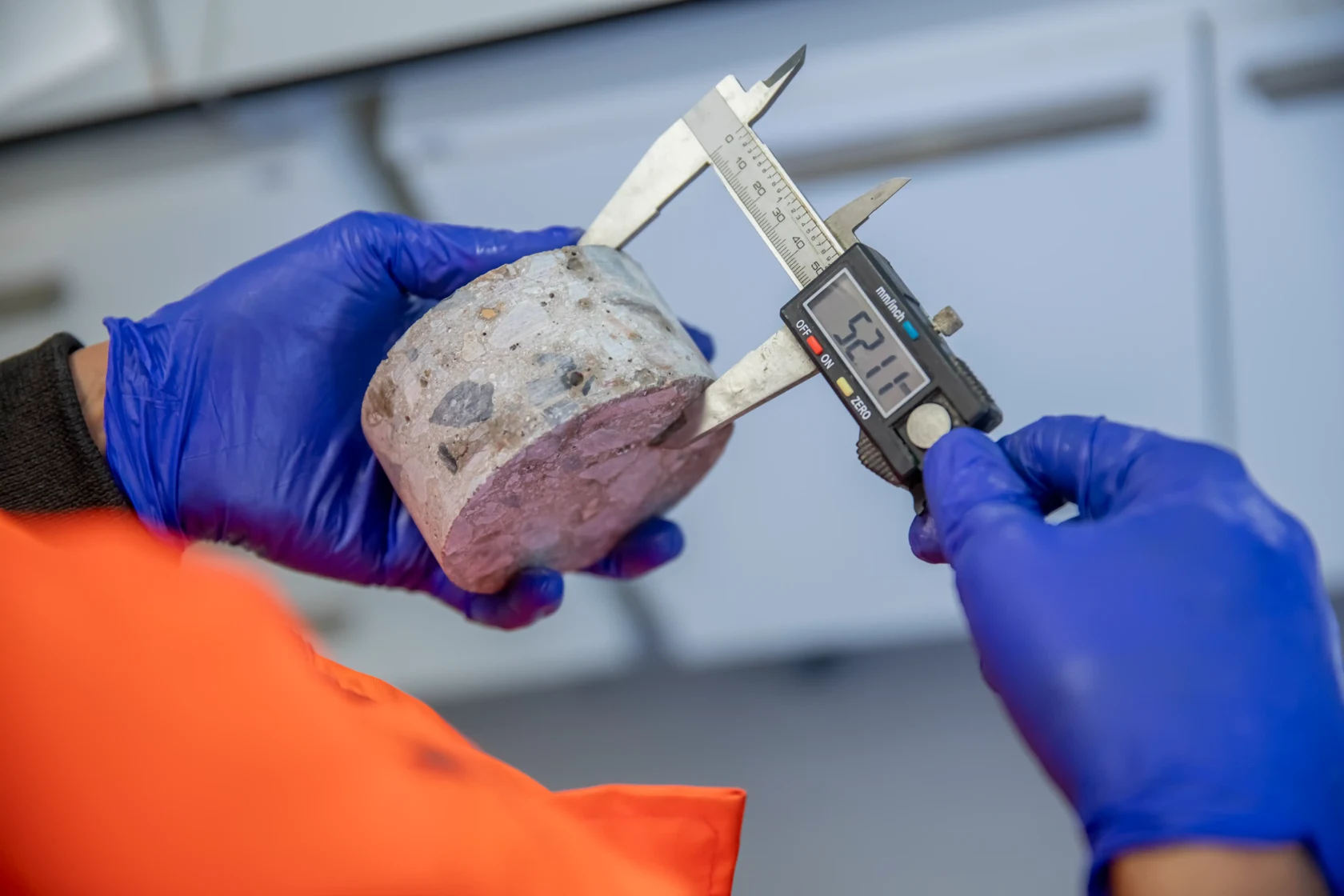
At Bouskoura, the Sustainable Construction Lab gives this argument a physical address. The 4,000-square-meter facility includes five testing rooms and a 600-square-meter prototyping area. Its showroom was inaugurated in 2024. Engineers can investigate materials, concrete behavior, durability and building systems, then move toward demonstrations that customers can inspect.
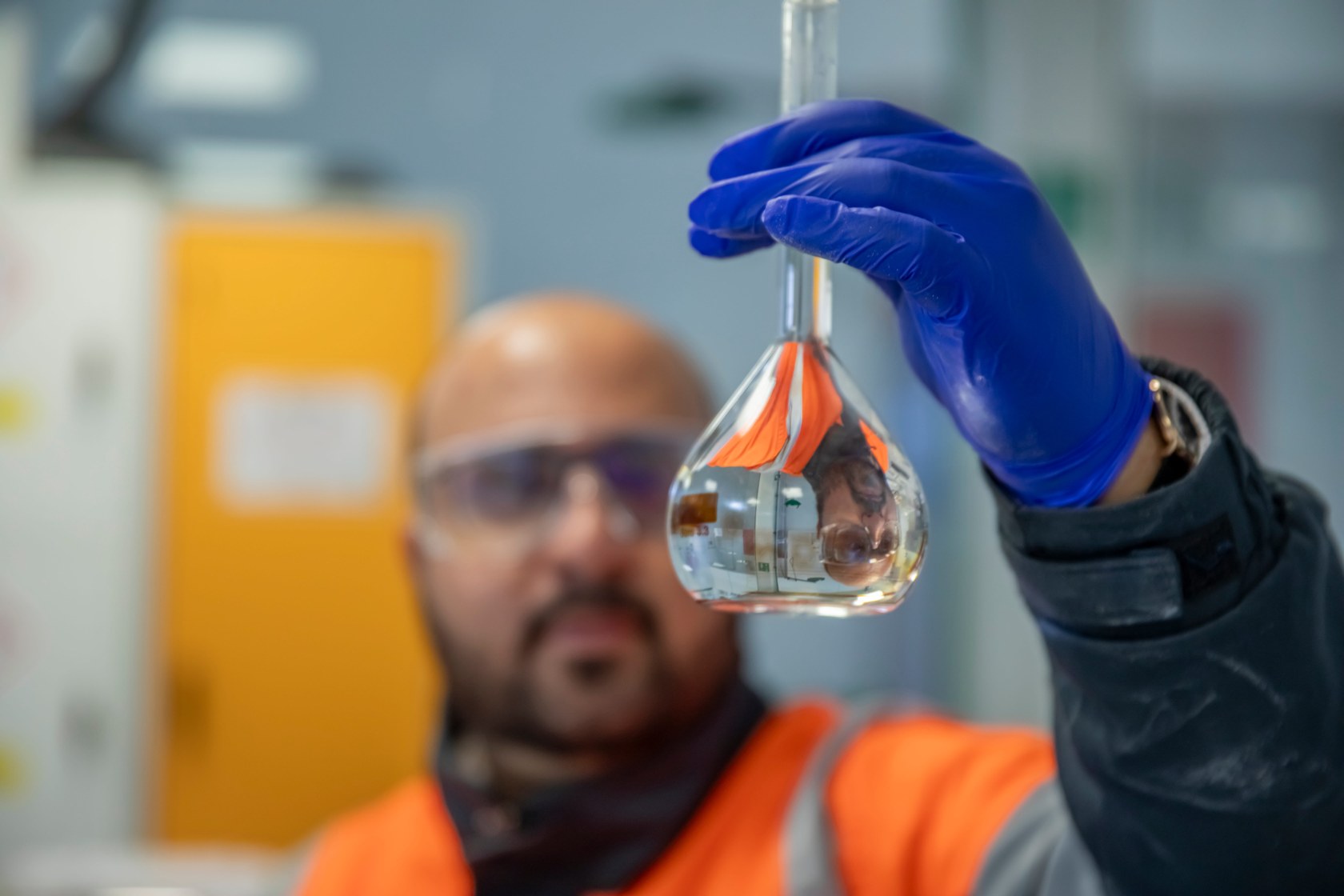
The laboratory works with developers, engineering offices, architects, researchers and industrial companies. Its remit includes local resources, industrial coproducts and insulation. That matters because the obstacle to changing a construction material is practical: somebody must specify it, somebody must place it, and somebody must trust the finished result. Demonstration gives those people something concrete to examine.
Irchad extends the relationship into customers’ factories. Introduced in 2016, it supports concrete plants and precast producers with technical work, training and digital tools for quality control and maintenance. The interpretation is straightforward: a supplier gains a stronger place in the customer’s operation when its expertise helps that operation run.
For a customer, that creates a practical way to approach the company: bring the application, its constraints and the required performance. A housing developer needs a different discussion from a precast manufacturer. The range is useful because the starting point can be the engineering problem, with the product selected after that problem is understood.
“Our priority remains reducing our carbon footprint.”
Khalid Samaka, chief executive
Translated from the company’s strategy statement
04 / Waste gets another assignment
Geocycle Maroc adds another connection. It manages and recovers industrial waste, using suitable prepared waste in cement co-processing. Since 2017, its Oum Azza platform has also recovered sorted household waste as alternative fuel. The useful word is “suitable”: sorting, preparation and industrial control are essential to turning a disposal problem into a resource.
This is also how to read the company’s differentiation. Ciments du Maroc, part of Heidelberg Materials, and CIMAT offer alternatives in the Moroccan market. Holcim Maroc’s case rests on the combination of industrial coverage, formulations, laboratory work and customer support. A buyer should test that combination against the actual job, including delivery and technical requirements.
05 / Rain still sets the schedule
The numbers put limits around the ambition. Consolidated revenue reached MAD 8.936 billion in 2025, up 9.6 percent. In the first half of 2026, revenue was almost flat at MAD 4.152 billion, while net profit fell 8.1 percent. Heavy first-quarter rainfall disrupted construction; higher fuel prices also pressed operating earnings. Better engineering cannot make a wet construction calendar disappear.
In May 2026, shareholders approved the change from LafargeHolcim Maroc to Holcim Maroc, shortening the name of the business formed by the 2016 merger. The more useful change to watch is operational. For another company, the lesson to borrow is to test what the customer already has before selling a replacement. It works when material suitability, specification and execution agree. Without those conditions, using less is merely an attractive proposal.