A tractor can have an imposing engine, an expensive guidance system, and a driver with a very long day ahead. Eventually, all that ambition has to reach the ground. Paul Reitz runs a business concerned with that last, unglamorous transaction. Titan International makes the wheels, tires, assemblies, and undercarriage products that help off-road equipment do its work. Its customers include equipment manufacturers and dealers. The person Reitz keeps bringing into the conversation is farther down the chain: the operator who needs the machine to behave.
There is something pleasingly literal about his subject. Traction is measurable. A delivery either arrives or it does not. A farmer has little use for a stirring presentation when the equipment needs a tire. For Reitz, president and chief executive of Titan, those practical demands give a large, geographically scattered business a common point of reference. They also provide a way into a career that began with financial statements and gradually acquired a great deal of mud.
The accountant gets a different set of keys
Before Titan, Reitz worked in businesses whose products were considerably easier to carry. His résumé includes Deloitte & Touche, directory publishing at Yellow Book USA and McLeodUSA Publishing, and movie exhibition at Carmike Cinemas. He was Carmike’s chief accounting officer before joining Titan as chief financial officer in July 2010. A cinema and a wheel factory make an unlikely double bill. Both, however, require someone to understand what the operation costs and where the cash goes.
His education combined a Bachelor of Business Administration from Northwood University with an MBA from the University of Iowa. At Northwood, he also played tennis. The sporting connection would recur in his thinking about leadership: individual ability matters, but so does the way people function together. Tennis supplies an especially unforgiving version of feedback. The ball has little interest in your explanation.
Titan promoted him to president in February 2014. In December 2016, the board announced that he would become CEO effective January 1, 2017, succeeding Maurice Taylor in the operating role while Taylor remained chairman. Taylor described a succession process stretching back six years, when the company had recruited leaders for wheels, tires, and finance. Reitz had arrived through the financial door. The board eventually handed him responsibility for the whole building.
A company needs more than a common name
The promotion came with an awkward lesson in timing. Titan’s markets had been emerging from a downturn when Reitz joined. By the time he became president, conditions had reversed. He later described a period in which roughly 40 percent of revenue disappeared in less than two years. That is a forceful invitation to reconsider how a business operates. The established products and customer relationships were valuable; they did not make the organization immune to a falling market.
Reitz’s answer included One Titan, a framework introduced in 2015 to bring the company’s global teams into closer contact. Collaboration, accountability, and information sharing sound agreeable on paper. Their practical value depends on whether useful knowledge can cross a factory gate, a time zone, or a reporting line before a decision becomes expensive.
He also described putting a task force closer to the people using Titan’s products. The aim was to learn directly from their experience. That changes the quality of the conversation. A product category is abstract. An operator explaining a recurring problem is wonderfully specific. For an executive with a financial background, that conversation adds the human and mechanical detail that a consolidated set of accounts necessarily leaves out.
In the same year, he helped expand Titan’s licensing arrangement with Goodyear, opening distribution of the Goodyear Farm Tire brand to 127 additional countries. It was a different kind of organizational problem: extending a familiar name into more markets while coordinating the business behind it. Branding can open a conversation, but it also creates expectations about availability and performance. For Reitz, the external expansion and the internal cooperation belonged to the same period. More reach meant more reasons for the people inside Titan to exchange what they knew.
The wheel is still open to suggestions
Consider Low Sidewall Technology, or LSW. Titan’s design pairs a larger rim with a smaller tire sidewall. In comparable assemblies, the outside tire diameter can remain the same. To a casual observer, the result still looks like a wheel. To the person working with a heavy machine, the proportions can matter. Titan presents the technology as a way to reduce unwanted bouncing and improve stability, with agricultural configurations also intended to reduce soil compaction.
The idea predates Reitz’s leadership. Taylor tasked engineers with developing larger rims in the late 1990s; Titan began producing LSW applications in 1999 and released versions for large agricultural equipment in 2010. Reitz’s part belongs to the continuing commercial and organizational work around innovation. A CEO does not have to invent the geometry to be responsible for keeping engineering, production, and customers in useful conversation.
The team behind the number
In 2022, Titan recorded $2.17 billion in sales, $253 million in adjusted EBITDA, and $114 million in free cash flow. These were company records at the time. They gave an unusually concrete backdrop to the leadership language. Better cooperation is a worthy intention. A business also has to turn its work into sales, operating earnings, and cash.
Those measures describe different things. Revenue records what customers bought. Adjusted EBITDA is a company-reported measure of operating performance with specified adjustments. Free cash flow concerns the cash left after capital spending under the company’s definition. Putting them beside one another gives a fuller picture than allowing one large number to do all the talking.
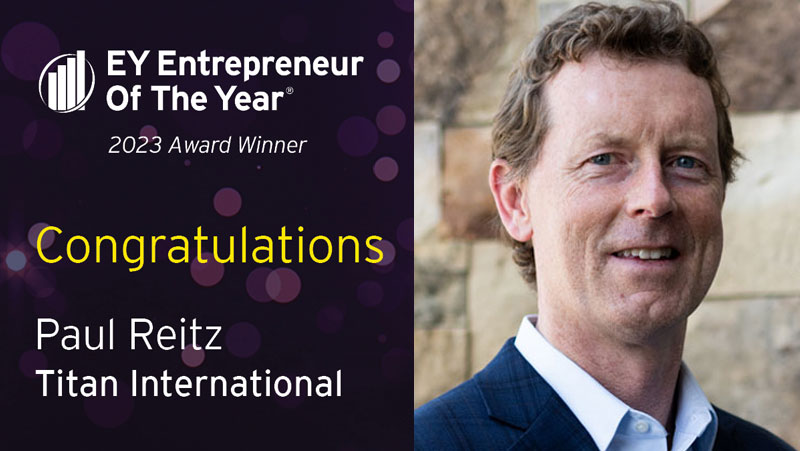
Reitz became an EY Entrepreneur Of The Year Midwest Award winner in June 2023. When he was named a finalist the previous month, he had offered a compact correction to the usual picture of executive achievement.
“I certainly didn’t do it alone.”
Paul Reitz · May 2023
What happens after the meeting ends
Reitz’s leadership conversations repeatedly return to trust. In a 2025 discussion, he emphasized how decisions are made, the responsibility employees take for them, and the importance of being able to speak honestly when things go wrong. He also described the pride people can take in products they can see doing useful work. A wheel has an advantage over many corporate initiatives: you can point to it.
There is a demanding management problem inside this outlook. Employees need room to decide, and the organization needs accountability. Too much fear encourages defensive behavior. Too little scrutiny permits avoidable mistakes to become habits. Reitz’s stated emphasis on the decision process places attention on the reasoning that people can examine and improve together.
His responsibilities also extend beyond Titan. He joined workforce-solutions company TrueBlue’s board in August 2023 and became chair of its Corporate Governance and Nominating Committee in May 2026. It is another setting in which the relationship between people and an operating business is central. Governance adds a different vantage point: an executive who usually answers the board’s questions also has to help ask them.
Buying a business means meeting its people
In February 2024, Titan acquired Carlstar in an approximately $296 million cash-and-stock deal before customary adjustments. Carlstar brought specialty tires and wheels for outdoor power equipment, powersports, trailers, and smaller agricultural and construction machines. It also brought manufacturing and distribution capabilities. The strategic attraction was breadth: more kinds of equipment, more routes to customers, and a consumer exposure different from large agriculture.
Reitz said he had spent considerable time visiting Carlstar’s plants and meeting its people. That detail matters because integration is carried out by the people who remain after the transaction announcements have been filed away. The financial terms determine what a company pays. The everyday cooperation helps determine what it gets.
The acquisition also sharpened a recurring question in his career. A global business can become larger while leaving its parts awkwardly acquainted. Bringing those parts into a useful relationship requires attention after the ceremony. The same executive who evaluates a purchase has to care about the less theatrical work of making the combined operation function.
Preparing for a Tuesday that has no date
By July 2026, Reitz was describing continued spending on Titan’s plants, products, people, and innovation while resisting a firm timetable for an agricultural-market recovery. He pointed to operating improvements and investments at facilities including Des Moines and Bryan. He also discussed the difficult decision to close the Jackson, Tennessee, plant and move production to other locations. Investment and consolidation were occurring within the same company.
That combination is less comfortable than a simple growth story. A manufacturer has to manage the demand it has and prepare for demand that may arrive later. Reitz’s stated approach was readiness in either direction. The customer’s eventual return is useful only if the factory can respond. Optimism, in this setting, needs a production schedule.
September brought another change of shape: Titan agreed to sell its ITM undercarriage business to USCO. The initial purchase price was $207 million, with a possible earnout and adjustments. Completion was expected in early January 2027, subject to approvals and other conditions. Reitz described the planned sale as a way to focus people and capital on global wheel and tire operations, reduce debt, and create capacity for future growth investments.
The pending transaction leaves his story open at a practical point. The former accountant is still allocating resources. The former college tennis player is still discussing teams. The operating executive keeps returning to the person at the far end of the business, waiting for equipment that works. The distance from office to field remains the useful measure. Whatever happens in the boardroom eventually has to travel it.