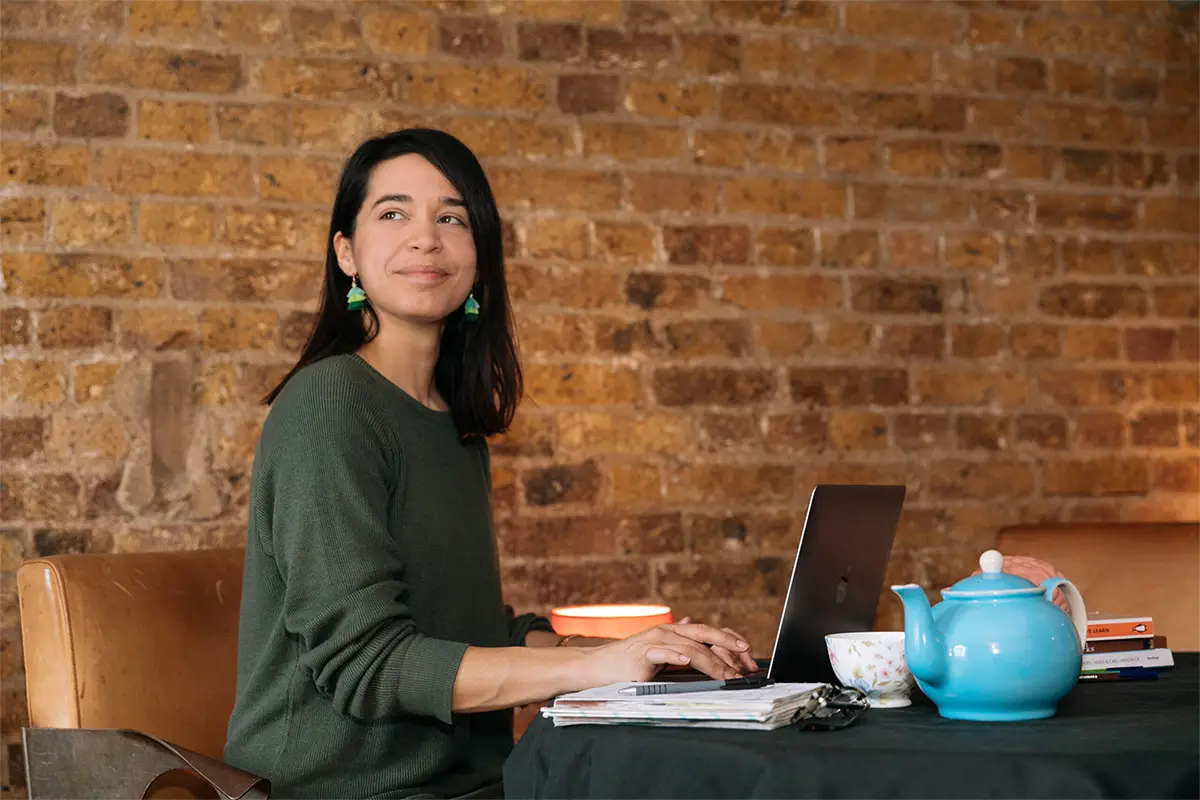
The Scientist Who Runs the Lab and the Newsletter
She was six years old when she looked at the sky and wondered not "why is it blue?" but "is the blue I see the same blue you see?" Most kids ask questions about the world. Anne-Laure Le Cunff asked questions about perception itself. Decades later, she is getting paid by the British government to find answers.
By 2015, she was in San Francisco running global marketing for Google Fit. The work was good. The money was good. And the future was completely legible - she could map out every promotion, every project, every next step. She called it "reading spoilers before watching the movie." So she quit.
What followed was the kind of messy, illuminating, expensive education that no MBA can teach. A co-founded startup. Raised funding. Misaligned values. Dissolution. Then, in 2019, the decision to enroll in a neuroscience master's degree at King's College London at age 28, simultaneously launching a newsletter as a personal study aid. The newsletter grew to 3,000 subscribers in two months without a single marketing effort.
She made $300 from Ness Labs in all of 2019. She made $10,000 a month by October 2020. No investors. No co-founder. No playbook.
"I could see every single next step at Google. It's almost like reading spoilers before watching a movie."- Anne-Laure Le Cunff on leaving Google
Today, Anne-Laure Le Cunff, PhD, holds a UKRI-funded postdoctoral fellowship at King's College London's Institute of Psychiatry, Psychology & Neuroscience, where she studies the evolutionary roots of curiosity. She is the author of Tiny Experiments (Penguin Random House, 2025), endorsed by Oliver Burkeman, Adam Grant, and Ryder Carroll. She runs Ness Labs - a community of 120,000 newsletter readers and 2,500 paying members - bootstrapped, profitable, and entirely hers.
She runs on morning journaling, strategic to-do list reordering, and the deeply French conviction that personal freedom is worth more than a predictable career. She is, as she puts it, less an architect and more a gardener - someone who plants ideas and watches which ones grow toward the light.
A Notebook That Got Out of Hand
Ness Labs was never supposed to be a business. When Anne-Laure started her neuroscience master's degree, she needed a place to think through what she was learning. The newsletter was a study tool - a way to check her own comprehension. ("Using jargon hides your lack of understanding," she says. "Writing accessibly was how I checked my own comprehension.")
The first readers were friends. Then friends of friends. Then, somehow, 3,000 strangers who found that a French woman studying brains in London and writing about thinking was exactly what they needed in their inbox. No paid ads. No growth hacking. Just good ideas, clearly explained, consistently delivered.
In March 2020, she launched a paid membership. In the first day, she hit $1,000 in monthly recurring revenue. By October of the same year, $10,000. She hired her first employees in March 2021. The whole thing - the courses, the workshops, the virtual meetups, the peer-matching program, the browser extension (Teeny Breaks, for mindful pauses), the private forums - was built without a single outside dollar.
The Ness Labs Numbers
$300 - total revenue in 2019, the founding year
$1,000 MRR - first day of paid membership launch
$10,000/month - seven months later
120,000+ - newsletter subscribers today
2,500+ - paying community members
~200 - articles written in a single year
$0 - outside investment, ever
What Ness Labs sells is a specific idea: that you do not have to sacrifice your mental health to be productive. "Mindful productivity," she calls it. Not a morning routine from a self-help book. Not a hustle culture rebrand. The actual application of cognitive neuroscience to how humans work, rest, and learn - delivered in prose so clear it doesn't feel like science until you realize you've changed something about how you live.
"Mindful productivity is the idea that you can achieve your goals without sacrificing your mental health."- Anne-Laure Le Cunff
What Happens When the Newsletter Founder Has a Lab
In 2019, most people who founded successful newsletters with 3,000 subscribers would have doubled down on the newsletter. Anne-Laure Le Cunff enrolled in a master's degree in applied neuroscience. Then a PhD. Then won a £133,574 UK Research and Innovation postdoctoral fellowship to keep going.
Her research sits at the intersection of evolutionary biology, cognitive neuroscience, and the very real experience of being a human in 2025 who cannot stop clicking on interesting things. She is, specifically, studying curiosity - why we have it, where it came from, what happens when it misfires.
The Hypercuriosity Theory of ADHD
Published in Evolutionary Psychological Science (2024). Le Cunff proposes ADHD traits are not a disorder, but an evolutionary mismatch of trait curiosity that was highly functional in ancestral contexts.
Her "Hypercuriosity Theory of ADHD" - published in the journal Evolutionary Psychological Science in 2024 - proposes something that rewrites how we think about attention disorders. ADHD traits like distractibility and impulsivity are not defects. They are features that were deeply adaptive in resource-scarce ancestral environments, where wandering attention meant finding food, spotting predators, and discovering opportunities. The problem is not the curiosity. The problem is that the modern world is not scarce - it is overwhelming, and the same trait that made ancestors thrive now produces diagnoses.
Her methodology uses EEG headsets and eye-tracking to literally measure curiosity in the brain. She recruits university students with ADHD diagnoses and maps their neural patterns. She also conducts qualitative interviews, because she has always known that the data and the story both matter.
In 2025, she published a second paper in the journal Neurodiversity: "Neurodiversity and cognitive load in online learning: A pilot EEG and eye-tracking study." For someone who runs an online learning community, this is not an academic abstraction.
The Research Portfolio
PhD supervisor: Professor Eleanor Dommett, ADHD Research Lab, King's College London
Fellowship: UKRI/ESRC Postdoctoral Fellowship, £133,574
Institution: Institute of Psychiatry, Psychology & Neuroscience, KCL
Methods: EEG, eye-tracking, qualitative interviews
Focus: Evolutionary neuroscience of curiosity; ADHD; AI; lifelong learning
Tiny Experiments
Goal-Obsessed World
Published March 4, 2025 by Penguin Random House (US) and Profile Books (UK), Tiny Experiments is the logical conclusion of everything Anne-Laure Le Cunff has been building for six years. The thesis is straightforward and quietly radical: the goal-setting industrial complex is broken, and the fix is science.
She replaces the linear goal-setting model - set goal, work toward goal, succeed or fail - with a circular, experimental approach to growth. Uncertainty is not the obstacle. Uncertainty is the territory. Each small experiment generates data. Each failure is a result, not a verdict.
She narrated the audiobook herself. She completed 60 podcast appearances in 60 days as the launch strategy - treating the book tour itself as a tiny experiment in intensive marketing. The tour worked. The endorsements are serious.
"I loved this profound, practical, and generous book."
"Easily one of the best productivity books I've read. Rigorously researched, deeply delightful, and powerfully practical."
"The fear of failure often stands in the way of learning from trial-and-error. This is a thought-provoking guide."
"This book will change the way you design your goals and live your life."
From Paris to PhD
Quieter Moments, Louder Ideas
The TEDx Blank-Out
Halfway through a TEDx talk in front of 800 people, Anne-Laure Le Cunff's mind went completely blank. She stopped. Said nothing. Let the silence run. Then she found her place and kept going. Inc. Magazine called it a masterclass in emotional intelligence - the kind of composed recovery most people can only dream about under pressure.
She avoided TEDx invitations for years after. When she finally said yes again, it was at TEDxNashville in 2025 - a packed house, a new talk, a different story.
The Sky Photographer
She photographs the sky. Not architecture, not portraits - the sky. The same question she asked at six years old, now documented in images on her phone: "Is the blue I see the same blue you see?" The answer, from years of neuroscience training, is: probably not, and that's the whole point.
This is what a genuine intellectual curiosity looks like when it finds its medium.
The Morning System
She journals every morning. Then she opens her to-do list and reorders it based on how she feels. Not based on importance. Not based on deadlines. Based on energy and attention. "I'm less of an architect and more of a gardener when it comes to exploring and generating ideas."
There is a one-hour dedicated writing block each morning. A "writing inbox" for capturing ideas mid-day. A "mind gardening" approach to notes.
The Connector
"One of the best feelings is introducing two friends who then connect without me." In a world where networking is transactional performance, Anne-Laure Le Cunff has built a business around genuine connection - the Ness Labs community exists because she creates spaces where interesting people find each other.
She is deliberately absent from those connections once made. The goal was never to be indispensable.
"Building a business is about failing like a scientist. Any failure becomes a new data point you can build upon."- Anne-Laure Le Cunff
Her Mother's Lesson
Anne-Laure's mother cleaned houses and worked in factories before becoming a secretary. Financial security was not abstract in the Le Cunff household - it was something you worked for, carefully, deliberately. That work ethic runs through everything Anne-Laure has built. The bootstrapped business model is not just a philosophical stance against Silicon Valley. It is, in part, a lesson absorbed at the family dinner table in a suburb of Paris.
Things You'll Want to Tell Someone
Hypercurious - The Next Chapter
In July 2025, Anne-Laure launched Hypercurious.com - a Substack-based "public research hub" that does something rare in both science and media: it shares the process, not just the conclusions.
Where most scientists publish peer-reviewed papers that strip away uncertainty and contradiction in favor of definitive findings, Hypercurious explicitly publishes those contradictions. Incomplete evidence. Moments of genuine scientific uncertainty. The messy middle of research, made readable.
The site covers curiosity as a phenomenon: how it operates in the brain, what happens when it misfires, how it intersects with ADHD, AI-accelerated information overload, mental health, and the question of what it means to learn anything as an adult in 2026.
It was featured in Longreads in April 2026 - a publication that exists to surface serious long-form writing for serious readers. The piece was titled "The Hypercurious Mind." It was, by all accounts, extremely well-received by people who ask questions the way Anne-Laure has always asked them: not "why is the sky blue?" but "is your blue the same as mine?"
Quotable
"I am a messy creator. I'm less of an architect and more of a gardener when it comes to exploring and generating ideas."
"Using jargon hides your lack of understanding. Writing accessibly was how I checked my own comprehension."
"I didn't need to raise millions or follow the Silicon Valley model to have meaningful impact."