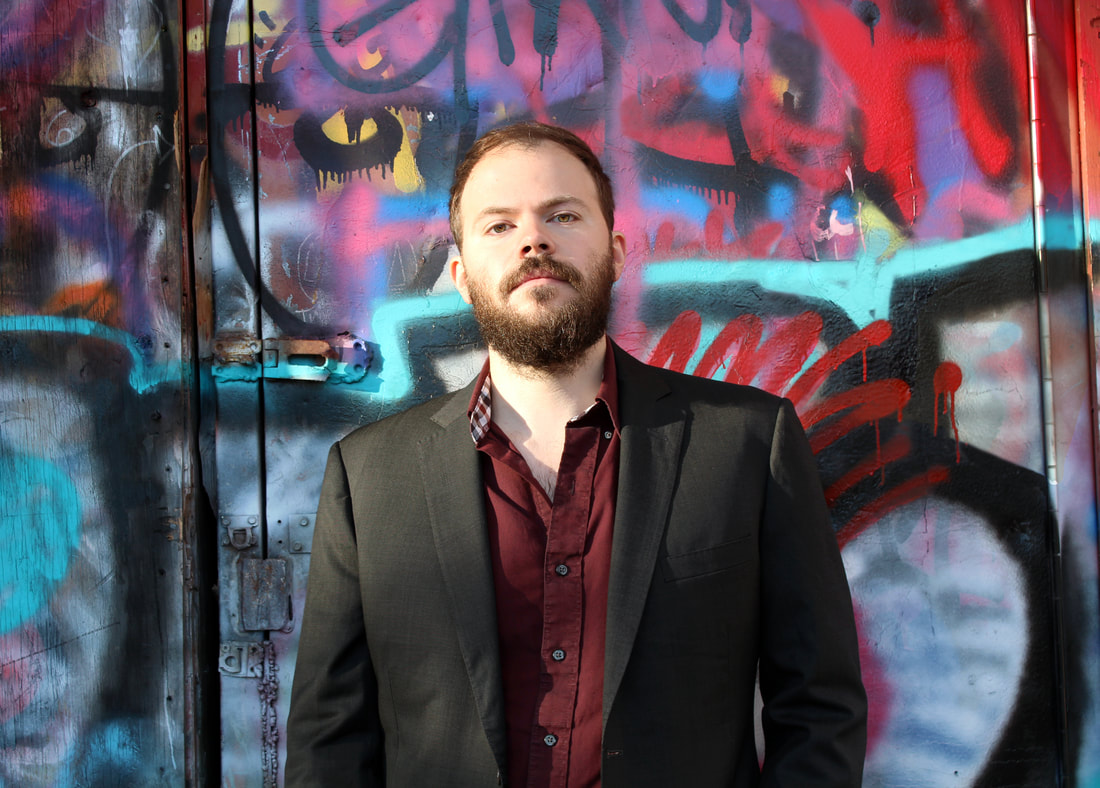
Who He Is
The Conscience of Consciousness Science
Right now, Erik Hoel is probably doing two things at once that most academics would consider mutually exclusive: writing a rigorous scientific paper and finishing a literary essay sharp enough to draw blood. He is that rare species - someone who genuinely belongs inside both the lab and the library, and refuses to choose between them.
Hoel grew up in Newburyport, Massachusetts, in the stacks of The Jabberwocky - his mother's independent bookstore. It is the kind of origin story that explains everything. By the time he was 13, the novelist Andre Dubus III was mentoring him. By the time he was 30, he had a PhD from Wisconsin under consciousness pioneer Giulio Tononi, a postdoc at Columbia, a visiting fellowship at the Institute for Advanced Study in Princeton (where Einstein once paced the halls), and a Forbes 30 Under 30 badge in science.
His scientific work centers on two ideas that sound simple until you sit with them. The first is "causal emergence" - a formal mathematical framework demonstrating that macroscale descriptions of systems can have more causal power than their underlying microscale components. In other words: the brain, not just its neurons. The whole, in a precise technical sense, can beat the sum of its parts. The second is the "overfitted brain hypothesis," which proposes that the surreal randomness of dreams is not noise but function - it prevents the sleeping brain from overfitting to daily experience, a theory that borrows from machine learning and gives it back to biology transformed.
In November 2022, Hoel made a move that raised eyebrows across neuroscience departments: he left his Research Assistant Professorship at Tufts University to write full-time. The decision looked like a gamble. It turned out to be a calculation. His Substack newsletter, The Intrinsic Perspective, had launched in 2021 and was already drawing readers who wanted science written without condescension and culture criticism without cynicism. Within two years it crossed 69,000 subscribers and ranked #16 in Science on the platform. Adam Mastroianni of Experimental History summed it up neatly: "Neuroscientist + novelist = god-tier Substack."
The newsletter is genuinely difficult to categorize. On any given week it might dissect the failures of modern academia, interrogate AI hype with the precision of someone who has actually read the papers, defend the importance of literary fiction, or lay out a new theory of consciousness with footnotes that don't condescend. Hoel describes it as covering "natural philosophy, belles-lettres, and polemics" - a deliberately old-fashioned frame for work that is entirely present-tense in its concerns.
His books are no different. The Revelations (2021, Abrams/Overlook) is a literary mystery set at NYU where eight young consciousness researchers - brought together for a prestigious fellowship - find themselves unraveling when one of them is murdered. It is science fiction only in the sense that it takes science seriously. Publishers Weekly called it "a dizzying, impressive debut." The World Behind the World (Simon & Schuster, 2023) is the nonfiction companion: a grand tour of consciousness science that argues, forcefully, that nothing in the brain makes sense except in the light of a theory of consciousness. It landed him a book talk at Harvard and reviews from people who had never previously read a neuroscience book.
Hoel is married to Julia Buntaine Hoel, a neuroscientist and founder of the SciArt Initiative, who bridges art and science professionally in ways that seem entirely fitting for his household. They have a son born in 2021 - the same year Erik launched the newsletter and published his debut novel, which tells you something about his work rate.
He has returned to active scientific research alongside writing, maintaining his affiliation with Tufts. His aspiration, stated plainly, is to see a comprehensive theory of consciousness that triggers real practical breakthroughs - not just philosophical satisfaction but something that reshapes medicine, AI development, and our understanding of experience itself. For Hoel, the newsletter, the novels, and the papers are not competing projects. They are the same project, approached from different angles.