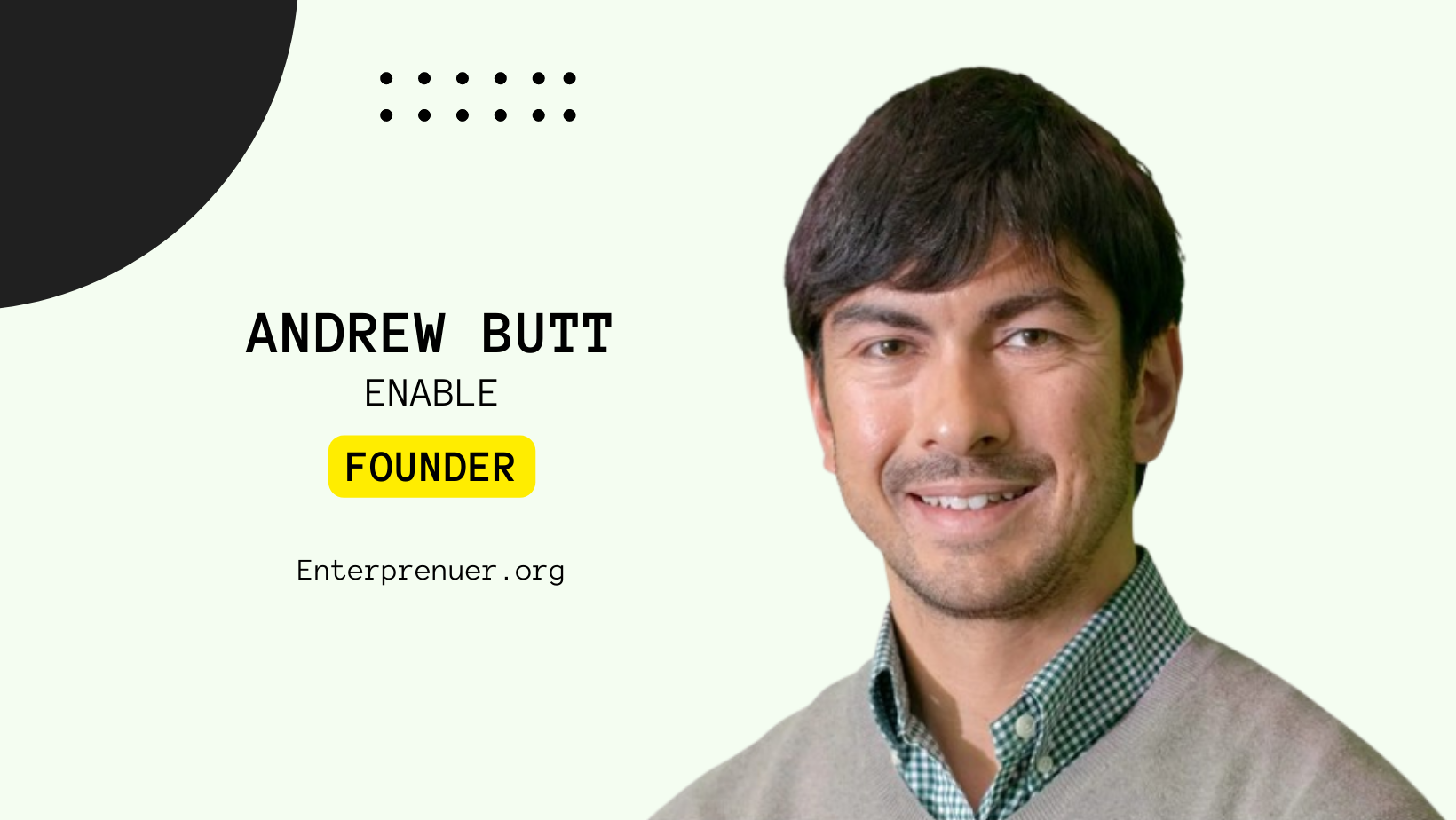
Profile
The man who found gold in the spreadsheet no one wanted to fix
There is a line item in the accounts of nearly every manufacturer, distributor, and retailer on earth - rebates - that has been managed for decades by a combination of spreadsheets, handshakes, and wishful thinking. Andrew Butt looked at that pile of dysfunction and saw not a mess but a market. The result is Enable, a San Francisco-based platform that turned rebate management into a $1.12 billion category in under eight years.
Butt did not arrive at this by accident. His preparation started in a helicopter hangar in Coventry, England, at age 12, when he offered to fix computers for the flying school in exchange for lessons. The school's owner, Captain Mike Smith, became his first real mentor - an entrepreneur who showed Butt what was possible and introduced him to a network that would shape everything that followed. One of those introductions was to a young Denys Shortt, who would later become Butt's co-founder across not one but two companies over two decades.
Butt left school at 15, compressing five days of curriculum into four hours on Saturday mornings. By 17, he was the youngest qualified helicopter pilot in his region. He had already started his first business: domain registration, web hosting, web development - the digital plumbing of the early internet, sold to whoever needed it. These weren't teenage hobbies. They were rehearsals.
"I wouldn't be content doing anything else. There is no alternative."- Andrew Butt
In March 2000, Butt and Shortt co-founded DCS E-Commerce, a software engineering firm that grew to 100 employees and landed a spot as the 50th fastest-growing private technology company in Britain, according to the Sunday Times. Then came Information Matrix Ltd, a B2B SaaS business aimed at property management - acquired by Sovereign Capital in 2010. Two companies built, one sold, one scaled. A pattern was forming.
The pivot to Enable was not a pivot at all, really. It was pattern recognition sharpened by years of watching the same operational failure repeat itself inside distribution and manufacturing businesses. Rebates - the agreements between trading partners to share profit based on volume, loyalty, or performance - were the invisible glue holding B2B supply chains together. And they were a disaster to manage. Tracked in spreadsheets, disputed quarterly, leaking money at the seams. No modern software had taken this problem seriously.
Pitching to a $30 billion company early in his career, Butt confidently told the room there was "no risk" in selecting his startup. He recognized the naivety the moment the words left his mouth. He got the contract anyway. The lesson stayed with him: audacity has to be backed by something real, or eventually the room stops laughing along with you.
Enable launched in 2016. Butt bootstrapped it through the early years, scrambling monthly to make payroll, building a product close to customers rather than for a hypothetical market. The early numbers mattered less than the proof points - and by the time Sierra Ventures and Menlo Ventures led a Series A in 2020, the company had done what most SaaS companies don't: it had survived the quiet years with its customer base intact.
Butt relocated from the UK to San Francisco to raise that capital, a tactical move he discusses plainly. "Once we'd got those success stories and happy customers... it was about adding go-to-market skills." He hired people who had scaled B2B SaaS before. He standardized the product. He made Enable look and feel like a modern software company rather than a bespoke consultancy with a recurring revenue model.
"Enable allows trading partners to manage all of their B2B rebate agreements together in a single location. We become the system of record for both sides of the trading relationship."- Andrew Butt, on Enable's core proposition
What happened next was compounding. In a six-quarter stretch, Enable quadrupled its customer count, tripled its team across the UK, Canada, the US, and Australia, and maintained a 98% customer retention rate while quadrupling revenue. The company grew 20x under Butt's tenure. By November 2023, a $120 million Series D led by Lightspeed Venture Partners, with Menlo, Norwest, Insight Partners, and Sierra all participating, valued Enable at $1.12 billion. Unicorn. The spreadsheet no one wanted to fix had become a billion-dollar category.
The platform now serves over 10,000 brands across more than 50 industries - manufacturing, distribution, retail, healthcare, automotive, consumer goods, building materials. The common thread is not the industry but the structural problem: companies doing significant volume with trading partners, whose rebate programs are complex, consequential, and chronically mismanaged. Enable's pitch is simple - both sides of the deal, together, in one place, with full visibility and auditability. It is the system of record for B2B commercial relationships.
The acquisition of Flintfox expanded Enable's footprint into pricing management, signaling Butt's intent to build beyond rebates into the full commercial performance stack. The company's evolving category name - "commercial performance optimization" - reflects an ambition larger than any single product.
"Enable started in rebate management because of the importance rebates play in the financial outcomes of manufacturers, distributors and retailers."- Andrew Butt
Butt starts work at 5am. He runs with his dog in the morning. He works seven days a week but insists on sleep, exercise, and travel as non-negotiable inputs to sustained performance. His philosophy on work is not the hustle-culture cliche - it is something more considered: "Work is the biggest part of life for most people, not something to be balanced against it." He thinks about the creativity movement, encouraging people to make things rather than passively consume them. He is, plainly, a builder.
His favorite quote is Churchill's: "Success is going from failure to failure with no loss of enthusiasm." It fits. The bootstrapped years, the payroll scrambles, the naive pitch to the $30B company - these were failures that did not stop the machine. They fed it.
From a Coventry helicopter hangar to a billion-dollar SaaS company based on San Francisco's Mission Street. The trajectory looks inevitable only in retrospect. In real time, it was a series of deliberate bets on unglamorous problems, made by someone who left school at 15 and never stopped building.
Straight from the source
Work is the biggest part of life for most people, not something to be balanced against it.
We identified some common themes and found rebate management as being a really big problem.
It's really not that difficult to open up in a new country.
Once we'd got those success stories and happy customers... it was about adding go-to-market skills.