Andre Haddad - CEO & All Star Host, Turo
The man who turned a million idle cars into an income stream - and a platform into a movement.
Andre Haddad is the CEO and Chairman of Turo, the world's largest peer-to-peer car-sharing marketplace. He joined in September 2011 and has been at the wheel ever since. In 2024, Turo generated nearly $958 million in revenue - with 60 cents of every dollar going directly to the car owners who host on the platform. He is also, genuinely, a Turo "All Star Host," renting out six personal vehicles including a $499-per-day Tesla Model X.
Before Turo, Haddad spent a decade at eBay, most prominently as CEO of Shopping.com, after co-founding iBazar - the leading European auction marketplace - and selling it to eBay for $140 million in 2001. The path to that exit ran directly through wartime Beirut, a tiny shared apartment in Paris, a crashed website, and a rejected $1 billion acquisition offer.
Today, Turo operates across the United States, United Kingdom, Canada, France, and Australia. Haddad oversees a team of 800, a marketplace of hundreds of thousands of vehicles, and a platform that has become something of a proving ground for the broader thesis that ordinary people should profit from their idle assets - not corporations.
In February 2025, he withdrew Turo's long-pending IPO filing, saying the process had become "a distraction." The plan: stay private, make bolder long-term investments, and grow on the company's own terms. Wall Street can wait.
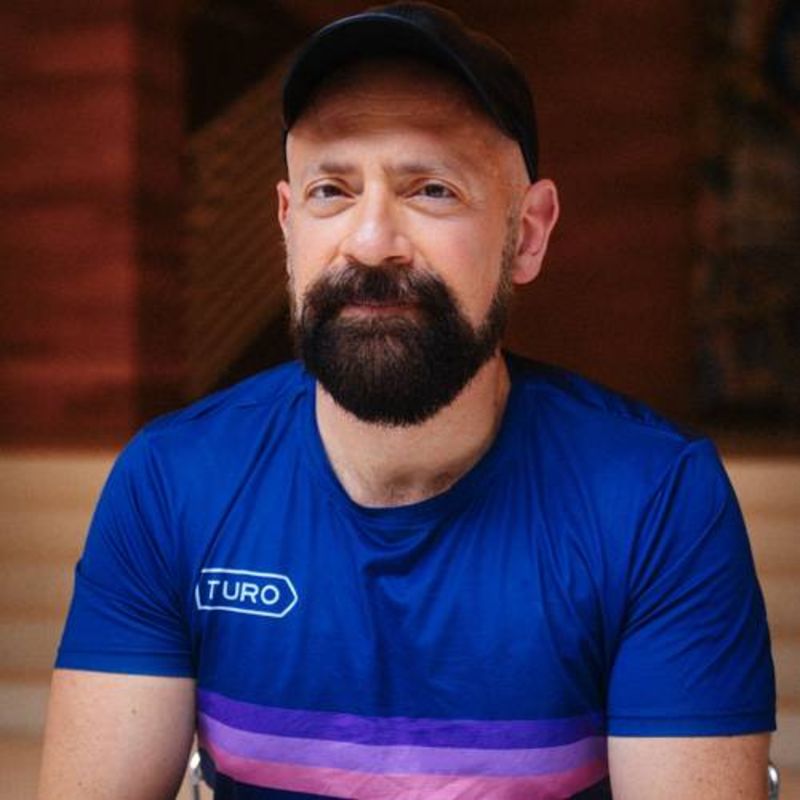
"After having survived the bombs of Beirut, nothing else could really go as bad as what happened 10 years before."- Andre Haddad, on entrepreneurial risk
Andre Haddad grew up as an introverted only child near the Green Line dividing East and West Beirut - the fault line of Lebanon's 15-year civil war. He kept a diary. He worked at a bookstore at 13. He discovered The Economist the same year, which lit a flame about the world economy that never went out. By summer 1988, he was a radio DJ at RML FM in Beirut, spinning records and developing a taste for performance.
In March 1989, a mortar shell destroyed his family's apartment. The decision to leave was obvious. What was less obvious: alone, without a school, he studied independently and passed his baccalaureate exam - earning his ticket to Paris.
He arrived in a city he didn't fully know, in a tiny shared room without a kitchen or refrigerator, enrolled in a competitive grande ecole program that would lead to his degree from HEC Paris. He was poor, scrappy, and paying close attention.
The pattern that emerges across his career started there: discomfort as data. Displacement as fuel. Every time Haddad has been forced to start over in a new context, he has found an opportunity the incumbents missed.
At 13, Haddad discovered eBay in 1998 (a full decade after his radio DJ days) and immediately spotted an arbitrage: music CDs from eBay, resold in Europe. That side hustle became iBazar. He named the company after his Middle Eastern heritage - "bazaar" - a decision he made deliberately, not accidentally.
In early 2000, eBay offered to buy iBazar for $1 billion. Haddad and his co-founders said no. They believed they were worth more. The dot-com bubble then collapsed, and they sold in 2001 for $140 million - a humbling data point he references openly when speaking about risk and hubris in startups.
When iBazar launched, Haddad convinced the team to spend 50% of the company's entire capital on a single television campaign. The website crashed on launch day from the flood of traffic. Within a year: one million users and a top-five French website.
Haddad left eBay in April 2011 planning a break. He had spent a decade inside one of the internet's founding empires - as GM in Europe, VP of International Operations, VP of User Experience and Design, and ultimately as CEO of Shopping.com, the comparison-shopping network eBay bought for $600 million. He wanted to breathe.
Within three months of leaving, he met Shelby Clarke, Turo's founder. The platform - a peer-to-peer car-sharing marketplace - clicked immediately. Not just as a business. His husband Benoit is an environmental engineer. The sustainability case was visceral. "A more sustainable future for us, as a society," Benoit called it during the family's 8-week camping trip where they debated whether Andre should take the job.
He joined as CEO in September 2011. The company's name was still "RelayRides." He rebranded it to Turo. He rebuilt the insurance model, which had been Turo's thorniest unsolved problem. He expanded internationally. He built the host ecosystem that now generates more income for car owners than any comparable service in the world.
By 2024, Turo's revenue reached $958 million - up from $150 million in 2020. The IPO that was filed in January 2022 was finally withdrawn in February 2025. Haddad told Bloomberg the process had become a "distraction." Plans: stay private for at least 2 to 3 more years and make bolder bets than public markets would have tolerated.
January 1, 2025. Two separate attacks in New Orleans and Las Vegas involved vehicles rented through Turo. The company's platform was weaponized. Haddad responded publicly and directly: the company was "outraged at the abuse of our platform" and "heartbroken for the victims."
The attacks generated immediate scrutiny of Turo's background-check processes and safety policies. It was the kind of incident that tests whether a CEO can maintain both operational composure and human decency at the same time. Haddad's statement, written in his own voice, showed both.
Despite the setback, Turo's core model remained intact. Haddad has consistently argued that the platform's insurance structures and safety policies are more sophisticated than the traditional car rental industry gives credit for - and that adversity is no stranger to a company he has led through the dot-com bust, the sharing economy's awkward adolescence, a global pandemic, and a withdrawn IPO.
Haddad wrote publicly in 2017 that "immigrants are innovators" - a point he makes not as sentiment, but as data. He has built two significant marketplace companies from contexts where he was a newcomer: France as a Lebanese student, the US as a Lebanese-French executive. Displacement trained his eye for gaps incumbents can't see.
Turo's environmental thesis - that a billion idle cars are a resource being wasted - was central to why Haddad said yes to the role. His husband Benoit, an environmental engineer, reinforced it. Haddad has written that car sharing gives electric vehicle adoption a jolt it couldn't get from traditional rental fleets alone.
In 2011, Haddad structured his week to spend dedicated time with his daughter, his son, and his husband separately. That kind of intentional presence - applied to both business and family - runs through every public account of how he operates. He and Benoit have twins born in 2006 via surrogacy and egg donation.
At 16, Haddad was spinning records at RML FM radio in Beirut. More than three decades later, he still loves playing 90s house music - and has done it for Turo employees. It is a data point about a man whose public presence is analytical and careful, but whose private self has always made noise.
His first job was at the bookstore in his apartment building in Beirut. At 13. He has described his early love of The Economist as the spark for his curiosity about how economies work. That curiosity became marketplaces - first iBazar, then eBay, then Turo. All businesses built around the mechanics of exchange.
"After surviving the bombs of Beirut, nothing else could go as bad." He repeats this in various forms. The 2001 bust, the COVID pandemic, the failed IPO, the New Year's attacks - they arrive in a life that started under literal bombardment. The calibration it gives him for risk is not a technique. It is biography.
"His father still doesn't believe the business model works. He runs it anyway."- From public accounts of Haddad's family skeptic
He was a teenage radio DJ at RML FM in Beirut during summer 1988. Still plays 90s house music for Turo employees.
He rents out 6 personal cars on Turo - including a Tesla Model X at $499/day - and personally reviews who drives each one.
He named iBazar after his Middle Eastern heritage. The word "bazaar" was deliberate - an immigrant branding his company with the culture that shaped him.
His first job at 13 was at the bookstore in his own apartment building in Beirut. His first product was literally books.
He met his husband Benoit on a French gay dating site in 1996 - the same year he got his first internet connection. He has called it proof that online relationships work.
His father still doesn't believe Turo's business model works. His son runs a platform generating nearly $1 billion per year. The conversation presumably continues.