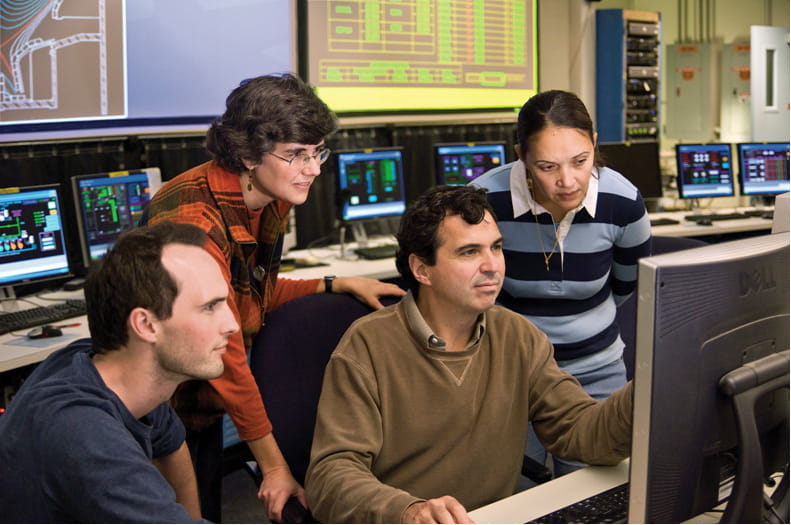
In the photograph, Alex Ince-Cushman is seated at the far left, watching a screen. Amanda Hubbard leans forward beside him. Gary Dekow and Maria Silveira are looking too. Behind them, monitors crowd the control room of MIT’s Alcator C-Mod fusion experiment. It is a picture of people trying to understand what a complicated machine has just done. Nobody appears to be preparing an elevator pitch.
The image belongs to an earlier chapter of a career that now runs through commercial buildings and electricity bills. Ince-Cushman, co-founder and CEO of Branch Energy, once studied the rotation of fusion plasmas. His company now installs and operates batteries at customer sites. The distance between those activities sounds considerable. Follow the work between them, though, and the route becomes easier to understand.
The physicist at the screen
His 2008 doctoral thesis had a title with little concession to the casual reader: Rotation studies in fusion plasmas via imaging X-ray crystal spectroscopy. The practical problem was how to measure and generate flows inside magnetically confined plasma, including approaches that might work in future reactors. A high-resolution X-ray instrument was designed, built, installed and operated on Alcator C-Mod as part of that research.
Those four verbs deserve a moment. They describe the passage from an idea to a working instrument. The resulting measurements helped reveal what was happening inside the plasma. An elegant explanation still needed equipment capable of telling the researchers whether it was right.
The thesis also makes the measurement problem unusually tangible. Some standard techniques relied on injecting neutral beams into the plasma. That approach would become harder in the large, dense plasmas envisaged for later machines. His research examined alternatives. Even in a field associated with distant possibilities, the task was specific: build a way to observe something that an existing method might struggle to reveal.
Ince-Cushman’s name also appears on a 2009 paper about plasma flow on Alcator C-Mod, alongside researchers including Yijun Lin, John Rice and Stephen Wukitch. His scientific background was experimental and collaborative. Long before Branch, there were already instruments, data and colleagues in the picture.
Six years, then a different kind of data
He joined McKinsey in November 2008 and stayed until February 2015. He became an associate partner and co-led the firm’s software development practice in North America. From March 2015 to November 2018, he worked as an executive at Palantir Technologies. Consulting and enterprise software brought another set of systems into view: organizations with information to interpret and decisions to make.
A 2016 advisory-board appointment at language-technology company Yappn catches him between those chapters. He was then at Palantir; his previous experience included research and lecturing at MIT. By 2019, he was Chief Technology Officer at Just Energy. The arc of the résumé had reached the electricity customer.
That last move put software experience inside an operating energy business. Electricity supply involves contracts, customer service and the consequences of a market that changes while customers go about their day. For an engineer accustomed to examining systems, the meter offered a particularly useful boundary to investigate.
A report, a daughter, an old friend
The personal reason for building Branch emerged after he became a father. Thinking about the world his daughter would inherit, Ince-Cushman read an IPCC climate report. He came away concerned by the scale of the problem and persuaded that existing technologies could already make a material difference if deployed widely. Waiting for another invention was only one possible use of an engineer’s time.
He had a longstanding collaborator in Daniel MacDonald. They met in middle school. Ince-Cushman had helped informally with MacDonald’s businesses on nights and weekends; a working relationship grew inside the friendship. He describes different problem-solving styles and a shared enjoyment of debating ideas. Their agreement extended to the usefulness of disagreement.
MacDonald brought experience building consumer businesses, including Filter Group. Todd Burgess, the third Branch co-founder, brought energy-industry experience and had been COO of Home Water. The founders’ paths overlapped at Just Energy. By the time they started Branch, they had experience with the technology, the commodity business and the work of persuading a customer to sign up.
Comcast Ventures backed the company in its early days. Investor Adam Spivack’s account of the investment dwelt on the team’s experience and the prospect of making renewable electricity and home energy improvements easier to buy. An energy company could offer more than a contract. It could help customers work out which equipment was worth having, then help get it installed.
By 2022, his discussion of the business already extended to commercial buildings. He and MacDonald were exploring how the same tools could affect larger properties. The customer changed, but the underlying questions traveled: how much electricity is being used, what could improve the result, and what would make an owner willing to act? The eventual emphasis on commercial batteries grew from a broader interest in making energy decisions easier.
The customer’s side of the meter
Branch received its Texas retail electric provider certificate in July 2021. The initial proposition combined green electricity with smart energy devices. Its founders were taking on an awkward gap in the market: a useful device can remain unpurchased when choosing, financing and installing it becomes a project of its own.
Ince-Cushman’s earlier work at Just Energy had drawn his attention to that gap. Suppliers focused on getting electricity to the meter. On the building’s side of it, equipment could change how and when a customer used power. That opened a different relationship with the customer, extending from the bill into the operation of the building.
“Branch is an energy provider built like a software company.”
Alex Ince-Cushman, 2025
The formulation brings together the roles he had already held. Retail energy supplies the customer relationship. Software coordinates decisions. Physical equipment makes those decisions matter. A battery has a pleasingly unromantic advantage here: once installed, it can do useful work while the building’s owner thinks about something else.
Making the battery earn its keep
By May 2024, Branch was discussing its battery deployments with WattCarbon. The economics depended on charging and discharging intelligently, and on finding ways to finance more installations. Their collaboration considered how purchases of energy attribute certificates could support additional batteries. Climate impact had to connect with a workable financial arrangement.
In August that year, Branch announced a $10.8 million Series A led by Prelude Ventures and Zero Infinity Partners. The money was intended for its battery management platform and field services infrastructure. The pairing is revealing: code could decide what to do, but field operations had to give the code something to operate.
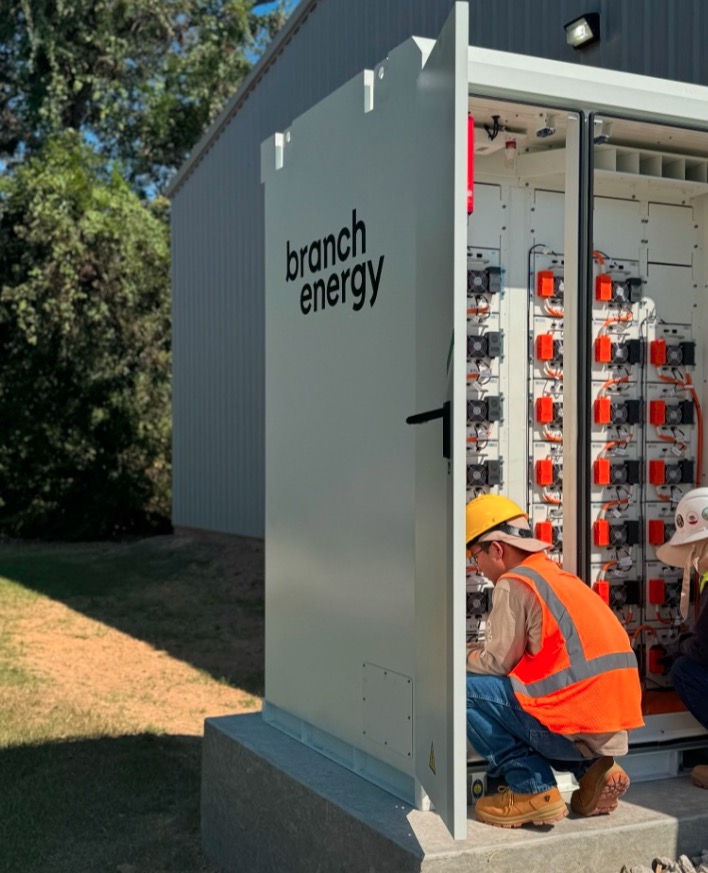
The following month, a partnership with Voltus added a connection to wholesale electricity markets. Branch’s software and Voltus’s platform could help determine, hour by hour, whether a battery offered more value through shifting electricity purchases or through market participation. The battery’s best job could change. Operating it meant continuing to make choices after the installation was finished.
Store electricity when conditions favor it.
Use stored power where it earns value.
Support the site during an outage.
For the host building, that arrangement means someone else has to understand the markets. For Branch, it means understanding both the building and the market well enough to keep the offer worthwhile. The customer’s simplicity depends on continuing work elsewhere in the business.
Asked about favorite milestones in 2025, Ince-Cushman included signing the first customer, closing the Series A and watching a battery respond to real-time prices for the first time. The last is an engineer’s sort of anniversary. Something that had existed in calculations was now making a decision in the world.
He also emphasized his colleagues. Building a company meant too many tasks, too little time and important decisions made with incomplete information. A capable team helped him work through them. The control-room photograph offers a useful visual echo: several people, different expertise, attention directed toward the same problem.
Illinois, and a larger bet
On September 15, 2026, Branch announced a $33 million Series B co-led by Piva Capital and Clean Energy Ventures. It also announced expansion from Texas into Illinois. The company’s Arc system packages batteries, grid equipment, cooling and controls into a unit roughly the size of a parking space. Branch owns and operates the equipment at commercial sites.
New financing announced as Branch takes its commercial battery model beyond Texas.
The expansion brings a financing opportunity as well as a new location. In PJM, the regional electricity system that includes Illinois, large energy users can help support additional capacity. Branch is pursuing a model in which long-term agreements can underwrite distributed batteries. For Ince-Cushman, demand for computing creates another potential buyer for what a fleet of batteries can provide.
He has described an ambition to reach tens of thousands of units over the next several years. That remains a target. The immediate work is more concrete: find sites, arrange capital, install equipment and operate it well. Geographic expansion adds another set of market arrangements for the company to understand.
Look back across the career and the recurring interest is in making complicated systems do something useful. At MIT, that involved an instrument that could measure plasma behavior. At Branch, it involves a business arrangement that can get a battery beside a building and keep it earning its place.
The customer need not share the founder’s enthusiasm for nuclear fusion, data science or electricity markets. A lower bill and some backup power are understandable on their own. For an engineer who wants existing technology to reach more people, that is a sensible place to put the explanation.