Alon Mashkovich kept encountering a peculiar ending to the modern energy story. There were sophisticated assets, ambitious owners and plenty of information. Then somebody exported a CSV. By 2018, working with renewable portfolios as a consultant, he had watched the process return to Excel often enough to see a business opportunity in the repetition. The spreadsheet had become the place where the industry's expensive machinery came to ask for directions.
His route into that problem ran through business consulting, where he sought out clients with substantial energy bills. He wanted to connect the economics of an inefficiency with the practical work of correcting it. Eventually, he and Roy Fadida built their own consultancy focused on renewables and energy efficiency. The recurring administrative tangle would help lead them toward enSights.
There is something revealing about that starting point. Mashkovich's entrepreneurial story begins with an operator's recurring chore. He was close enough to the work to see the same difficulty arrive wearing different company logos. A mundane inconvenience, repeated across expensive portfolios, can make a persuasive business proposition.
A lawyer's education, an operator's question
Mashkovich holds an LL.B. and an MBA in finance, both with honors. His professional territory stretches across energy, strategy, technology and finance. Those disciplines give him several ways to interrogate the same asset: what it does, what it owes, what it costs and what its owner expects to receive.
That mix suits the business he now leads. A solar installation is physical equipment with financial obligations attached. A battery has operating constraints as well as an investment case. Understanding either business calls for more than an attractive picture of energy production. Somewhere, a person has to decide whether the numbers justify the next action.
By September 2026, his conference work included scheduled moderator roles at the Battery Asset Management Summit USA in Garden Grove, across technical and battery asset management roundtables. It is an apt setting for his multidisciplinary interests: a room where engineering performance and commercial expectations have to speak to each other.
Three founders, and a price on the problem
In 2021, Mashkovich co-founded enSights with Fadida and Dekel Yaacov. Mashkovich became CEO, Fadida CPO and Yaacov CTO. Their company developed a cloud platform to bring renewable energy operations and financial performance into the same working environment.
By December 2024, enSights reported more than 6,000 clean energy assets and over 1.6 GWp under management on its platform. Those figures describe the company's reported footprint at that time. They also put some scale around the founders' original observation: the administrative problem existed across thousands of assets.
A $10 million Series A followed, announced in December 2024 and co-led by JAL Ventures and XT VC, with the Menomadin Foundation participating. The amount is a company financing milestone. It gave the founders resources for a larger business, and a larger set of obligations to deliver on.
The less glamorous part of going abroad
The company's funding announcement set out a practical use for the money: expansion, particularly in the United States, including local headquarters and hiring industry professionals. enSights had already expanded into Europe in 2022. For Mashkovich, growth meant moving beyond the market in which the founders had accumulated their original relationships.
There is a useful sobriety in those details. International expansion can sound like a line drawn across a map. Here it involved hiring people and establishing a local base. Software can travel almost instantly; a company still has to establish the relationships and working knowledge that make customers willing to depend on it.
That distinction matters in renewable energy. The customer buys a system intended to help manage an operating business. The cost of a misunderstanding may turn up in a maintenance decision, a financial forecast or a delayed response. Proximity to customers has an ordinary, practical value when their work is this consequential.
Why he asks who else is in the room
In his April 2025 writing about buying solar management software, Mashkovich challenged the habit of starting with a department's technical wishlist. He argued for a broader evaluation that considers the enterprise and its financial outcomes. It is the consultant's instinct again: examine the business around the request before choosing the tool.
His argument gives the finance team a reason to join the conversation early. A company needs a consistent account of electricity revenue, as well as information about operations. He connects that visibility to financing terms and cash flow pressure. The desired outcome extends well beyond a convenient interface for one team.
A wishlist is wonderfully easy to lengthen. Each department can add its favorite feature until the buying exercise resembles a wedding seating plan. Mashkovich's approach imposes a harder question: how will the organization work once the software arrives? The purchase has to make sense to the people responsible for the whole business.
A meeting about what happens next
At the beginning of 2026, Mashkovich brought the enSights operating leadership together in Austin. His account of the gathering centered on execution as portfolios become more complicated. He described a focus on making financial impact clear and turning alerts into work with responsibility attached.
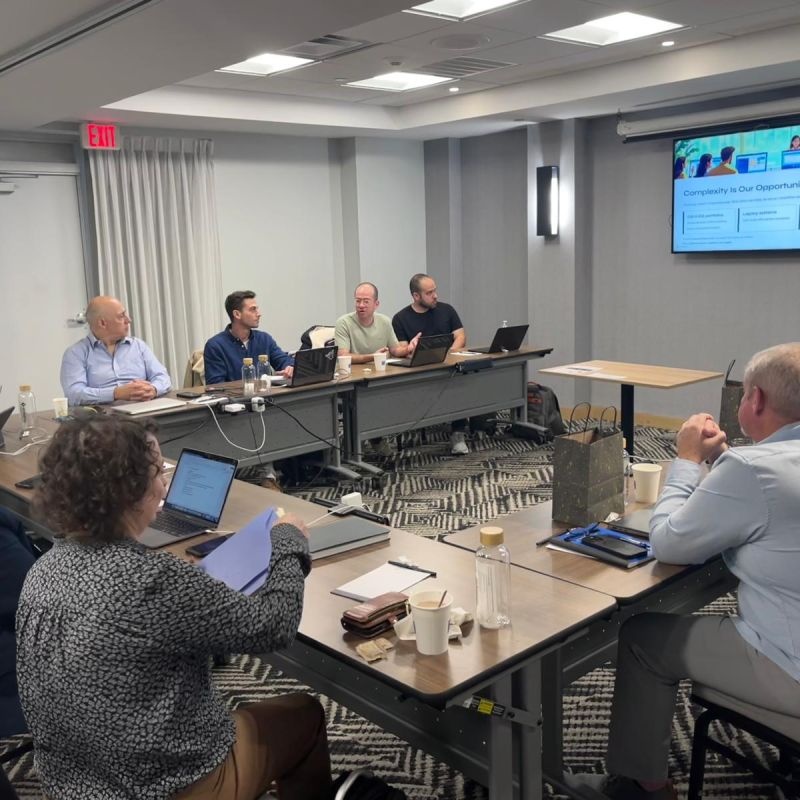
The photograph is pleasingly ordinary: laptops, water bottles, a conference table and people talking. A business concerned with automation still requires this kind of gathering. Someone has to agree on the priorities before a system can help carry them out.
His stated aim was to make good decisions repeatable across performance, contractual obligations, energy management, cybersecurity and operations. It is a demanding aspiration because it crosses the boundaries that organizations tend to build between departments. An alert can reach a screen quickly. Getting the appropriate response requires agreement about who acts and why.
The book title he had to check
Asked about professional inspiration during a 2025 conversation, Mashkovich pointed to his father and grandfather. He described listening to audiobooks while driving and running, and named SunCast among his listening habits. When a useful book came to mind, he had to check the title: Patrick Lencioni's The Five Dysfunctions of a Team.
The moment has the modest charm of actual reading. An idea has stayed with him more securely than its packaging. His interest in the book centers on communication and trust within a leadership team. Business brings rapid changes in fortune; colleagues need enough confidence in each other to withstand them.
“Eventually, it's all about humans”
Alon Mashkovich
His life outside the work includes his children and early runs. He described running at least three times a week and joining conference 5Ks. Asked what he would tell his younger self, he emphasized listening, openness and balance. These are small details, but they bring the chief executive back to a recognizable scale: a parent finding time for a run and a leader trying to listen better.
The battery cannot spend the same kilowatt twice
By August 2026, Mashkovich was discussing a battery economics calculator for the PJM market. His concern was familiar: financial models could look persuasive while mishandling the relationship between different revenue streams. He warned against treating competing uses of the same energy as if they could all be sold independently.
That is a particularly concrete version of his broader argument. A battery can support several business opportunities, but its physical capabilities impose limits. A financial model has to respect them. He also stressed the importance of historical consumption data: a short sample can miss patterns that appear across a fuller business cycle.
His finance education connects directly with the questions he raises about investment assumptions. The investment case and the operating asset must remain in conversation after the purchase. A projection becomes useful when the people making it can test its assumptions against what the equipment actually does.
The distinction gives a spreadsheet a useful job description. It can help describe a business case. The people relying on that case still need a way to check it over time, as consumption patterns, market opportunities and the equipment itself change. The forecast needs a continuing relationship with reality.
Keeping the promise after installation
In February 2026, Mashkovich wrote that solar's next phase would depend on asset performance, clean data and accountability. He treated cybersecurity as part of the financial and operational responsibility of managing a portfolio. The equipment's ability to generate power is only one part of keeping an investment on course.
His company's participation in TotalEnergies On, Batch 6, points toward the same ambition: improving the performance and profitability of distributed energy fleets. The accelerator describes enSights as combining data acquisition, monitoring, diagnostics and optimization for solar and battery storage.
Across those activities, Mashkovich keeps returning to the distance between an asset's promise and its working life. His contribution sits in that distance: helping the people who own and operate equipment understand what is happening, what it means financially and what to do next. For an entrepreneur whose opportunity began with another CSV export, that is a suitably practical place to keep working.