The trouble began with waiting. Solar Medix, a New Jersey solar maintenance provider, depended on an outside company to monitor its fleet. Reports could arrive weeks late. Its own team lacked real-time visibility into that monitoring platform. The equipment was scattered across sites; useful information seemed scattered across people. Growing the business meant carrying the same delays into more places.
- enSights joins solar and battery data with maintenance, contracts, and finance.
- Its customers run renewable portfolios: owners, power producers, service providers, and equipment makers.
- The practical promise: identify the loss, price its consequences, and assign the work.
Solar Medix tried enSights on 5 MW of its fleet. According to the vendor's case study, better visibility and workflows persuaded it to expand and bring control-center operations in-house. The story is interesting because the purchase changed who did the work. Software helped a field-service company assume a responsibility it had previously outsourced.
The alarm is only the beginning
A renewable-energy portfolio presents an awkward managerial puzzle. Machines generate readings. Technicians generate service records. Contracts specify obligations. Finance tracks income. All describe the same business, yet each can tell a different story. An inverter fault might matter to an engineer; its lost production matters to the owner; an overdue response matters to whoever signed the service agreement.
enSights connects those accounts. Its cloud platform takes data from equipment and site systems, standardizes it across manufacturers, and adds weather, market signals, and contract terms. It then ranks issues by financial impact, operational risk, and service obligations. The ambition is a shorter route between seeing a problem and deciding who should act.
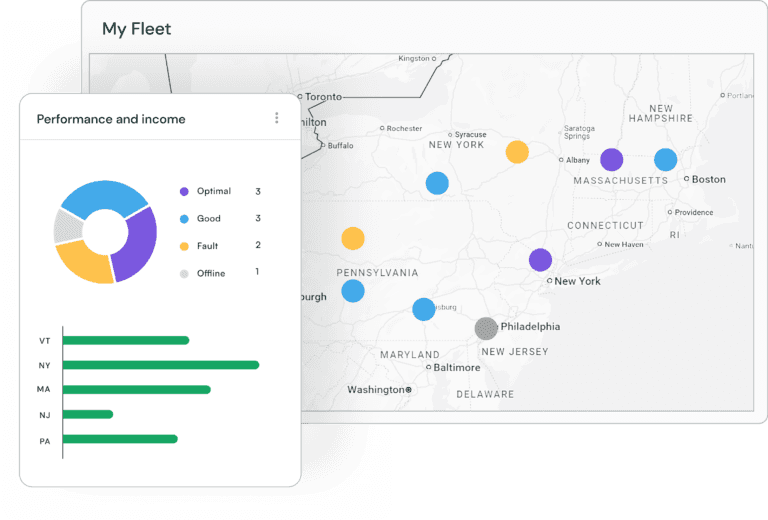
That approach suits asset owners and independent power producers watching portfolio returns, O&M providers coordinating technicians, and manufacturers or integrators supporting equipment. Solar and storage can sit in the same system. A collection of vendor portals may tell each device's story perfectly well; assembling the portfolio's story is the harder assignment.
- 01 / ConnectEquipment + site data
- 02 / ContextWeather + prices + contracts
- 03 / PrioritizeLoss + risk + obligations
- 04 / ActTickets + reports + controls
The minutes hidden inside the megawatts
Nextcom offers another example. Its monitoring arrangements had become fragmented, leaving staff to collect and reconcile data manually. The company wanted standardized information and automated processes. In enSights' published account, Nextcom cut monitoring time by 50% and made reporting more than 90% faster, moving from two weeks to hours. More than a decade of historical data was migrated in under a week without downtime.
Nextcom results reported in an enSights customer case study.
Those are vendor-published customer results, rather than a promise for every installation. Still, they identify a useful unit of value: staff time. A portfolio can become larger while the hours needed to understand it become smaller. That is a more practical proposition than a splendid screen that everyone must spend longer studying.
“everything all in one place”Anthony D'Angelo, Solar Medix CEO, in the customer case study
A repair has a contract attached
The Asset Management Suite, launched in May 2025, extends that argument into business administration. It tracks actual and expected financial performance, manages obligations, and generates stakeholder reports. Dashboards cover revenue and expenses alongside alerts, warranties, insurance periods, service calls, and technician status. A fault can therefore be examined with its business consequences attached.
Doral Energy is a named customer in the launch announcement. Its general manager in Israel, Avital Ofek, described improved operational control and decision-making after adoption. The detail to notice is the audience: an asset manager needs a view that can survive a conversation with finance, a service provider, and an investor. Each asks a different question of the same lost electricity.
The price of making things less scattered
enSights sells business software as a service. One public AWS Marketplace listing prices commercial-and-industrial monitoring at $0.27 per kilowatt per month, with CRM at $99 monthly and maintenance at $189. At that monitoring rate, 1 MW would cost $270 a month for monitoring alone. Connectors, meters, and other dimensions are separate; contract terms and infrastructure can change the bill.
Treat those numbers as a listing-based illustration, rather than a quote for the entire platform. The relevant buying question is how the selected modules compare with reporting labor, outside monitoring, and operational losses. A useful pilot measures those quantities before the software arrives, then measures them again. Otherwise, a faster-looking workflow can remain an expensive impression.
A battery must earn its keep
Storage adds another complication: operating the asset changes its future usefulness. enSights' battery calculator recommends sizing and operating modes while considering efficiency, depth of discharge, cycling, and degradation. Its August 2024 launch announcement said customers had described optimization complexity as a brake on deployment. The product grew from that complaint.
By September 2026, the company was describing a PJM-focused economics calculator being built into its energy management system. The intended connection runs from modeled revenue to physical battery operation. Site data and tariffs matter because the same battery can have different opportunities in different locations. A handsome forecast needs an operating plan capable of delivering it.
A crowded market, a specific wager
Alon Mashkovich, Roy Fadida, and Dekel Yaacov founded enSights in 2021. A $10 million Series A announced in December 2024, co-led by JAL Ventures and XT VC with Menomadin Foundation participating, funded plans for US expansion and further SaaS development. The company also participates in TotalEnergies On's sixth accelerator batch.

Its market includes serious competition. Power Factors offers monitoring, asset performance, field service, financial oversight, and energy control. Breadth alone cannot distinguish enSights. Its pitch emphasizes independent data validation, cross-vendor integration, and priorities tied to money. The test is whether those connections make a particular operator's decisions easier to defend.
The next connections include cybersecurity: in May 2026, the BIRD Foundation approved a development project pairing enSights with Solitude Labs for critical-infrastructure operational technology. For buyers, the enduring lesson remains smaller and usable. Start with a representative fleet slice, trusted inputs, and people who can act on the results. The sun supplies energy. Someone still has to organize the business.