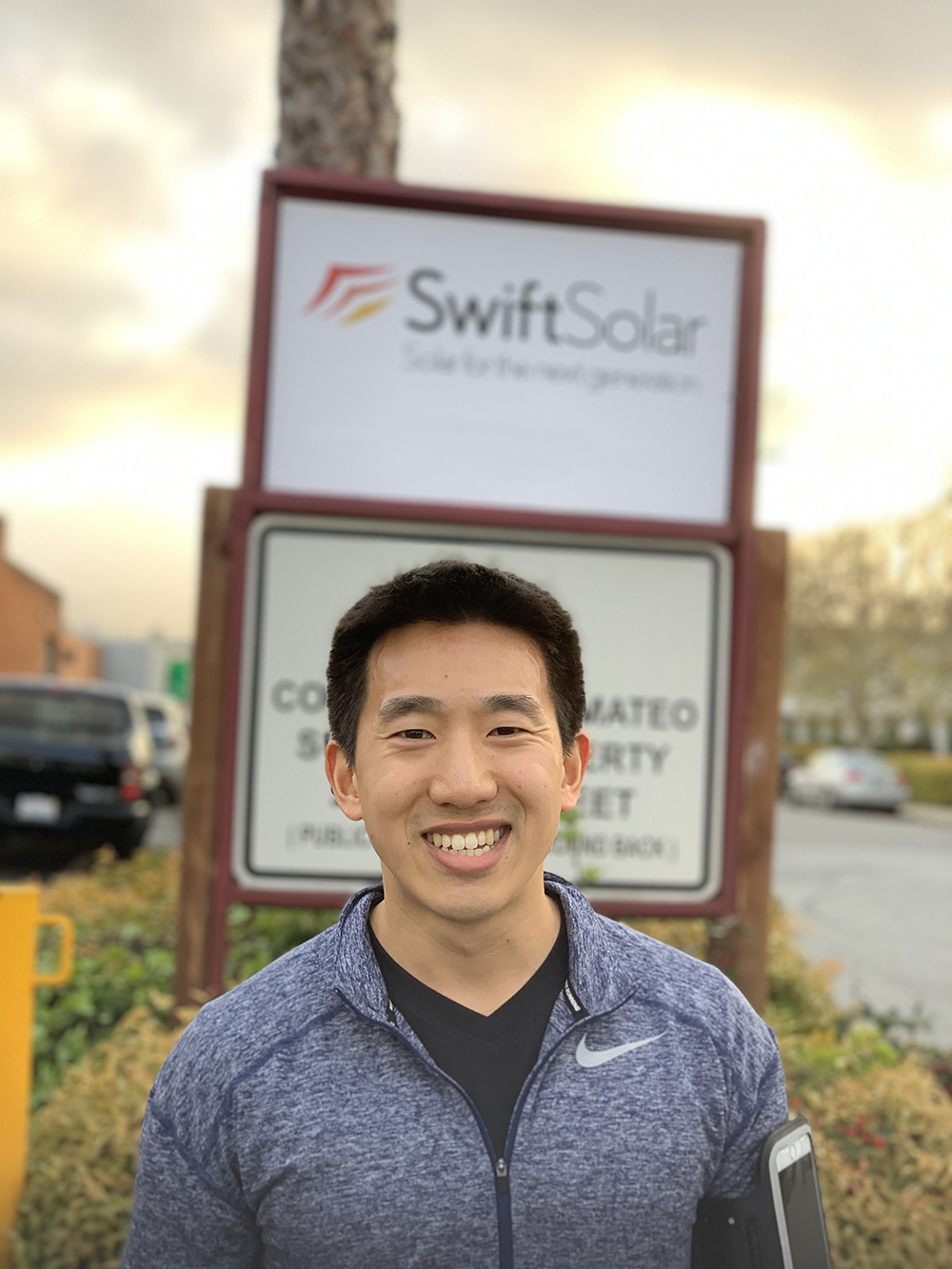
The Profile
There's a specific kind of frustration that comes from writing a very good report. You document the problem. You model the solutions. You propose the path forward. Then the report gets published, the academic world nods approvingly, and nothing moves. Joel Jean read that frustration clearly in 2015, sitting in the middle of writing the MIT Future of Solar Energy study with thirty-plus experts - and decided the only logical response was to start the company the study called for.
That instinct - from Beavercreek, Ohio, through Stanford's electrical engineering labs, through MIT's research basements - is what produced Swift Solar. The company Jean co-founded in 2017 is not doing incremental improvements on silicon. It is building perovskite tandem solar cells that stack two crystal layers to capture different slices of the light spectrum, targeting efficiencies that silicon chemistry cannot reach. The theoretical ceiling for silicon sits around 29.5%. Perovskite tandems have a path to 45%. That gap is Jean's entire business case.
"We're the only company focusing on high-efficiency all-perovskite tandems. They're hard to make, but we believe that's where the market is ultimately going to go."
- Joel Jean, Co-Founder & CEO, Swift SolarSwift Solar launched out of a Google Hangouts call across three time zones in early 2016. Jean and five co-founders - each with PhDs from institutions including MIT, Stanford, Oxford, Cambridge, and NREL - had all been working independently on perovskite chemistry and realized they were circling the same commercial opportunity. When the company formally launched in November 2017, it landed with unusual scientific credibility: six PhDs, four Forbes 30 Under 30 fellowships, and more than 80,000 combined research citations on a founding team. That density of domain expertise is not accidental. Jean assembled it with intention.
Before Swift Solar, Jean spent two years as founding Executive Director of Tata-MIT GridEdge Solar, an MIT research program scaling new photovoltaic technologies for off-grid applications in India. The experience - combining materials science with technoeconomic modeling and policy analysis - gave him a lens that most deep-tech founders lack. He didn't just know the science. He understood why the science wasn't enough.
The Founding Thesis in One Sentence
Silicon solar has a hard efficiency ceiling. Perovskite tandems can break it - and if you manufacture them in the US, you sidestep the supply chain dependency on Asia that makes the current solar industry geopolitically fragile.
Jean grew up in Beavercreek, Ohio - population 45,000, about as far from Sand Hill Road as you can get while still being in the continental US. He went to Beavercreek High School, then headed west to Stanford for a BS in electrical engineering (with distinction), building computational models of electron transport in nanostructures. Then east to MIT, where he spent six years as an NSF Graduate Research Fellow and MIT Energy Fellow under professor Vladimir Bulović, working on quantum dot and organic solar cells while also co-authoring the Future of Solar Energy study, co-leading the MIT EECS Graduate Student Association, organizing climate action with Fossil Free MIT, and coaching graduate students at the MIT Communication Lab. All simultaneously.
That breadth matters. Jean is not a pure scientist who wandered into entrepreneurship. He moved from materials science to policy analysis to leadership development, deliberately, before deciding that "a startup seemed like the only real direction that could have an impact."
"I worked on quantum dot and organic solar cells for most of my PhD, but I also spent a lot of time looking at energy policy and economics, talking to entrepreneurs, and thinking about what it would take to succeed in tomorrow's solar market. That made me less wedded to a single technology."
- Joel JeanBuilding Swift Solar
Swift Solar's technology works by stacking two perovskite layers: the upper absorbs high-energy blue light, while the lower captures red and near-infrared. Two layers, two absorption windows, more of the spectrum converted to electricity. The manufacturing relies on a proprietary deposition process that Jean and the team developed to make these multi-layer structures at scale - thin, lightweight, and flexible enough to serve markets that conventional silicon panels cannot reach.
The company targets three distinct verticals: utility-scale electricity generation, where higher efficiency translates directly to lower land use and lower cost per watt; defense and government applications, where portable lightweight power is operationally critical; and aerospace and satellite applications, where weight per watt is essentially the only metric that matters.
Solar Cell Efficiency Comparison
ILLUSTRATIVE - BASED ON PUBLISHED RESEARCH AND COMPANY STATEMENTS
In June 2024, Swift Solar closed a $27M Series A co-led by Eni Next (the venture arm of Italian energy major Eni) and Fontinalis Partners. Combined with prior equity and grants from the DOE and DOD, total funding crossed $60M. The company has over 40 patents, backed by exclusive IP from MIT, Stanford, and NREL.
Then came the moment that changed the company's trajectory. In August 2025, Swift Solar deployed its US-manufactured perovskite tandem panels in a live Department of Defense exercise - the Cyber Fortress exercise in Virginia Beach, Virginia. The panels ran alongside two other power sources in a Rapid Deployment Hybrid MicroGrid designed for natural disaster response and battlefield conditions. It was the first real-world deployment of perovskite solar technology in the United States. DoD walked away interested in integrating the technology across cyber, electromagnetic, and space-based energy missions.
"Partnering with the DoD at Cyber Fortress validates our US-made perovskite solar technology in real-world defense conditions and underscores Swift Solar's potential as a key provider of ultra-efficient, next-generation solar solutions for the US government and beyond."
- Joel Jean, after the DoD Cyber Fortress exercise, 2025In March 2026, Swift Solar made a move that transformed the company from cell developer to full-stack manufacturer. The company acquired Meyer Burger's US HJT (heterojunction silicon) manufacturing assets, its IP portfolio, and critically, its specialized engineering team - including Gunter Erfurt, former CEO of Meyer Burger, and Marcel Koenig, former global head of R&D. Meyer Burger's silicon platform is the ideal foundation for Swift's perovskite layers. The acquisition addressed the single biggest bottleneck in US solar manufacturing: domestic cell production. Module assembly plants had been proliferating across America; actual solar cell production remained almost entirely in Asia. Jean is now building the supply chain to change that.
Career Timeline
2007 - 2011
BS in Electrical Engineering at Stanford University, with distinction. Built computational models of electron transport in nanostructures.
2011 - 2017
SM and PhD at MIT EECS as NSF Graduate Research Fellow and MIT Energy Fellow, advised by Prof. Vladimir Bulovic. Research focused on quantum dot, organic, and ultra-lightweight flexible solar cells. Also co-led the EECS Graduate Student Association, organized Fossil Free MIT, and coached researchers at the MIT Communication Lab.
2015
Co-authored the landmark MIT Future of Solar Energy study - a 30-expert report on scaling solar capacity to multi-terawatt levels by mid-century.
2015 - 2017
Founding Executive Director, Tata-MIT GridEdge Solar program. Developed technoeconomic models and scaled lightweight, flexible PV technologies for off-grid use in India.
2017
Named Forbes 30 Under 30 in Energy. Received the 2017 Katerva Award for ultra-lightweight flexible solar cells. Co-founded Swift Solar in November.
2021
Delivered "Perovskites at the Edge of Tomorrow" keynote at the US-MAP Consortium webinar, articulating Swift Solar's commercialization roadmap.
2024
Closed $27M Series A (Eni Next + Fontinalis Partners). TIME named Swift Solar a Top GreenTech Company in America.
2025
First US deployment of perovskite solar technology at DoD Cyber Fortress exercise, Virginia Beach. Swift Solar named TIME Top GreenTech Company again.
2026
Acquired Meyer Burger's US HJT manufacturing assets, IP portfolio, and engineering leadership team. Swift Solar becomes a full-stack American solar manufacturer.
What Makes Him Different
In His Own Words
"The whole world is finally starting to see the threat of climate change and that there are many benefits to clean energy. That's why we see such huge potential for new energy technologies."
"A startup seemed like the only real direction that could have an impact."
"That made me less wedded to a single technology." - on spending as much time on energy policy and economics as on lab work during his PhD
"We're the only company focusing on high-efficiency all-perovskite tandems. They're hard to make, but we believe that's where the market is ultimately going to go."