The Engineer Who Chose the Sun
In 2015, a PhD student in MIT's Human Systems Laboratory finished work on a business plan for a company that would use drones to help farmers collect real-time crop data. That plan won $100,000 at the MIT $100K Entrepreneurship Competition. And then it slowly became something else entirely.
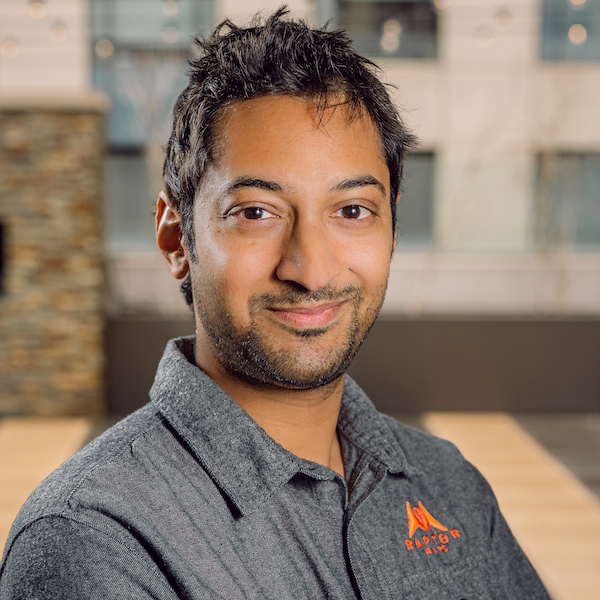
His name is Nikhil Vadhavkar. His lab at MIT sat inside the Department of Aeronautics and Astronautics, where his actual research focused on thermal control systems for next-generation spacesuits. On the side, he had led a Bill & Melinda Gates Foundation-funded project using drones to deliver emergency medical supplies across Gambia and Zambia. He had worked at NASA's Johnson Space Center. He had spent years inside the kind of technical problems that only a handful of people on Earth are qualified to think about.
None of that is what he's known for today.
"If solar is going to become the number one source of energy in the world, this process needs to be standardized and scalable."
- Nikhil Vadhavkar, MIT News 2019The Accidental Solar Company
Raptor Maps started as an agriculture play. The idea was clean: drones equipped with thermal cameras flying over fields, machine learning pulling crop insights out of the data. Vadhavkar and his co-founders - Eddie Obropta and Forrest Meyen, also MIT graduate students - won their competition prize, went through Y Combinator in the summer of 2016, dropped out of their PhD programs, and started building.
Then, in 2017, something unexpected happened. They opened their software up publicly, and watched who showed up. Not farmers. Solar operators. People pointing their thermal cameras at photovoltaic panels instead of wheat and corn. When Raptor Maps looked at the data, the signal was impossible to ignore. Early 2018, they made the call: solar, exclusively.
"The growth of the industry is what drives us," Vadhavkar would later say. "We're directly seeing that what we're doing is impacting the ability of the industry to grow faster."
The pivot turned out to be the whole thing. In 2018, Raptor Maps processed data representing 1% of the world's solar energy - millions of panels across six continents. By the time the company closed its Series C in December 2024, it was managing more than 50 GW of solar PV assets across more than 40 countries, with over 200 million solar panels on the platform.
A Systems Thinker Running a Systems Company
Vadhavkar holds a B.S. in Biomedical Engineering and an M.S. in Engineering Management from Johns Hopkins University. Both disciplines reward the same kind of thinking: understanding systems at the component level while holding the whole picture in your head. That instinct runs through everything Raptor Maps does.
Where other solar software companies chase point solutions - this module is degraded, that string is underperforming - Raptor Maps set out to become the operating system for an entire asset class. The platform manages inspection data, performance analytics, maintenance planning, regulatory compliance, and now, through Raptor Solar Sentry, the actual orchestration of field operations using both human technicians and autonomous robotics.
"We're at that point where every solar farm represents a billion dollars of solar assets," Vadhavkar has said. "And when you have that much capital at stake, being able to be standardized, efficient, transparent, and auditable, having an ecosystem to plug into really starts to matter."
The company has started calling itself the system of record for the solar industry - a deliberate reference to how enterprise software tends to consolidate around a single source of truth. It's a position that took nine years of unglamorous data normalization, API integrations, and hard-won customer trust to earn.
"AI and robotics solutions in solar need to be built with one goal in mind: empowering the people."
- Nikhil Vadhavkar, SolarPlaza Summit 2024Robots, Drones, and the Dull, Dirty, Dangerous Work
At the SolarPlaza Summit Asset Management North America in 2024, Vadhavkar sat on a panel titled "O&M Automation: The Rise of Robots." His framing was practical and pointed. Robots, he argued, should handle "the dull, the dirty, and the dangerous" - the repetitive inspection flights, the thermal scans during heat events, the storm damage assessments. Human technicians should be freed to do what humans do best: diagnosis, judgment, repair.
"AI can perform actions at a scale and speed at which humans cannot," he said during the panel. The punchline: that's precisely why the human side of the equation needs better tools. Structured data feeds AI. AI surfaces the right problems. Technicians solve them. The loop closes.
Raptor Solar Sentry, the product launched alongside the Series C, is the company's bet on that loop. It's an industry-first software that orchestrates solar operations and maintenance work across both human field teams and autonomous robotic systems - drone fleets, automated inspection workflows, real-time anomaly detection - coordinating them through a single platform.
Major buyers like Meta and Amazon have entered the solar market as power purchasers at scale. The regulatory environment is shifting fast: NERC GADS reporting requirements, IRA tax credit documentation needs, new insurance protocols. Vadhavkar reads all of it as maturation, not complication. The industry is growing up, and growing up means needing a system of record.
How to Build, According to Nikhil
Vadhavkar has spoken at length about the philosophy behind his years at the helm of Raptor Maps. His framework is notably unfashionable for a Silicon Valley-adjacent founder: focus narrowly, resist expansion, earn the right to grow.
"Success is more reliant on what you choose not to do," he has said. "Own the thing you're doing today and earn the right to expand." That discipline - saying no to adjacent markets, resisting the pressure to become a general-purpose platform too early - is a large part of how a company that began as an agricultural drone startup became the definitive platform for utility-scale solar asset management.
On failure: "Get in the weeds, get your hands dirty, fail quickly. Time is the most important thing we have." The advice is from Michael Seibel and Dalton Caldwell at Y Combinator, passed on and internalized. On starting: "Don't worry about what is the perfect idea. Just give yourself reps. Put in the grit."
His key mentors include Seibel and Caldwell at YC, and Dr. Dava Newman - MIT Media Lab director and former NASA Deputy Administrator - who Vadhavkar credits for demonstrating what unconventional career paths look like for engineers who care about impact.
He keeps his CEO approach grounded: "Roll up your sleeves and understand your own business. Stress-test what you think the future looks like." In the solar industry, that means time in the field, not the conference room.
"It's not a sacrifice to be in climate anymore. It's a privilege."
- Nikhil VadhavkarFrom Kilimanjaro to Korea
The career arc - biomedical engineering at Hopkins, spacesuit research at MIT, drone deliveries in Zambia, agricultural tech pivot, solar dominance - is unusual enough. The personal details fill it in further. Vadhavkar is married with a child. He proposed on the summit of Mount Kilimanjaro. He's an avid hiker. He and his family adopted an elderly Great Pyrenees rescue dog from South Korea.
These are not throw-away details. The pattern is consistent: someone who is drawn to scale, challenge, and systems that are larger than any single person. Mountains. Medical delivery at continental scale. Energy infrastructure for 40 countries. The same instinct, different latitudes.
His framing of climate work as privilege rather than sacrifice is deliberate, and cuts against a common narrative. The solar industry, he notes, now has enough capital at stake - and enough talent choosing to enter it - that the story of what it costs to work in climate needs updating. The growth is real. The problem is tractable. The tools are catching up.
In December 2024, Raptor Maps closed a $35 million Series C led by Maverix Private Equity, with participation from MKB, Blue Bear Capital, Congruent Ventures, Buoyant Ventures, and Y Combinator - the firm that told Vadhavkar and co-founder Eddie Obropta to drop their PhDs and build in the first place. Total funding now stands at $63.9 million. The plan: accelerate product development in solar automation, expand the software engineering and data science teams, and keep scaling.
Somewhere out there right now, 200 million solar panels are sending data through Raptor Maps' platform. The company that started because farmers didn't show up has become infrastructure for a global energy transition. The engineer who designed spacesuits is running one of the most important software companies in renewable energy.
He'd tell you he just gave himself reps and put in the grit.