A parking space is a peculiar place to look for an energy business. Branch Energy sees something else: room for a battery beside a building that already has an electricity connection. The connection is the interesting part. The expensive work of getting power to that address has already happened.
- Branch installs and owns the battery; qualifying businesses avoid the upfront equipment bill.
- The host gets electricity savings and backup for short outages.
- Branch earns money by putting stored energy to work in electricity markets.
The Houston company’s proposition begins with an unglamorous question. If a useful device saves money over time, why must its customer find the cash, choose the equipment and arrange the installation? Branch puts those chores inside the service. A business provides space. Branch supplies electricity, manages the battery and shares some of the value.
The battery has two customers
One customer is the building. It wants a predictable bill and fewer interruptions. The other is the electricity system, which needs power at particular moments. A battery lets Branch serve both. Electricity stored during cheaper periods can be used when prices rise, or dispatched to support the grid. The difference in timing becomes a source of revenue.
On its current Texas website, Branch calls the bundled offer Energy+ Battery. It advertises an annual battery credit of at least $2,000 for qualifying commercial customers. That is a useful number to bring into a conversation about the total electricity bill. It is also a company offer, subject to qualification, rather than a universal estimate of what any battery will earn.
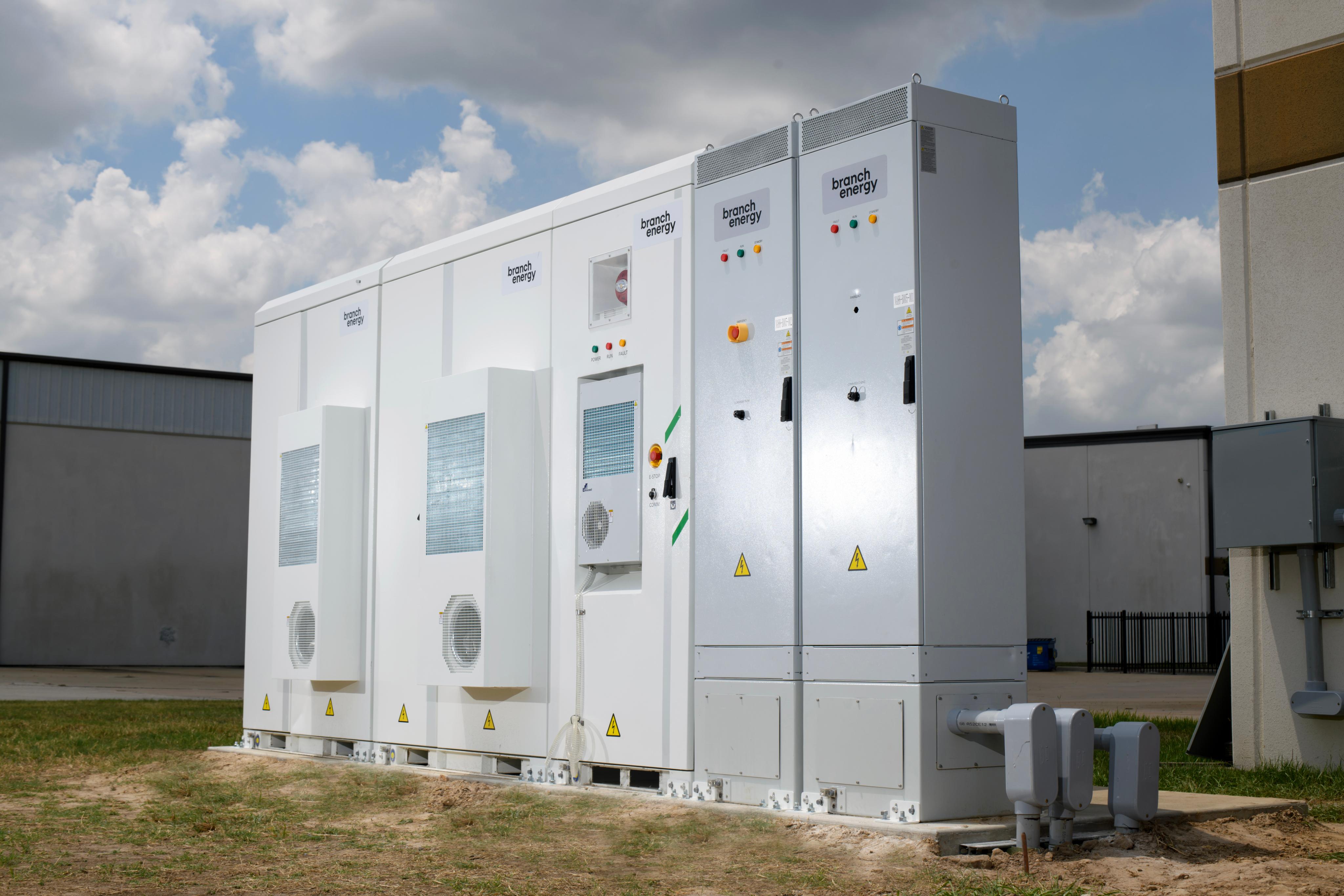
Branch says a fully installed commercial-scale battery can cost upwards of $150,000. Its host avoids that capital expense because Branch owns the system. The host still buys electricity. The bargain is an exchange of space and a customer relationship for savings and backup; the equipment earns its return elsewhere in the arrangement.
Operating logic, not a promise of fixed daily prices or unlimited backup.
A physicist discovers the paperwork problem
Alex Ince-Cushman studied nuclear fusion at MIT, then worked at McKinsey, Palantir and Just Energy. Daniel MacDonald, his friend since middle school, had built consumer businesses, including Filter Group. Todd Burgess brought energy-industry experience. The company combined knowledge of electricity with knowledge of how people actually buy things.
In a 2022 interview, Ince-Cushman described becoming a parent and reading climate science as a turning point. He came away persuaded that existing technologies, deployed widely, could make a material difference. The ambition did not require waiting for an invention. It required getting useful equipment into places where people would otherwise never install it.
Branch’s 2021 launch pitch focused on green electricity and smart devices for consumers. The problem was friction: evaluating a device, financing it and coordinating a tradesperson could defeat a perfectly sensible purchase. Comcast Ventures captured the early mission as “Green Energy, Made Simple, For Less.” Simplicity here meant taking responsibility for the errands.
“an energy provider built like a software company”
Alex Ince-Cushman, in a 2025 interview
By 2025, Ince-Cushman described a progression from building the retail platform to financing and installing batteries. That makes the current commercial emphasis easier to understand. The early insight was about adoption. The later product gave Branch an asset it could operate, with a customer bill on one side and an electricity market on the other.
The clever part is who does the chores
Branch’s expertise sits between disciplines that businesses usually purchase separately: electricity supply, data engineering, equipment installation and ongoing operations. Its software controls physical assets. Its field crews make those controls consequential. A clever calculation has limited value if the battery is still waiting for someone to finish the electrical work.
The partnerships reveal how the company assembled that machinery. In January 2022, ENGIE Energy Marketing announced a $40 million wholesale power supply facility with Branch. It supplied market access and working capital. This was a non-dilutive commercial facility, a different instrument from venture investors buying shares in the company.
In September 2024, Energywell announced a licensing agreement for its Proton platform, which handles energy data and operations. That month, Voltus announced another integration: Branch’s batteries could participate in ERCOT grid-service markets. The software would help determine whether a battery produced more value through energy arbitrage or through those market services.
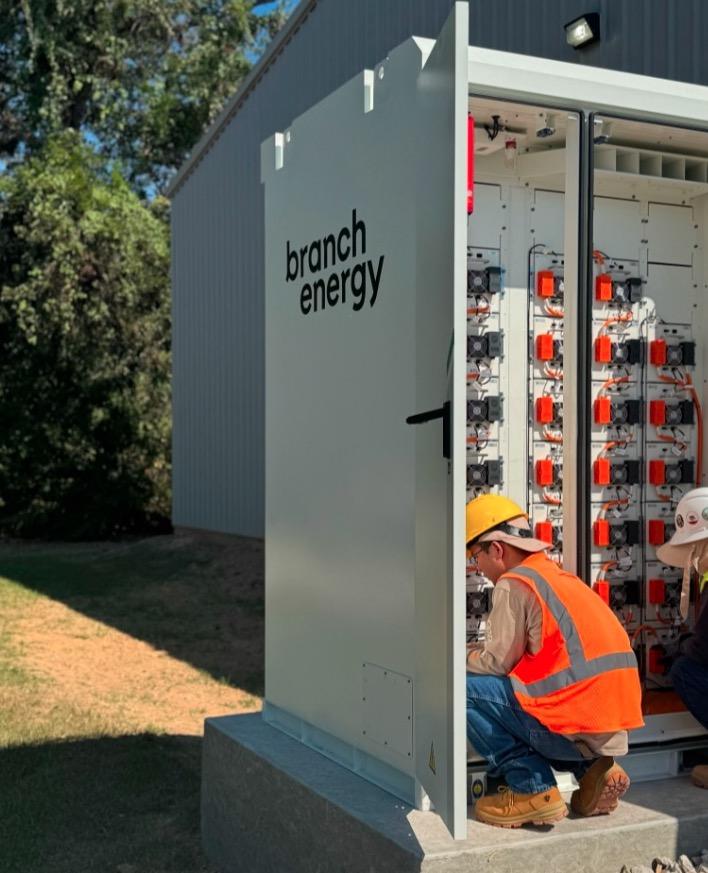
Voltus initially described engagements with 15 Branch customers, with installations planned by the end of 2024. It also specified capacity reserved for host consumption. That detail matters: a battery cannot be treated solely as a trading account when the business beside it expects backup.
Texas first. Illinois next.
The financing followed the changing product. Branch announced $4.5 million in seed funding in 2021 and a $10.8 million Series A in August 2024. The latter supported battery-management software and field services. In September 2026, a $33 million Series B led by Piva Capital and Clean Energy Ventures backed expansion beyond Texas, starting with Illinois.
Equity rounds shown separately from the ENGIE wholesale supply facility.
The newer hardware is called Arc, a self-contained system combining batteries, grid equipment, cooling and autonomous controls. Branch describes a footprint roughly the size of a parking space and installation in two days. That is an installation claim. It should not be read as a guarantee that site qualification, permitting and every prerequisite disappear.
Illinois introduces another route to revenue: capacity arrangements associated with growing data-center demand in PJM territory. Latitude Media reported that Branch plans to use long-term agreements to help finance deployment. That changes the economics of expansion. A contracted buyer can support financing differently from a company paying for assets with venture equity alone.
The small print is the product
Branch’s own eligibility guidance favors predictable consumption, moderate-to-high power needs, outdoor space near the meter and a long planning horizon at the site. It explicitly describes backup for short outages, rather than multi-day blackouts. A business should start with its load and the interruption it needs to survive, then compare the contract with its existing electricity plan.
The lesson other companies can borrow is practical: remove the work between wanting a benefit and receiving it. Branch bundles the equipment, money and maintenance around a familiar monthly bill. The parking space is only the visible part. The product is the arrangement that makes putting a battery there worth everyone’s trouble.