The diesel generator is an unlovely island icon. It sits behind the villas, beyond the palm trees, making the steady mechanical racket that keeps the lights, freezers, pumps and air conditioners alive. Every liter it burns has already taken a costly trip by tanker, cargo ship or small boat. When fuel prices jump, so does the electricity bill. When delivery is late, the whole island notices.
Canopy Power built its business around making that machine less important. Founded in Singapore in 2016, the company designs and implements renewable microgrids for remote resorts, communities and commercial sites. Solar panels and batteries are the familiar pieces. The harder product is a reliable system that can combine them with wind, floating solar, an existing generator, a grid connection or even hydrogen, then keep the combination working in a place that may be several flights and a boat ride from the engineer.
This is not the broadest corner of climate technology. It is a deliberately awkward one. Mainstream solar developers can cover a warehouse roof or build a large field beside a transmission line. Canopy Power goes after sites where there may be little roof, less land, no grid and no tolerance for a blackout. The company’s customers have included luxury resorts, factories, fisheries, community projects and industrial operators across Southeast Asia, the Maldives, Australia and the Pacific.
A business discovered during a blackout
For co-founder and CEO Sujay Malve, unreliable electricity was personal before it became a market. He has recalled trying to study through power cuts while growing up in India, and watching outages disrupt the factory where his father worked. Malve trained as a mechanical and industrial engineer, worked on wind-energy components in the United States, moved into energy consulting, and later led business development in Asia for solar manufacturer REC.
That route gave him an unusually useful view of the gap. Renewable developers were chasing easy urban rooftops or giant grid-scale projects. In between were thousands of islands, plantations, mines and communities paying dearly for diesel. They had demand and, in many cases, the ability to pay. What they lacked was an integrator willing to handle a complicated small power system far from the usual service network.
In many places, the lack of electricity supply doesn’t mean that people are poor.Sujay Malve, co-founder and CEO
Malve spent about 18 months shaping the plan and co-founded Canopy Power with Tim Walsh. The first contract arrived through a battery supplier: a photovoltaic and storage system at Misool Eco Resort in Raja Ampat, Indonesia. Completed in 2018, it supplied a reported 55 percent of the resort’s power needs. Projects in Myanmar and Indonesia followed. The small company had found its wedge.
Floating solar
Wind where useful
Hornbill controls
Diesel as backup
Lower fuel exposure
Remote visibility
The product is the whole system
Canopy Power is best understood as an engineering and project company, not a panel maker. It can begin with feasibility and system design, continue through equipment sourcing, construction and commissioning, then stay involved through operations and maintenance. For eligible customers, it also offers financing structures such as leases or power-purchase agreements. That full path matters because a remote client is unlikely to want separate vendors arguing over whether the battery, inverter, software or generator caused an outage.
The company’s Hornbill energy-management system is the connective tissue. It monitors performance, supports load management and helps engineers diagnose faults from afar. Malve said in 2020 that 80 percent of problems could be solved remotely, in minutes or hours rather than days. WIPO GREEN’s listing for the system also describes performance analysis, predictive maintenance and automated workflows for renewable-energy certificates. The software is not the glamour shot. It is the part that keeps an expensive collection of hardware from becoming an expensive collection of mysteries.
The commercial model follows the lifecycle. Canopy Power earns from engineering, procurement and construction, system integration, maintenance and monitoring, with financing added where it helps a project clear the initial-capital hurdle. The pitch to a resort owner is consequently less about buying technology and more about replacing a volatile operating expense. Sunlight does not need a delivery schedule.
When the roof runs out, use the lagoon
The Maldives exposed the next constraint. Canopy Power designed and built solar-battery microgrids at Soneva Fushi and Soneva Jani that now provide roughly 40 to 45 percent of those resorts’ electricity. But Soneva Secret wanted substantially more renewable power. Its sculpted villa roofs were a poor platform, and using scarce island land for a solar field would compete with the very landscape guests came to see.
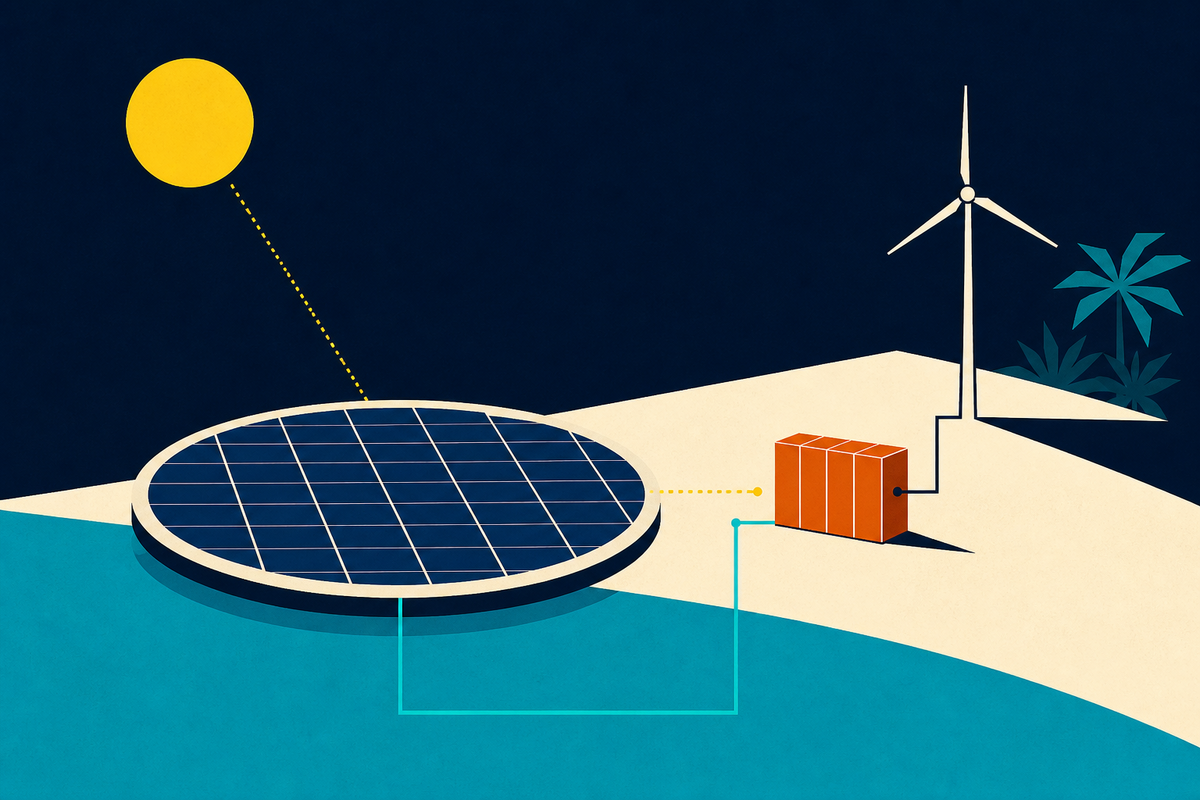
The answer was water. Working with Norwegian floating-solar specialist Ocean Sun, Canopy Power delivered a 2 MWp photovoltaic plant on membrane-based floating rings, paired with a 3 MWh Huawei battery system. The resort targeted roughly 75 to 80 percent renewable penetration. Public project figures estimate annual diesel savings of 900,000 to 1 million liters, more than 2,000 tonnes of avoided carbon emissions, and generator-off periods of 16 to 18 hours a day.
The membrane design brings a stack of side benefits. Panels sit close to the water and run cooler. The circular structure uses relatively little material, can be packed for transport and presents a low silhouette from shore. Integrated pumps can collect rainwater from the membrane. Canopy Power estimates that a single 75-meter ring could theoretically gather millions of liters a year, depending on rainfall. For an island that is short of both land and fresh water, that is more than a clever footnote.
Canopy Power does not claim a proprietary solar cell or battery. Its differentiation is orchestration: choosing components, sizing the hybrid system, navigating remote logistics, training local partners, financing the build and watching the plant after everyone else has gone home.
A moat made of customs forms and boat rides
Large electrical groups such as Schneider Electric, ABB and Siemens sell microgrid technology. Regional solar contractors can install panels and batteries. Other specialists pursue community mini-grids. Canopy Power’s place between them is narrower: customized, roughly commercial-scale renewable systems for remote and edge-of-grid operators, with floating solar increasingly central to the offer.
That position creates an unfashionable kind of expertise. On one Indonesian project, equipment sat in customs for months. The lesson, Malve said, was to build strong logistics partnerships in every market. On the Soneva work, Canopy Power partnered with Yonsan Engineering for local construction. Its website emphasizes an ecosystem approach rather than parachuting in a crew. The installer, customs broker and trained operator become part of the power plant’s reliability.
The company itself remains small. LinkedIn places it in the 11-to-50 employee band, while supplied company data lists 22 people. Its public team spans engineering, project delivery, operations, software and business development. Malve has described hiring early-career people for potential, appetite for risk and belief in the climate mission, then teaching the specialist knowledge. In a field where the job site can be a lagoon, adaptability is not a poster on the office wall.
From powering the island to moving around it
The next act extends the microgrid beyond buildings. In March 2026, Canopy Power signed a memorandum of understanding with Swedish electric-boat maker Candela. The idea is a floating-solar charging station for Candela’s P-12 hydrofoil ferry, linking local renewable generation directly to low-energy water transport. Canopy Power designs the microgrid, Ocean Sun supplies the floating platform, and the ferry turns that electricity into mobility.
It is a logical expansion. Island resorts and coastal communities burn fuel twice: once to make electricity and again to move people and supplies. A common solar, battery and charging system can attack both bills. In July, the company published a white paper on that business case and released a video about the Soneva Secret installation.
Canopy Power’s limits are visible too. Every project is bespoke, permitting varies, shipping is messy, and hardware deployment consumes time and capital. Floating solar must be designed for the water body, weather and marine environment rather than treated like a rooftop array with a life jacket. Project claims also depend on modeled production and customer operations. The work scales by repeating engineering patterns, not by clicking “deploy” in a dashboard.
Still, the market logic is sturdy. Remote operators already pay a premium for power, already endure fuel volatility and often have sustainability promises to keep. Canopy Power does not need to persuade them that diesel is inconvenient. It needs to prove that a more intricate system will be more dependable. The strongest evidence is quiet: a generator that does not start, a fuel boat that can come less often, and a guest who never notices either one.