The least glamorous object in a school may be its most persuasive budget document. It is the utility bill: a monthly record of old boilers running too hard, lights burning too long, water escaping through tired fixtures and control systems that were clever in 1996. Ameresco looks at that bill and sees collateral. If new equipment cuts the expense, the avoided cost can help finance the equipment. A building that could not afford its future begins, in a limited but useful sense, to pay for it.
That mechanism is an energy savings performance contract, or ESPC, and it sits near the center of Ameresco's identity. Founded in 2000 by energy-services veteran George Sakellaris, the Framingham, Massachusetts company audits facilities, designs upgrades, arranges financing, manages construction and verifies performance. It can remain after the ribbon cutting to operate and maintain the systems. It can also build an energy asset nearby, keep ownership and sell the output under a long-term agreement.
The result is difficult to fit into a tidy climate-tech category. Ameresco is a construction manager, engineer, financier, software provider, asset owner and plant operator. Its catalog ranges from LED streetlights, HVAC controls and smart water meters to solar arrays, batteries, microgrids and renewable natural gas. The common product is not a panel or a pump. It is a coordinated route from an infrastructure problem to a funded, working system.
The product is permission
A mayor, hospital executive or school superintendent rarely needs convincing that a failing chiller is bad. The obstacle is permission to spend. Capital budgets compete with classrooms, clinical equipment, payroll and dozens of visible public promises. Ameresco's financial structures make an infrastructure project legible to that constraint. Under an ESPC, upgrades are selected and modeled so energy and operating savings can cover all or much of the project cost across an agreed term. Under a power purchase agreement, Ameresco or a financing partner can fund an energy asset and sell its production to the customer over time.
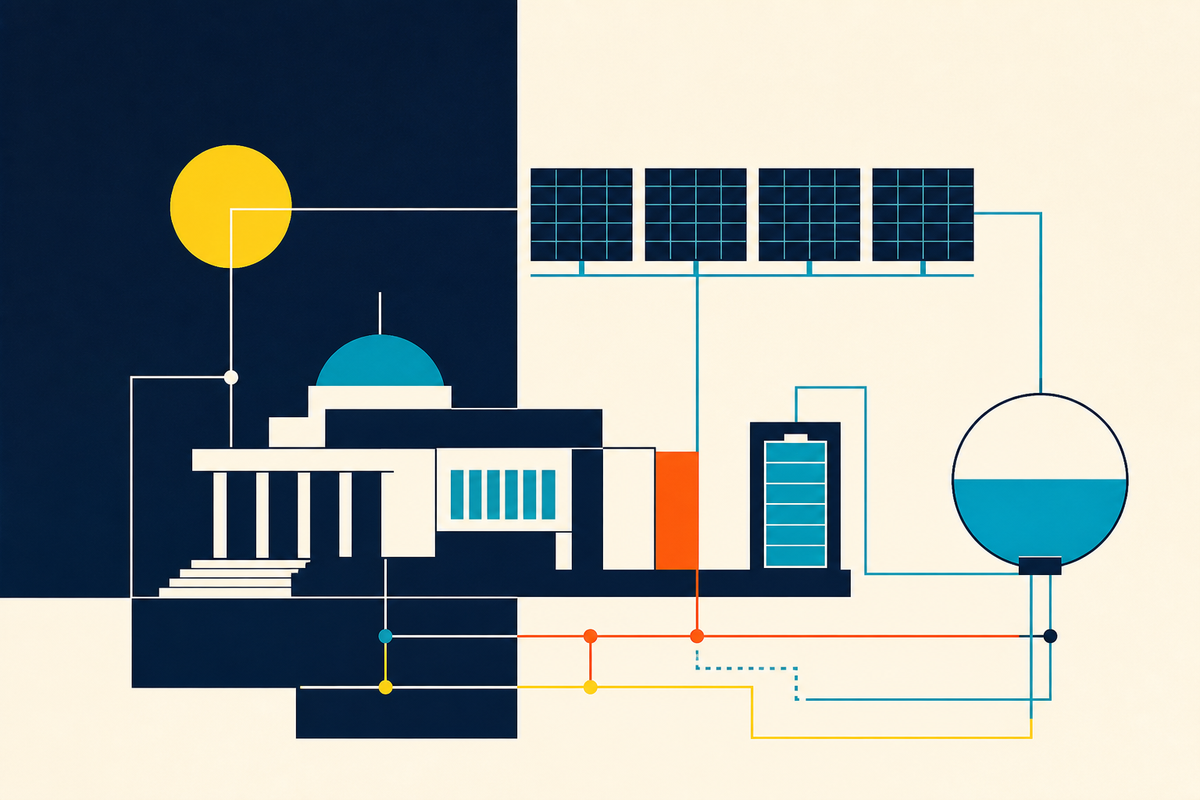
How the performance-contract loop works
The wording matters. Savings are not magic money, and forecasts remain forecasts. Contracts define baselines, performance commitments and methods for adjusting results when weather, occupancy or building use changes. Ameresco's federal work can involve terms lasting seven to 23 years. The technical installation may take months; accountability can outlive several administrations.
Ameresco does not sell one machine. It sells fewer reasons for the customer to say no.
That gives the company a different posture from an equipment manufacturer. Johnson Controls, Honeywell, Siemens and Schneider Electric arrive with deep product portfolios and global service networks. Ameresco's pitch is that it is technology-agnostic. It can choose across vendors, combine measures that do different jobs, source capital and accept responsibility for the package. The choice for a customer is less “whose thermostat?” and more “who can get this unruly project through procurement, financing, construction and the next decade?”
One customer, several revenue clocks
Ameresco's income arrives on different schedules. Project work is the largest stream: development, engineering, equipment and construction generated $1.485 billion of its $1.932 billion in 2025 revenue. Operations and maintenance contracts add recurring service income after completion. Owned energy assets produce long-duration sales of electricity, gas, heat or cooling. AssetPlanner software and energy-supply consulting occupy a smaller, data-driven layer. In the second quarter of 2026, project revenue was $380.9 million, energy assets produced $75.9 million and O&M contributed $36.2 million.
The mixture gives Ameresco a flywheel. A construction project can become a maintenance contract. An owned asset can create decades of contracted visibility. Operating a system reveals the next replacement need. The trade-off is capital intensity: energy assets bring depreciation, interest expense and project debt alongside recurring revenue. At June 2026 the company reported $2.24 billion in energy-asset book value and $1.55 billion in related debt. This is not software economics wearing a hard hat.
Public infrastructure is a moat with paperwork
Ameresco's customers include federal agencies, cities, public housing authorities, school districts, universities, hospitals, utilities and industrial businesses across North America and Europe. Public-sector entities accounted for about 61 percent of 2025 revenue. That concentration is both expertise and exposure. Government sales cycles can stretch from 18 to 42 months. Budgets, shutdowns and policy changes can delay awards or contracts. Public buyers also demand guarantees, approved measurement rules and patient navigation of procurement.
Ameresco has spent a quarter-century learning that bureaucracy. It says it has guaranteed more than $2.8 billion in savings through federal ESPC and utility energy-service projects. At a military installation, the goal can extend beyond lower cost to keeping a mission running through a grid outage. A microgrid may combine solar, batteries, engines and controls so a site can disconnect and operate on its own. The customer is buying resilience - an insurance policy rendered in switchgear.
Water projects reveal the same logic in a different pipe. Advanced meters can find losses and improve billing. Wastewater systems can be rehabilitated. Biogas from landfills or treatment plants can become electricity or renewable natural gas. Ameresco is willing to follow waste through a facility until it becomes either a saving or a saleable molecule.
This puts the company in the crowded middle of the energy transition. It overlaps with building-technology companies on controls and HVAC, engineering contractors on construction, utilities and independent power producers on generation, and specialist developers in solar, storage and renewable fuels. Its defense is breadth: audit, finance, build, own, operate and verify. Few competitors are equally credible at every step, although larger rivals have deeper balance sheets and proprietary technology.
The data-center turn
The newest chapter begins with a customer that has abundant capital and a severe shortage of power. Data centers need large amounts of electricity, quickly, with little tolerance for interruption. Grid interconnections can lag their construction schedules. Behind-the-meter generation, storage and controls give Ameresco a familiar integration problem at a new scale.
In the second quarter of 2026, Ameresco announced a record $1.8 billion in new project awards. Data-center power infrastructure supplied $1.2 billion of that total. The company said it had five data-center projects in awarded backlog, helping total project backlog rise 32 percent from a year earlier to $6.73 billion. The numbers are awards, not yet the same thing as revenue; $4.42 billion of the backlog remained awarded rather than contracted. Still, the shift is meaningful. A business schooled on municipal boilers is now being pulled toward one of the century's largest new electricity loads.
Ameresco is also stretching its technology horizon. A 2025 collaboration with Terrestrial Energy explores molten-salt reactor projects for tailored supply, including data centers and industrial heat. In Europe, its SUNEL joint venture is designing, building and operating utility-scale solar, including a 58 MWp Romanian project announced in July 2026. In renewable fuels, the 2026 Neogenyx venture with HASI moves biogas assets into a dedicated growth platform. None is a guaranteed winner. Together they show a company following the customer's power problem rather than defending one favored device.
The energy transition is often photographed in a field of solar panels. Ameresco's version also lives in contracts, basements and control rooms.
What the customer can actually do
For an organization with aging facilities, Ameresco offers a practical sequence. Consolidate scattered utility and asset data. Identify where energy, water and maintenance money is leaking. Bundle quick-payback measures with necessary but slower-payback infrastructure. Compare direct purchase, third-party finance, an ESPC, a PPA or a design-build-own-operate-maintain structure. Then establish how performance will be measured before construction begins.
That last step separates a climate goal from an operating plan. Carbon reporting may describe the destination, but a facilities director needs specifications, a commissioning schedule, trained operators and a baseline that survives scrutiny. Ameresco's expertise is translating between those worlds. It can be useful when an institution knows the outcome it wants but does not want to coordinate engineers, contractors, lenders, utilities, software and maintenance providers separately.
The model carries real risks. A project can be delayed. Equipment prices and interest costs can move. Savings can disappoint. Owned assets require debt and reliable counterparties. Heavy government exposure makes policy and public finance material. The company competes for talent and contracts against firms far larger than itself. Its long sales cycle consumes resources before revenue appears.
Yet the core observation remains sturdy. Most infrastructure owners do not need another catalog of climate technologies. They need someone to arrange the technologies, capital and accountability into a decision they can make. Ameresco has spent 25 years turning that arrangement into a company. The solar panel is visible. The permission structure is the product.