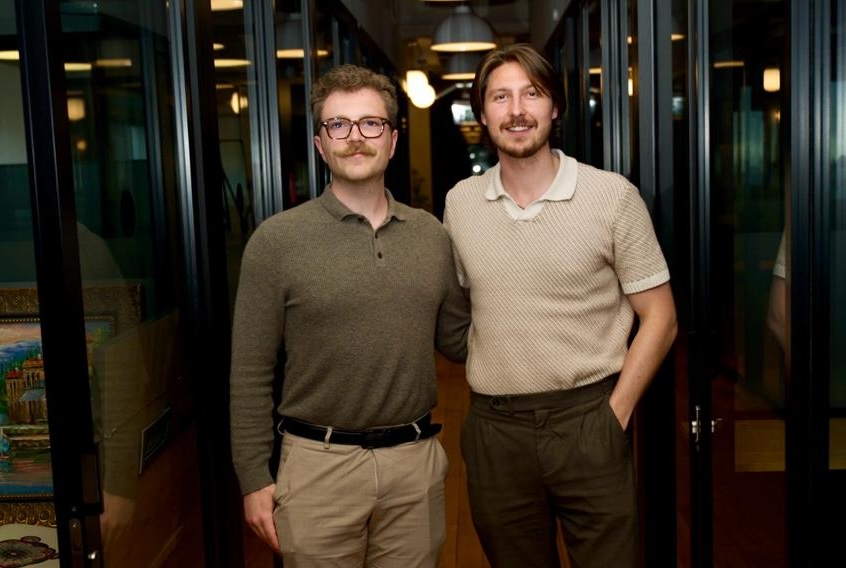
Some companies begin in a garage. CareCycle began somewhere on the road out of the Bay Area, during a three-day trip Alex Doonanco had to make to renew his visa. The founder was driving, thinking and taking inventory. He knew conversational AI from the inside. He also knew that knowing a technology is not the same as knowing where it belongs. Somewhere along the route, he called his technical friend Evan Roubekas with a compact proposal: Doonanco would teach him voice AI, and together they would go after a particular, awkward corner of the insurance business.
The corner was Medicare distribution. Agencies field torrents of calls, especially around enrollment periods. Their licensed agents spend precious hours qualifying prospects, chasing confirmations, booking appointments and answering questions that arrive after the office has gone quiet. Many customers hear from an agency when a policy is sold and then barely again until renewal. The relationship has all the warmth of an annual software update.
Doonanco and Roubekas saw a job for software hiding in those silences. Their first version handled incoming and after-hours calls, screened leads, scheduled appointments and carried context into follow-ups. It was deliberately unglamorous. The telephone is old. The work is repetitive. The industry speaks in acronyms and rules. In startup fashion, this is either a warning label or an invitation.
The education of an interface
The phone call makes more sense when set against Doonanco's crookedly coherent education. At the University of British Columbia, he concentrated in economics, philosophy and Mandarin Chinese. He led the UBC Trading Group, wrote an explainer on Tobin's Q Ratio and worked in impact investing. He also served as a bilingual emcee for the university's Asian Studies department. Years earlier, at Western Canada High School, he made promotional films after an administrator saw one of his narrative projects.
Markets, arguments, languages, movies: each is a system for persuading people to notice one thing rather than another. His early career continued the sampling. There were analyst and fund roles, economics editing, research and business development. At AI Rudder, a Singapore-based voice AI company, he led U.S. expansion and worked on contact-center automation across several consumer industries. One automation for loan underwriters saved minutes on calls and earned him money. Useful, yes. Yet it also offered a clue. Generic intelligence becomes valuable only when it learns the peculiar manners of a real workplace.
That lesson pushed careCycle away from being voice AI for anybody. Medicare is full of constraints that a horizontal demo can avoid: permission, documentation, identity checks, tightly defined responsibilities and the boundary between an automated assistant and a licensed adviser. Doonanco's wager was that those constraints could form the product rather than merely slow it down.
The decision also matched a pattern visible in his student years. He did not confine himself to reading about markets. He ran a trading group, helped manage a student-led impact fund and moved between communications and investment work. Even the filmmaking mattered. A promotional film must translate an institution into a story another person can follow. A voice product faces the same editorial demand in miniature: identify what the listener needs, discard the rest and make the next step obvious.
“People are used to an unhelpful robot, and that's worse than anything.”Alex Doonanco
Helpfulness beats the impression
Voice AI companies can become preoccupied with the parlor trick of sounding human. Does the bot pause convincingly? Does it deploy the correct quantity of “ums”? Doonanco prefers a more severe test: did it help? CareCycle is designed to retain the thread of earlier conversations, greet a returning member with context and move licensed questions to a human. The aim is continuity, not ventriloquism.
His favorite company memory makes the point without a benchmark chart. After one automated conversation, a senior cheerfully ended the call with “Thanks, sweetie - have a blessed day.” The line delighted him because the system had not simply completed a workflow. The caller had felt comfortable enough to offer the sort of farewell usually reserved for a person who had been useful.
This is where Doonanco's interest in voice becomes less nostalgic than practical. No one needs a tutorial before asking a spoken question. “There's no learning curve,” he has said. A person need not find a password, read a menu or discover which tiny icon contains the next tiny icon. Voice is the interface learned in infancy. In a software industry forever inventing new gestures, the radical move may be to remember the original one.
The distinction is especially useful for a founder choosing what to optimize. A flawless imitation can still send a caller in circles. A plainly synthetic voice can still retrieve the right detail, schedule the right appointment and make a clean transfer. One earns applause in a demonstration. The other earns a place in the daily operation. Doonanco keeps returning to the second category, where software is judged by the work it completes and the confidence it leaves behind.
The careCycle loop
A narrow door opens wider
The product launched in October 2024. In its first month, careCycle generated $70,000 in revenue. By August 2025, it had reached $1 million in annual recurring revenue with a core team of four and processed one million conversations. That month it announced $2 million in seed financing from investors including Strike Capital and Pioneer Fund. A 2026 conference biography later put the conversation count above four million.
Numbers at that speed can make a company sound finished when it has barely chosen its furniture. CareCycle's early traction also exposed the hard part. A voice tool is only as useful as the systems surrounding it. Customer records may sit in HubSpot, Salesforce or specialist software. The next action may require a dialer, a note, an audit trail or a transfer. Connecting the pieces takes forward-deployed engineering and can make a tidy software subscription resemble a service business wearing a laptop.
Doonanco's response is expansive. CareCycle has been moving toward the system of record itself: the phone, the customer history, the workflows and the memory around them. He has even suggested giving the CRM away instead of charging per seat. It is an aggressive bit of arithmetic. If the company can own the work performed around the record, the record becomes connective tissue rather than the tollbooth.
The approach also reveals a broader view of vertical AI. The models underneath will grow cheaper and more interchangeable. Durable value must come from industry knowledge, specific workflows and the platform built around them. Doonanco has said as much plainly: when the technology is commoditized, defensibility comes from embedding vertical knowledge and solving vertical problems. A general model can speak. A useful product knows when it is allowed to, what it should remember and when to fetch a person.
Y Combinator's Winter 2025 batch sharpened that focus. Doonanco has described the program's lesson as learning what worked with large agencies and compressing it into something smaller agencies could adopt in days. It is a common founder ambition expressed with an uncommon target: enterprise-grade capability without enterprise-grade ceremony. The challenge is to preserve the specificity that makes the product useful while removing the implementation work that makes it difficult to buy.
Trust has a long memory
Doonanco describes his leadership method as starting with the impact on the member and working backward. In his formulation, trust accumulates slowly and can disappear in a moment. That belief shapes careCycle's emphasis on documented interactions, consumer consent, identity verification, opt-outs and human handoffs. It also sets a productive limit on automation. The software handles non-licensed work; people keep the advice and judgment that belong to them.
He has been consistent on this boundary. At AI Rudder, he publicly argued against unsolicited AI calling and tied outreach to consumer-initiated action. At careCycle, the ambition is proactive but not indiscriminate: identify a useful moment, preserve the person's context and offer a next step. There is an old-fashioned courtesy in the design. Remember the last conversation. Do not ring without reason. Know when to stop talking.
His current plans stretch toward predictive engagement, identifying members who may leave and helping agencies reach them at an appropriate time. He has also discussed adjacent regulated areas. Yet the company remains most legible in its smallest moment: one person asks a question, software supplies what it can, and a human enters where expertise is required.
The road-trip call to Roubekas contained a promise that sounds almost comically simple: I will teach you this technology, and we will apply it there. The years since have made “there” larger. After-hours coverage became follow-up, support, records and a possible operating system. But the animating question has stayed compact. Can a machine pick up the phone without making a person wish it had not?
Doonanco's answer is still being built, one remembered conversation at a time.