The most revealing moment in a phone call is not hello. It is the interruption. Someone begins with a question, remembers a missing detail, changes the requested date, and expects the listener to carry all of it forward. Humans do this with barely a shrug. Software, historically, has responded by asking for Tuesday again.
Oliver Silverstein has made that awkward gap his work. As co-founder and CEO of OpenCall, he is building AI agents that answer calls and texts, hold onto context, follow the rules of a business, and update the tools where the actual work lives. The voice is the visible part. Beneath it sits a less glamorous stack of memory, logic, integrations, escalation, and the small clerical acts that turn speech into an outcome.
His route there was not a straight line through chatbots. It began close to the physical world. His earliest listed role, in 2015, was as an ophthalmic technician. A year later he worked as an intern consultant technician at INTEGRIS Health. Then came a computer science degree at Northeastern University and a succession of jobs in which code had to touch something more consequential than a demo.
Software, meet the real world
At scientific-instrument maker SciAps, Silverstein worked as a software engineering co-op. At Northeastern's Choice and Thought Lab, he programmed an AI system to track student outcomes. At Arm, his cloud engineering work helped streamline chip-design processes. Pluralsight added another software engineering stop before graduation in 2022. The pattern is easy to miss because the industries change. The useful commonality is that every system had a job outside itself.
There were early signs of a founder who liked the full stack of making. In 2018, Northeastern's College of Engineering gave him an Innovative Design Award for work that included SolidWorks design, optimizing parts for 3D printing, sourcing materials, budgeting, and helping with the pitch. The same year, the university's IDEA venture accelerator gave him a Husky Startup Challenge funding award for a machine-learning fashion app that classified and rendered user photos. Model, material, budget, pitch: the compartments were already leaking into one another.
That invitation arrived in a public post at the end of 2022. Silverstein described a project aimed at fundamental limitations in GPT-like models. The intended system would plan across long time horizons, use external information as memory, and access APIs to perform tasks rather than merely answer questions. The ambition was broad. The tone was refreshingly workshop-like: he was one developer, he wanted help, and he wanted people to find the holes.
The phone becomes the proving ground
OpenCall, founded in 2022, gave that large idea a brutally specific place to work. A telephone conversation offers no patience for the leisurely rhythm of a lab demo. The caller can interrupt. They can refer to something from forty seconds ago. They can supply half an address, change the subject, or assume the agent knows what “the usual time” means. Then they expect the calendar, record, or internal queue to reflect what was decided.
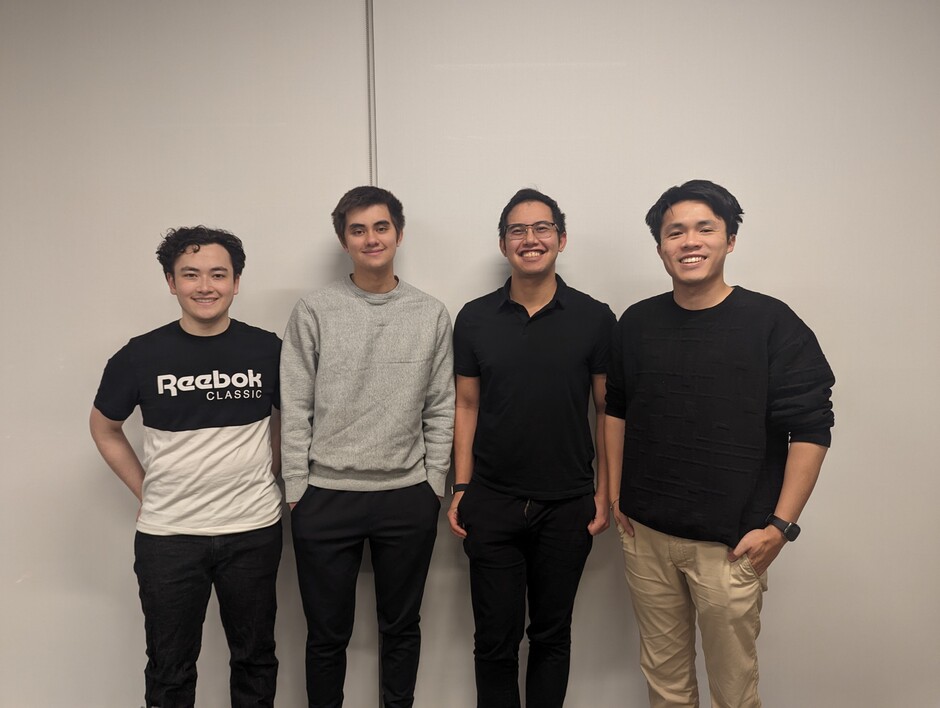
The company's Y Combinator launch in 2024 framed the opportunity in simple economics: businesses miss calls, missed calls lose revenue, and conventional call centers are expensive. OpenCall offered custom AI receptionists that could answer questions, book appointments, and connect with existing software. Setup, it said, could take less than an hour without code or flowcharts. The founding photograph was equally plain: Nicholas Lee, Oliver Silverstein, Arthur Silverstein, and Eric Mei standing shoulder to shoulder against a blank wall.
The product language has since moved from receptionist to administration. That shift matters. Answering a call is a channel feature; completing a multi-step workflow is an operating responsibility. OpenCall's current platform describes agents that gather information across voice, SMS, and web, carry context into a human escalation when needed, and close the loop by syncing the result back into the customer's software.
The completion loop
This is the stealable lesson in Silverstein's story: move the scoreboard to the end of the task. A model can produce a fluent sentence while failing the customer. It can sound warm while losing a date, skipping a rule, or neglecting to write the result anywhere. Completed work is less cinematic and far easier to audit.
Conversation is a program
Silverstein's January 2026 essay supplies the technical version of the idea. Most voice agents, he argues, falter when a customer interrupts because the industry treats conversation like a state machine. His alternative is to treat conversations as programs, with work that can begin speculatively, adapt to new information, and continue without dumping the context that came before.
The phrase sounds abstract until you picture the ordinary failure. A caller has already said Tuesday, but the agent asks for the day. A person changes topics, and the system restarts its checklist. The software heard the words but failed to preserve their place in the larger job. The technical architecture becomes manners in real time.
His other essays keep returning to the same border between intelligence and operations. One argues that enterprise AI projects should be managed by business service levels rather than model benchmarks. Another describes sending work into the systems a company already uses, without reducing every process to a menu of supported flows. The recurring objection is not that models cannot talk. It is that talking is an incomplete unit of value.
There is a playful side to the rigor. When OpenCall's autonomous contact centers began handling thousands of daily calls, Silverstein marked the milestone by asking what else AI could make. He used Claude for a script and shot planning, Midjourney for visual concepts, and Runway to animate them. The experiment led him back to a human claim: originality of thought may matter more as production becomes commoditized.
That position keeps the company from becoming a simple imitation game. The aim is not a voice that passes for a person at any cost. It is a system that absorbs repetitive operational work while preserving human judgment for novelty, sensitivity, and exceptions. Even the most autonomous workflow needs a theory of when to hand over the controls.
A narrow interface, a broad ambition
OpenCall is still a small company. Y Combinator currently lists seven team members. Its public profile is therefore less the record of a finished institution than a snapshot of a technical thesis under commercial pressure. The useful tension sits between Silverstein's early wish for AI capable of generalized, long-horizon tasks and the fussy reality of one phone call that must update one correct field.
That fussiness may be the advantage. Grand theories are generous to their authors. Operations are not. A live caller finds the forgotten state, the brittle rule, and the integration that worked only in the happy path. Every interruption is a tiny audit. Every completed action is a piece of evidence.
Silverstein's career has moved steadily closer to that evidence: from parts and instruments, to research data and chip-design tooling, to a voice on the line with somewhere to be. The phone is old technology, almost comically so. Yet it contains exactly the disorder a general-purpose agent must learn to survive.
The founding team also makes the ambition less solitary than that first one-developer post. Arthur Silverstein arrived with experience at Verily, Argo AI, and Meta. Eric Mei had worked on job-posting quality and communications at LinkedIn. Nicholas Lee joined them in the public launch lineup. Y Combinator paired the company with group partner Diana Hu for Winter 2024. The company story is Oliver's, but the work has always had several sets of hands on the receiver.
Silverstein's public writing now functions as a running engineering notebook for the category. He moves between latency, deployment economics, workflow design, and the odd social contract created when software answers a person. The posts are rarely about a single model in isolation. They keep asking what the surrounding system permits the model to do, what it remembers, and how a business can tell whether it worked.
That is also where his broad aspiration remains visible. The 2022 plan called for AI that could tackle generalized tasks across long time horizons. OpenCall narrows the interface but keeps the demanding parts: memory, planning, tools, changing context, and an observable finish. A call lasts minutes. The architecture beneath it is rehearsing for much longer work.
The wager behind OpenCall is that useful intelligence will be judged after the conversation ends. Did the software retain what mattered? Did it follow the rules? Did it touch the right systems? Did the person get what they called for? A charming hello is welcome. The finished job is the point.