There is a revealing detail on Ajel’s website. Among the promises about artificial intelligence, cloud computing and digital transformation sits a rather older problem: what to do with software that still works. An application may be unfashionable, difficult to maintain and essential to Monday morning. Replacing it means disturbing everything attached to it. Keeping it means accepting its limitations. Ajel sells help with that decision, and with the difficult work that follows.
- Build, connect and maintain business software.
- Move legacy applications without forgetting their dependencies.
- Manage consulting operations through Ajil-DEM.
- Read the financial disclosures alongside the service pitch.
That makes the company worth examining for a reason more practical than novelty. Its catalogue describes the complications that appear after a business has already bought technology. There are databases to convert, interfaces to preserve, reports to reconcile and people who need the new arrangement to behave sensibly. The buyer is purchasing an outcome assembled from many pieces.
The trouble with a clean slate
Ajel’s migration service begins with assessment: identify the inventory, rationalize applications, define a strategy and draw a roadmap. Its published options include porting an application, upgrading its environment, re-engineering functionality and cleaning data. These are different interventions. A business may need a new database without needing every application rewritten. A better interface may be useful while established business rules remain valuable.
The point is easy to miss in a software demonstration. A demonstration presents a bounded world. An operating company has accumulated exceptions. Ajel’s approach recognizes the existing environment as something to investigate before drawing the replacement. The useful lesson for a buyer is to ask for the inventory and dependency map before getting attached to a proposed destination.
applications→Assess
Connect
Test→Changed
operations
Testing belongs in the same conversation. Ajel names Selenium, Appium and JMeter among its frameworks, and advertises functional, performance, security, compliance and mobile testing. It offers to work independently or alongside an internal team. That gives a customer another option beyond handing over an entire development programme: bring in help at the point where confidence in the software needs to be earned.
A consulting firm builds for consulting firms
The most specific product in this broad catalogue is Ajil-DEM, or DEM Suite 2.0. It targets the administration of consulting businesses. Its modules cover customer relationships, consultant resources, projects, human resources, accounting and invoicing. Ajel describes a workflow stretching from consultant sourcing to payroll. The audience is growing and midsize organizations with financial and operational work to coordinate.
Consider the logic of that sequence. Recruiting someone creates a record. Assigning that person creates project information. Their work produces timesheets, invoices and payroll obligations. These activities are closely related even when separate departments handle them. A suite organized around the sequence is an attempt to carry information through the business without repeatedly starting the administrative process again.
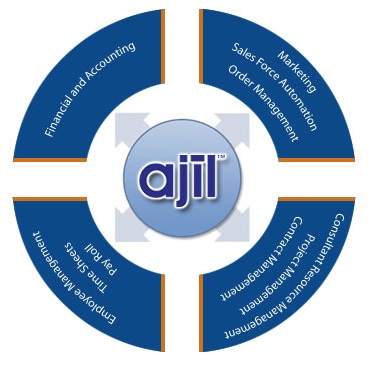
Ajel also implements third-party enterprise software, including Microsoft Dynamics, SAP, Oracle and Infor. That places it between a software vendor and the organization using the software. The work is selection, customization, integration and support. Its proprietary suite sits beside that services offer; the two should be evaluated on their own merits.
The fourth verb matters
Ajel describes delivery with four words: Discover, Design, Deploy and Drive. Discovery examines the business and its technology. Design turns that understanding into an approach. Deployment implements it. Drive covers what happens afterward, including training, help-desk services and application and infrastructure support. In this model, going live begins an operating responsibility.
“We will be the single point of accountability for your software, hardware and implementation services.”
Ajel · Our Business Approach
The business model follows the work: consulting and implementation engagements, custom development, professional staffing and outsourced operations, with product enquiries directed to a quotation. Delivery can blend onsite, offsite and offshore resources. For a customer comparing alternatives, the consequential questions concern scope, responsibility and ongoing support. A low initial estimate says little about who will resolve an interface problem six months later.
Customers need the handoffs to work
Ajel addresses healthcare, manufacturing, logistics, retail, education, financial services, media and government. Its homepage carries a Berlin Industries testimonial about allocating and deploying IT resources. The company history records consulting agreements with Dell and Diebold in 2012. Those dated agreements offer evidence of past work, rather than a count of present customers.
Its market position is that of an integrator and services provider. Customers can alternatively choose a larger offshore consultancy, a specialist implementer or their own IT department. Ajel’s pitch combines application work, enterprise packages and operations under one relationship. The appeal depends on whether the buyer actually needs that breadth. A simple, standalone requirement may be better served by a narrower engagement.
The offshore calculation has a second side
Ajel’s public reporting supplies a less comfortable perspective. Management describes weaker U.S. public-sector spending, reduced activity at large clients and disappointing acquisition of smaller customers. It discusses expanding offshore work and exploring India and Middle East opportunities. Lower delivery costs may improve an engagement’s economics; they do not create a customer’s budget.
Auditors issued a disclaimer of opinion. Reported figures need that context.
The FY2026 annual report reports a smaller consolidated loss than the previous year. Its auditors nevertheless declined to express an opinion, citing insufficient appropriate audit evidence. They also record a Bank of Maharashtra loan account classified as non-performing in October 2024. These disclosures belong in a buyer’s assessment of continuity and delivery risk.
The practical idea worth borrowing remains the order of operations. Understand the systems, define the change, test the connections and assign responsibility for what follows. Ajel’s offer makes that work explicit. For anyone planning a migration, the useful first move is to write down what the business must still be able to do on Monday morning.