A cardboard box is an unpromising place to look for the future. It has no screen, no conversational interface, and very little interest in your funding announcement. It needs to get out of the truck. AJ Meyer has built a company around taking that instruction seriously.
In 2018, Meyer visited a UPS warehouse during a winter night shift. Fifteen people were unloading trucks. None had been there longer than 90 days. When the visitors asked why, the workers laughed and asked whether they had ever tried the job. The encounter gave an engineering question a customer, a location, and a reason to matter.
Meyer, the co-founder and CEO of Pickle Robot Company, had gone looking for a useful application for robotics. The warehouse supplied a fairly blunt answer. A job that looks simple from the outside can consume years of engineering once a machine has to do it. The box, it turns out, has been keeping secrets.
That is the useful tension in Meyer’s career: an interest in what robots might eventually become, coupled with an increasingly exacting account of what a customer needs today. His story runs through a consulting business, shared workshop space, a change of product, and a change in his own understanding of a promise.
First, find room for the engineers
Meyer arrived at MIT in 2005 with an interest in AI and robotics. He graduated in 2009, having studied electrical engineering and computer science. That same year, he and colleagues started LeafLabs. The work put software and hardware in the same conversation, a practical education for anyone hoping eventually to make a machine act on the world.
The consultancy still describes its work in concrete engineering terms: firmware, digital circuits, signal processing, FPGA development, and systems architecture. These are the parts of a product that rarely get a close-up in its launch film. They are also the parts that determine whether the attractive object on the screen does anything when it arrives.
Meyer’s next venture began with an ordinary accommodation problem. LeafLabs needed somewhere to work after its founders graduated. Industry Lab, founded in Cambridge in 2011, grew into a coworking community that mixed technology businesses with artists. Its tenants included filmmakers and musicians; its shared resources included a machine shop and recording space. Formlabs began there, too.
The connection is revealing without requiring a mythology about genius in a garage. Before Meyer could sell robots, he helped make a place where people could build things. Desks, tools, and neighbors belong in the history of invention alongside algorithms. The glamorous part of entrepreneurship occasionally begins with arranging somewhere to put the glamorous part.
The warm-up that had to end
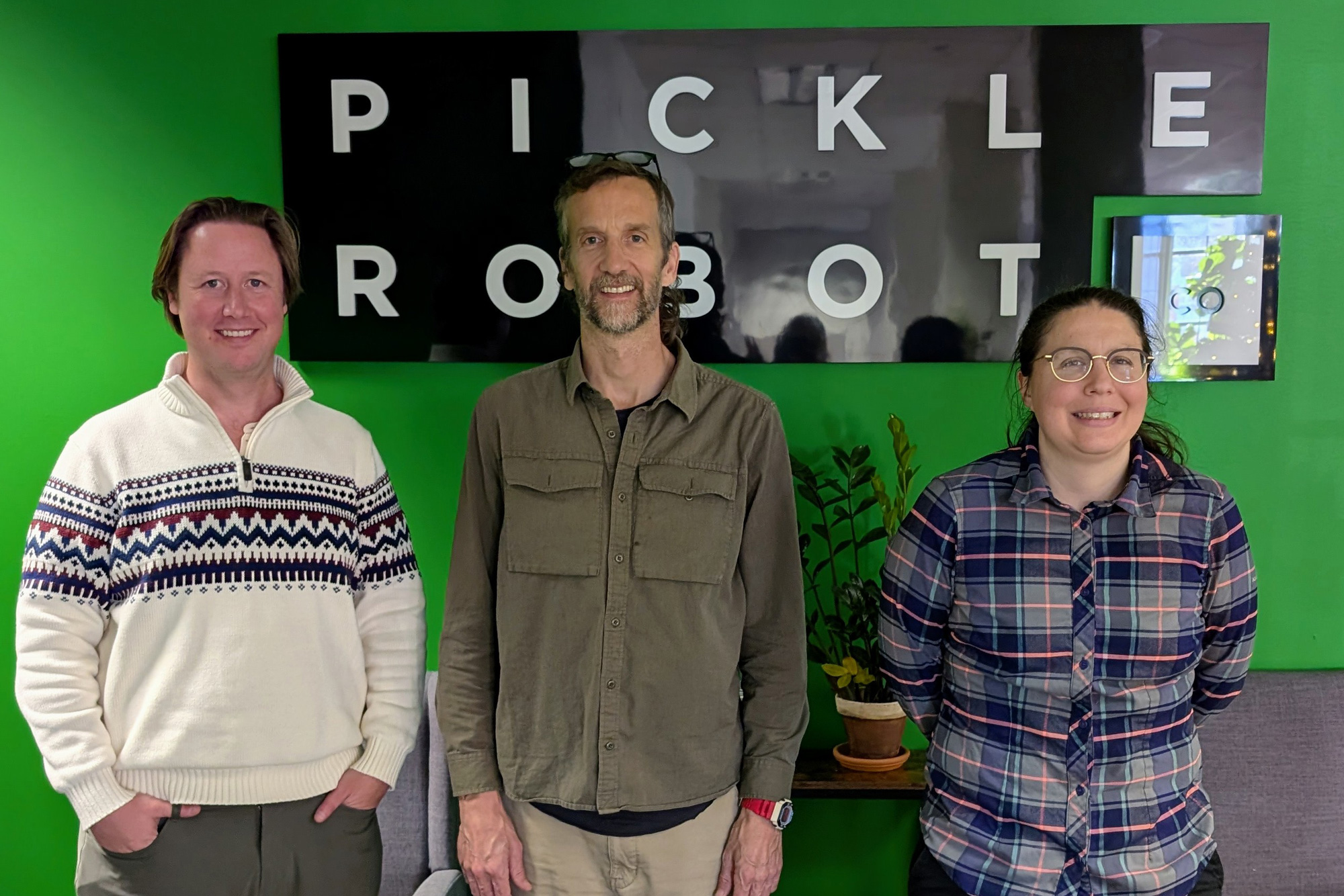
Pickle emerged from the LeafLabs circle. Meyer’s fellow founders were Ariana Eisenstein and Dan Paluska, both MIT alumni. Eisenstein became chief technology officer; Paluska brought robotics experience. Their shared history gave the venture a working relationship before it had a working unloading product. Toyota’s investment account dates the founding to 2018; Meyer dates incorporation to 2019.
The early team first built box-sorting robots, a more approachable exercise than emptying a trailer. The machines worked, but the business struggled. With funds running low, the founders turned toward unloading. “Why spend our last dollar on a warm-up task?” Meyer recalled. A short proof-of-concept video brought hundreds of potential customers to their door.
There is a particular discomfort in that decision. Preparatory work feels responsible. It lets a team solve a manageable problem while the larger one waits politely in the future. But a company also has a clock. An intermediate achievement may prove technical competence without giving customers enough reason to buy.
Meyer’s turn toward the harder task makes the earlier warehouse visit more consequential. He had already seen demand in the form of a job people did not stay in. The difficulty was committing the company to meeting it. A twenty-second demonstration could invite a conversation; a customer operation would require a much longer answer.
- MIT graduation and the start of LeafLabs
- Industry Lab opens in Cambridge
- Pickle founded; the team investigates warehouse work
- Pickle incorporates, in Meyer’s account
A robot with no need for a dinner jacket
Pickle’s machines are conspicuously green. The company name nods to Apple Computer Company, and its autonomy engine is called Dill. Someone has clearly allowed the naming department to enjoy itself. The product’s job remains quite sober: handle freight inside the confined space of a trailer and deliver it to a conveyor.
Meyer’s business starts with the work rather than a prescribed silhouette. A robot doing a dedicated job need not carry every feature useful to a person. Wheels, an arm, and suction can be an appropriate arrangement. The interesting question is whether that arrangement performs the assigned task at an acceptable cost.
Pickle’s autonomy system coordinates sensing, movement, grasping, and placement. Its vision system reassesses the scene as packages move. A trailer offers changing surfaces and changing choices; removing one box changes what the machine can reach next. Even a repetitive assignment contains a procession of fresh decisions.
The current Dill architecture combines classical control with generative AI. A guidance layer plans motion, a skills layer handles variability, and an independent guardrails layer constrains commands. Human corrections also supply training examples. The structure makes room for learning while keeping the machine’s actions tied to the practical demands of the task.
This is a useful way to read Meyer’s engineering background. The product asks several disciplines to cooperate. Software has to account for hardware; learning has to operate within constraints; a promising movement has to become a repeatable action. Cardboard is an unusually effective examiner. It does not award partial credit for an elegant explanation.
Dill / a simplified architecture
The second machine was the company
By July 2025, Meyer was discussing another redesign: how Pickle itself worked. In his conversation with Natalie Nathanson, he described moving away from an Agile approach toward commitments extending 18 months or two years. The transition took a year. A team accustomed to replanning after short sprints had to develop a different habit.
The change matters because a customer buying physical equipment organizes other decisions around its arrival. A plan has consequences beyond the engineering team. Procurement, installation, training, and the rest of an operation need to fit together. Moving a date can move somebody else’s work as well.
His leadership discussion also placed recruiting, sales, marketing, and customer feedback inside the CEO’s responsibilities. For an engineer, this broadens the definition of the thing being built. The robot has to work, and the organization has to find buyers, recruit colleagues, deliver equipment, and support it after the demonstration ends.
In November 2024, Pickle announced a $50 million Series B. Six customers had ordered more than 30 production robots during the preceding quarter. Investors included Toyota Ventures, Teradyne Robotics Ventures, and Ranpak. The announcement connected the funding to product development and expansion of the commercial team.
A financing round can buy time and capacity. It cannot empty a trailer on its own. Read alongside Meyer’s account of changing the company’s planning habits, those orders put substance behind the management lesson. A promise to deliver machinery gives the calendar an authority that an internal research target may never possess.
NOVEMBER 2024
BY SIX CUSTOMERS IN Q3 2024
A shift is longer than a demonstration
Pickle’s customer page names operators with recognizably unromantic requirements. Randa had been looking for a workable container-unloading solution for more than five years. Ryobi’s distribution executive described two installed robots and four more on order. These are snapshots of customer experience, rather than guarantees about every deployment. They show what the sales conversation is about.
The company’s dashboards track picks per hour, unload times, and package mix. Those measures put the machine inside the vocabulary of a warehouse. An operator needs to know whether freight is flowing, where it slows, and what sort of load is being handled. The dashboard is a bridge between engineering performance and an operational decision.
Meyer’s July 2026 podcast discussion offered a telling account of human help. An intervention can become a demonstration from which the robot learns. This gives a supervisor’s correction a second use beyond getting the immediate job moving again. The person helping the machine is also supplying an example for its future behavior.
In his public reflection on 2025, Meyer emphasized speed and the need for robots to pay for themselves quickly enough for customers to afford them. That is a useful discipline for ambitious technology. A machine can be fascinating while its economics remain awkward. The buyer has to make room for both the equipment and the bill.
There is something pleasingly unsentimental about this standard. A robot may invite wonder, but its working day is judged in the language of time, packages, and money. Meyer’s customer emphasis keeps returning the discussion to that daily arithmetic. The future has to get through receiving before it reaches the boardroom.
The next box belongs to somebody else
On June 30, 2026, Pickle and Ambi Robotics announced an integration connecting unloading to pallet stacking. Pickle’s equipment feeds packages along a conveyor into AmbiStack, which identifies, scans, and stacks them. The companies described a workflow using existing warehouse infrastructure. The significance is in the handoff: one machine’s completed task becomes another machine’s starting point.
“Customers want automation that improves real-world throughput while fitting into existing operations,” Meyer said. It is a modest-sounding sentence with a demanding premise. A warehouse already contains equipment, procedures, and people. A new product has to participate in that arrangement, and its value depends partly on how well its neighbors can use the result.
That ambition extends to the software. In August 2026, Meyer discussed plans to offer the Dill Autonomy Engine as a platform for partners during 2026 and 2027. Pickle’s product page describes licensing as forthcoming. The distinction matters: an announced direction gives a view of the company’s intentions, while a deployed product supplies evidence of execution.
For Meyer, the next chapter therefore reaches beyond the green arm. It concerns how lessons from one physical job might help with several others, and how equipment from different builders might cooperate. The company has to preserve the specificity that made unloading a business while expanding what its software can support.
The career began with an interest in robots and passed through the practical business of making room for engineers. It now rests on an equally practical exchange at the end of a conveyor. Meyer’s ambitions are large; the unit of progress remains wonderfully plain. Pick up a box. Put it where the next job can begin.
“Customers want automation that improves real-world throughput while fitting into existing operations.”AJ Meyer · June 2026
Keep the conversation moving
- Pickle Robot Company ↗
- AJ Meyer on LinkedIn ↗
- LeafLabs: embedded systems engineering ↗
- The Cambridge beginnings of Industry Lab ↗
- Watch: Meyer on leadership and long-term commitments ↗
- Watch: the Topline conversation about robotics adoption ↗
- Listen: The Robot Industry Podcast, July 2026 ↗
- Read: Pickle and Ambi Robotics connect unloading to pallet stacking ↗
- Read: Dill Autonomy Engine platform plans ↗
- Read: robots and the warehouse door ↗