Imagine a speaker trying to keep a private conversation aimed at your ears while you turn your head. The problem is geometry with a deadline. Locate the listener too late and the sound goes where the ears used to be. A sharper picture might seem helpful. But a sharper picture also gives the processor more work before it can answer the only question that matters: where are the ears now?
- Compute with sensor charge before doing unnecessary conversion.
- Trade image detail for timing when the task permits it.
- Sell both the sensing chip and designs other chipmakers can license.
Two ears are a moving target
That is the task behind AIStorm’s collaboration with Audioscenic, whose spatial-audio technology steers sound toward a listener. AIStorm describes a familiar frustration: tracking points lagging behind a moving gamer, pulling the listener out of the intended audio field. Its answer uses Cheetah, an imager built around a small pixel array and a charge-domain neural input layer.
The interesting choice is the small image. A 120×80 array has 9,600 pixels; VGA has 307,200. For a task that needs locations rather than a handsome portrait, collecting more detail can create work that the model later discards. AIStorm’s approach tries to make the information available sooner, giving downstream processing more of the frame interval to finish.
The expensive journey from light to numbers
AIStorm makes semiconductor products and licensed circuit designs. Its defining method, charge-domain processing, operates on electrical charge. Light striking a sensor produces charge; AIStorm uses that starting point for computation instead of insisting that every signal first travel through the usual conversion and transfer chain.
In Cheetah HS, the first neural-network layer sits beside the pixels. The chip can send a pulse stream onward to subsequent layers. That distinction matters: the sensor begins the work, but the application may still need downstream computing. Nor does charge-domain processing forbid digital output. Cheetah’s published documentation also describes a raw-pixel output mode. Architecture is more complicated than a slogan.
- 01 Light becomes charge
- 02 First AI layer at the pixels
- 03 Pulse output to further processing
Conceptual path in the AI mode. Raw imaging is another option.
The alternative is a sensor that digitizes its measurements and feeds a separate digital processor. CPUs, GPUs, NPUs and FPGAs can serve that role. AIStorm also distinguishes its implementation from processing-in-memory. Its proposed savings come from changing the route through the system: less conversion overhead, less movement and, for suitable tasks, less hardware waiting around.
Read the small frame
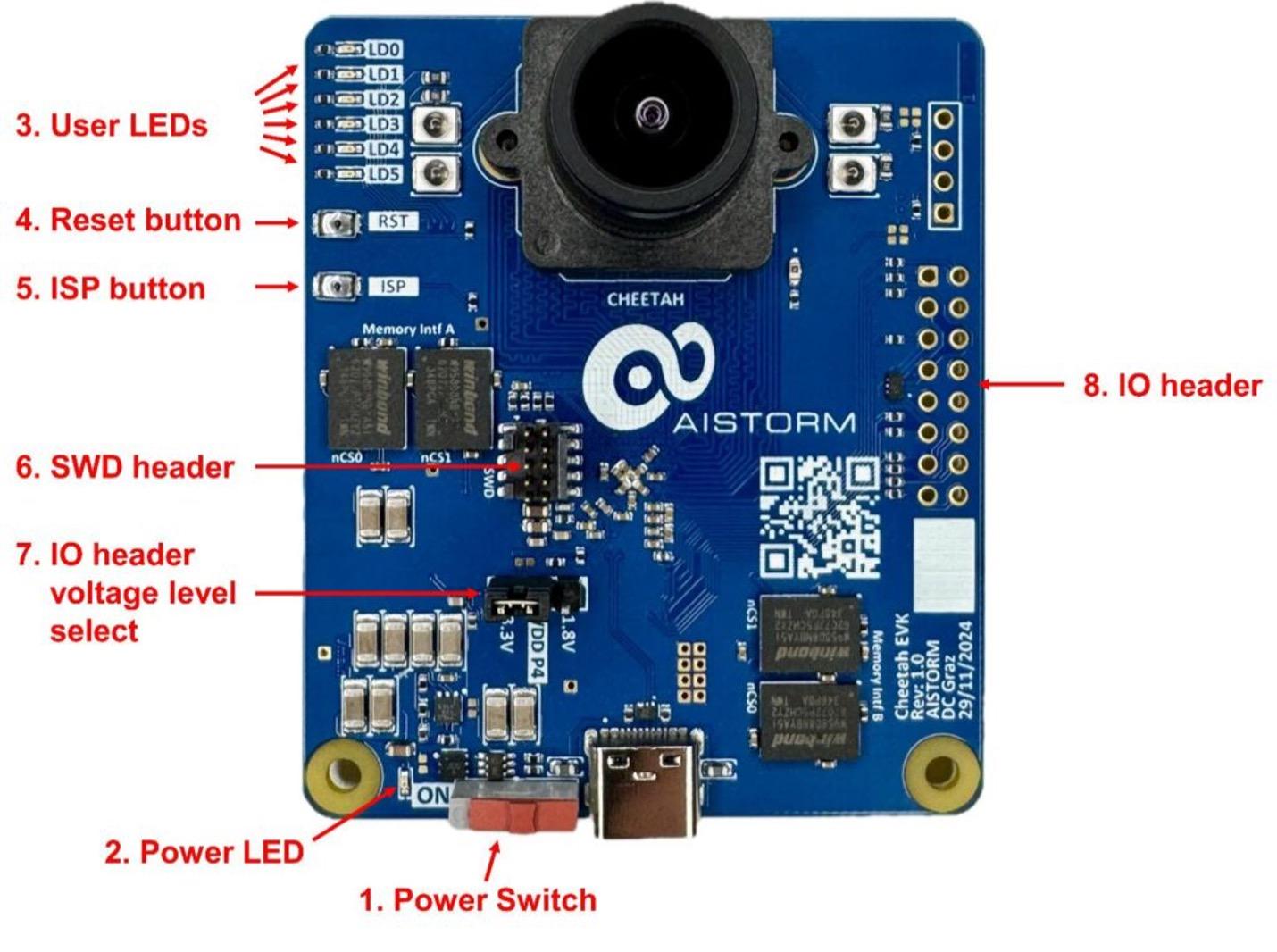
In August 2025, AIStorm and Tower Semiconductor announced Cheetah HS availability as a chip and reference-camera system. Tower supplies the charge-domain imaging platform. Inspection, robotics, vibration monitoring and golf-swing analysis are among the applications named in the announcement. Each needs to catch something that refuses to sit still.
The headline specification is up to 260,000 frames per second. Read the capture-window conditions, though: 120×80 pixels reaches up to 40,000 fps; 40×30 reaches 260,000. Speed and detail share a budget. A golf-ball measurement may tolerate that bargain. A task requiring fine visual evidence needs a different calculation.
The microphone has a standby bill
Audio supplies another version of the same problem. A device waiting for a spoken command must listen without spending its entire battery on anticipation. AIStorm’s Sparrow microphone includes smart activity detection, with a published typical current of 19 microamps. Mantis addresses continuous imaging; Chameleon addresses biometric and vibration inputs; Monarch handles spectral conversion.
With DB HiTek, AIStorm introduced SpectroMic KWS in June 2025. The launch specified 18 microamps of always-on current and a price below $3 at 1,000-unit quantities. That is microphone-package pricing. Keyword spotting also uses compatible microcontrollers and model libraries; a finished product carries additional costs.
The SpectroMic design packages a microphone, smart voice activity detector and spectral engine together. Noise matters because false triggers wake the expensive circuitry. The engine supplies compact spectral information over SPI, helping offload signal processing. Here, efficiency is partly the art of deciding when another circuit deserves to wake up.
A head count without a portrait
In December 2025, AIStorm introduced a Cheetah-based people counter for settings including retail, buildings and transportation. Its described output is presence or count metadata, without transmitting images. The system combines the AISC11C imager with detection models and tools for adapting deployment to the environment.
For an operator interested in occupancy, a count can be the useful product. Keeping image data on the device also changes the privacy discussion. This is a specific output policy for this solution; it should not be mistaken for a property of every camera carrying the company’s silicon.
The investor at the workbench
AIStorm announced a $13.2 million Series A in 2019 and a $16 million Series B in December 2020: $29.2 million together. The later investors included AsusTek, Egis, Knowles, Meyer Corporation and Senvest. Computing equipment, biometrics and microphones place several backers close to the markets the chips must satisfy.
CEO and co-founder David Schie brings a semiconductor background. The company describes a team experienced in developing and manufacturing integrated circuits. Its published workplace principles offer a revealing instruction: “Question everything and everybody.” Employees are encouraged to challenge supervisors with facts. It is a fitting ambition for engineers proposing a different signal chain.
“Question everything and everybody.”AIStorm’s published workplace principles
Sell the chip, or sell the idea inside it
AIStorm’s business extends to IP licensing, custom development and supporting models and software. Its digital-compute pitch includes replacing selected circuit blocks while retaining existing design flows. That makes established chipmakers potential buyers as well as providers of alternative technology.
For a prospective customer, the available evaluation boards and application tools make the architecture testable. An engineer can ask whether a model retains the necessary accuracy with a smaller input, how much illumination the installation requires, and whether savings at the sensor survive the demands of the rest of the device. A component specification is the beginning of that investigation.
The practical lesson is to specify the answer before buying the machinery. Prototype the smallest useful input, measure response time and accuracy in the actual environment, then price the complete system. AIStorm’s architecture makes that exercise interesting. The decisive question remains delightfully unglamorous: how much homework does this sensor really need?