The lightbar on a police car has a wonderfully uncomplicated job. It flashes. People notice. The car gets through. Ekin Smart City looked at that strip of roof space and found room for several other occupations: reading license plates, measuring speed, watching the surroundings and checking parking. The object still flashes. It has simply acquired an ambitious second career.
- Ekin combines enforcement hardware with its own central management software.
- Its signature products put multiple sensors in patrol lightbars and modular street poles.
- Coral Gables and Sarajevo Canton provide concrete deployment examples.
- A Florida pilot shows why installation and local conditions matter as much as the camera.
That is a useful place to begin with a company whose field, “smart cities,” can otherwise sound like a committee trying to name the future. Ekin makes physical equipment for real streets. Police departments, municipalities and private institutions use it to collect traffic and safety information. Its proposition is unusually tangible: move several jobs into one enclosure, then give the people responsible for them a common place to see the results.
The lightbar gets another job
Patrol G2 is the clearest expression of the idea. Ekin packages cameras, processing and communications into a working lightbar. Its current product page advertises seven-lane coverage, automatic license plate recognition, speed and parking enforcement, and 360-degree video. Those are vendor specifications; the useful purchasing question is how a particular configuration performs on an agency’s own roads.
Consider the plate reader. A camera captures a registration plate, software turns the image into searchable information, and a match against a list of wanted or stolen vehicles can trigger an alert. Parking integration adds another use: checking vehicles against municipal or third-party parking systems. An officer who would otherwise inspect each vehicle has a machine doing the repetitive comparison.

Ekin also describes approach alerts and automatic recording during traffic stops. The vehicle becomes both an enforcement instrument and a place from which officers can observe their immediate surroundings. In June 2025, the company published coverage of Patrol G2 in Sarajevo Canton Police interceptor vehicles, giving the product a setting more concrete than a trade-show stand.
The mobility matters. A fixed device observes the place where it was installed. A patrol-mounted device follows the route of the vehicle. Those roles complement each other: continuous observation at an intersection and changing coverage along a patrol route answer different questions. Ekin offers Bike Patrol for bicycles and motorcycles, plus X Spotter and Box Spotter for portable or fixed deployments. A narrow street can demand a smaller vehicle long before it demands a cleverer algorithm.
A designer’s habit of hiding the machinery
Founder and CEO Akif Ekin’s biography offers a small clue to the company’s fondness for an all-in-one object. Born in Turkey and raised in Germany, he studied aerospace engineering at the University of Stuttgart. While studying, he founded Akart, a lamp-design company. He later moved to Istanbul, distributed Sanyo products, and founded Ekin Electronics in 1998.

There is a family resemblance between designing a lamp and designing a smart pole. Both involve fitting useful machinery into an object that people must live beside. That is an interpretation of the product choices, rather than an origin myth supplied by the founder. But the evidence of a design interest is plain: Red Dot recognized Box Spotter in 2018, and its jury remarked on the device’s humanoid appearance. Even a traffic-enforcement box, apparently, is allowed a face.
The expertise spans software, electronics and industrial design. Ekin’s own history identifies the 2004 NATO Summit and the 2006 FIFA World Cup among early installations. It reports operations across five continents, more than 35 patents and over 40 awards. Those company-reported totals describe a long-running hardware business; they do not measure how much safer a particular street became.
The $18,000 pole meets the weather
In Coral Gables, Florida, the argument moved from the car roof to the sidewalk. The city wanted to consolidate equipment such as cameras, connectivity and traffic and environmental sensors. Ekin supplied technology; Pininfarina brought industrial design. The appeal was partly visual and partly practical. Every separate installation brings its own mounting, wiring and footprint. A modular pole offers those functions shared accommodation.
Cost of an early Coral Gables pole, reported by a city official in December 2021. Later configurations and installation work can differ.
The money needs careful handling. A 2020 city resolution set out a combined ceiling of $150,000 for design standards and proof-of-concept work with Pininfarina and Ekin. That was a project scope, not the sticker price of a pole. In December 2021, Miami Today reported that the early pilot pole cost the city around $18,000, according to Chief Innovation Officer Raimundo Rodulfo.
Rodulfo also described feedback from the pilot feeding the next generation. After officials saw the original prototype, the design was changed to withstand hurricane winds. No collapsed pole is required for this lesson. A design can need revision before anything physically breaks. Florida supplied a requirement that a showroom could politely overlook.
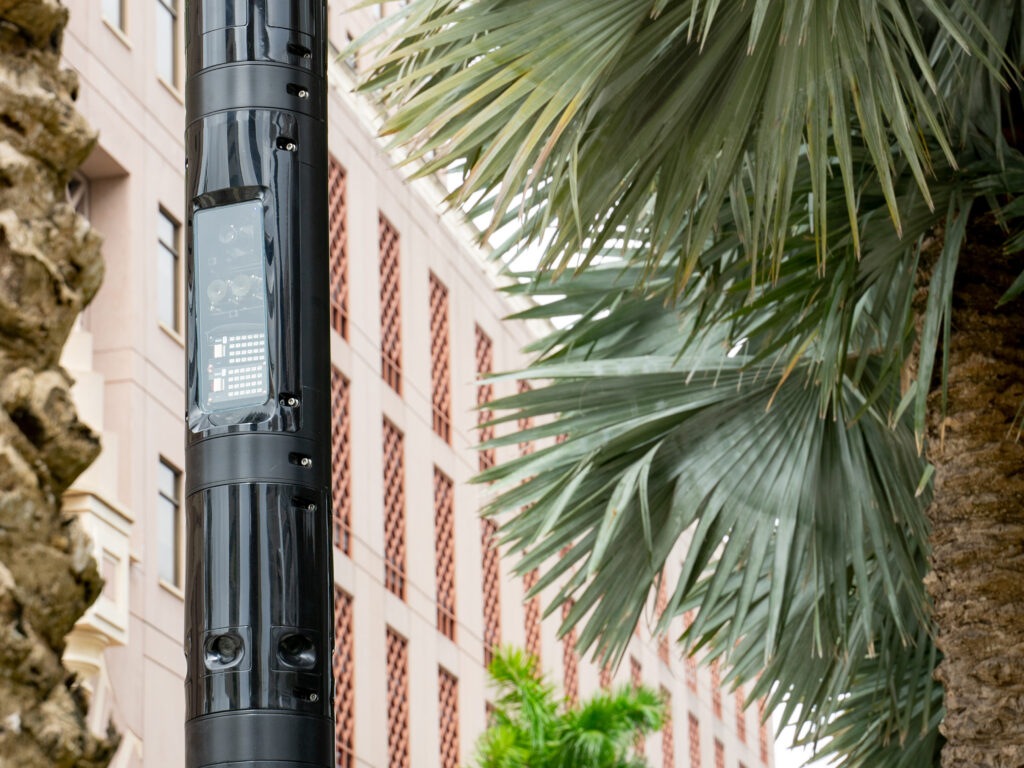
By September 2025, Ekin reported three new Spotter-powered poles in Coral Gables, including one at Alhambra and Douglas roads. The installations combined capabilities such as video, traffic analytics and environmental monitoring, with connectivity to the city’s Community Intelligence Center. The story is therefore about a pilot followed by further deployment, with the physical design adapted along the way.
For another municipality, the part to copy is the sequence: choose an actual location, test the enclosure against local conditions, learn from the pilot, then specify the next installation. Buying every possible sensor at once would skip the most instructive step.
The screen behind the street
The coordinating product is Maestro OS. Ekin describes a central management platform for live and stored video, detection alerts, traffic information and environmental readings. It says the software was developed with law enforcement and municipalities and communicates over standard networks and protocols. The point of a connected family of devices is that observations can reach a shared operational screen.
Portable devices
Video · data · alerts
Operational decisions
Conceptual workflow, not a claim of measured response-time improvement.
That places Ekin across several established markets. Genetec’s AutoVu already offers fixed and mobile plate recognition within a wider security platform. VITRONIC supplies traffic-enforcement equipment and adjudication software. Ekin’s distinction is the combination of functions in a lightbar or modular pole, joined through its own software. A buyer should compare the complete configuration and workflow, rather than assume that combining features makes each one superior.
The business follows that configuration: public agencies and private organizations acquire equipment, software and deployment support through direct operations and partners. This is a business-to-government and business-to-business proposition. The unit of value is an operational installation, rather than a consumer app download.
A city has to buy the whole chain: the view of the street, the connection to the screen, and the procedure after the alert.THE PROCUREMENT QUESTION
The next investment is close to the customer
In December 2025, Ekin announced a $25 million investment in U.S. expansion for 2026, with plans for more than 100 U.S. hires and a transition of assembly and manufacturing into the country. It described expanding its Miami and Atlanta presence and plans for Southern California and New York. These were announced commitments, rather than a report that every facility had opened.
“We’re listening to the market, aligning our solutions to U.S. operational needs,” Akif Ekin said in the announcement. The choice of words matters. A city buys ongoing support as well as cameras. Local engineering, installation knowledge and someone who understands the customer’s working day belong in the product’s economics. The company also reported more than $100 million in annual revenue in that release.

For a prospective buyer, Ekin offers a practical opening: an on-site Patrol G2 demonstration using an agency vehicle, which it says can be fitted in three to four hours. Treat that as a chance to test familiar routes and the handling of alerts. A demonstration should expose the handoffs between people and equipment, as well as produce an attractive image.
The choice depends on the task. A permanent intersection needs continuous coverage; a changing enforcement location may favor mobility. Shared hardware must still suit the site and connect to the systems people use. An alert requires a review procedure, and data collection requires rules about access and retention. Those are decisions the city brings to the purchase. Ekin’s most useful idea is easy to understand: let familiar objects do additional work. The demanding part is making all that work fit the place.
Take a closer look
PRODUCTS, FIELD STORIES & FILM