A chair should be a fairly simple purchase. At Inland Empire Health Plan, getting an ergonomic assessment and the equipment it recommended could take four weeks. A request went to HR. An assessment produced a report. Purchasing needed to join the conversation. Paper and email traveled between people who each held a small piece of the answer.
IEHP redesigned that process with Adobe Workfront custom forms and centralized communication. Its published customer story reports a reduction to 24 hours. The interesting part is how ordinary the problem was. Nobody needed to invent a better chair. They needed to stop the request from spending its life in transit.
- The business: enterprise software for requests, projects, staffing, approvals, and reporting.
- The sweet spot: marketing and creative teams with many contributors and repeatable production workflows.
- The Adobe fit: organizing the work around the tools used to create and manage content.
- The useful lesson: a complete brief and a named approver can be worth more than another status meeting.
01 / THE HANDOFFThe job around the job
Workfront lives in that territory between intention and delivery. Someone requests a campaign. Someone else decides whether it deserves resources. A team produces the assets. Reviewers ask for changes. Managers want to know what happened to the budget. Every stage creates information the next person needs.
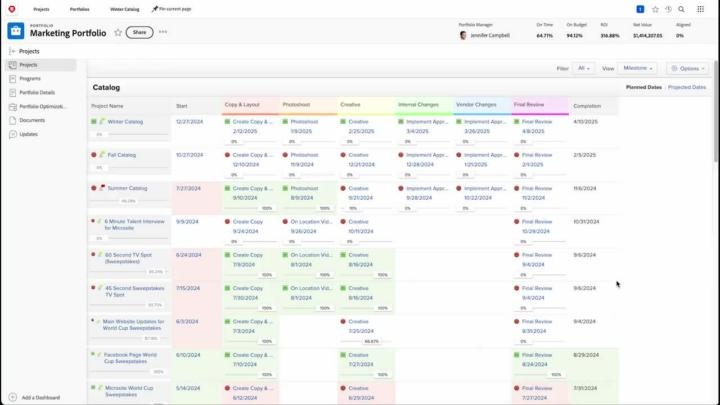
The platform puts these activities in a shared system. Request queues and custom forms collect incoming work. Project plans turn it into tasks. Resource tools show capacity and assignments. Reviews gather feedback against the content. Reports expose progress and demand. Its expertise is the machinery of coordination: giving a complicated organization a common account of what is happening.
The promise becomes practical when a traffic manager can distinguish “ready to start” from “waiting for a brief,” or see that the designer with the right skills is already booked. A calendar full of deadlines says little about whether anybody has time to meet them.
Capture the brief, deliverable, and deadline.
Match the assignment with available capacity.
Keep feedback and approval with the content.
Report progress, demand, and resource use.
02 / THE COMPANYA name that outgrew the task
The company began in 2001 as AtTask, founded by Scott Johnson with Abe Knell, Jason Fletcher, and Nate Bowler. Johnson later described financing the early business with a second mortgage and maxed-out credit cards. Enterprise order had a decidedly disorderly household budget behind it.

By January 2015, the company wanted a name broad enough for the work it managed. AtTask became Workfront. The announcement described more than 1,000 clients and over 135 paying more than $100,000 in annual recurring revenue. “Simply stated, we have outgrown the AtTask name,” said then-CEO Eric Morgan. A task sounds small. Coordinating a corporation is a different proposition.
The financial milestones require careful labels. A $33 million Series E followed in August 2015. In March 2019, investors bought roughly $280 million of shares from existing holders through a secondary transaction. That money changed shareholders; it should not be casually counted as fresh cash for operations.
Adobe completed its approximately $1.5 billion cash acquisition on December 7, 2020. It reported more than 3,000 Workfront customers and one million users at the time. Those are historical figures, but the strategic fit was already tangible: the companies had more than 1,000 joint customers before the purchase.
03 / THE FACTORY FLOORMarketing has a production line
Consider FOCUS Brands. Its creative teams handled nearly 500 concurrent marketing jobs in the published case study. The old approval process involved printed artwork, routing forms, and visits to a traffic manager’s desk. Remote approvers received email. Requested changes sent the process around again. A good idea could become a very well-traveled piece of paper.
The company rolled Workfront out in phases and created about 20 custom forms for common deliverables, while retaining separate request queues for brands. Digital proofs kept comments with the artwork. Reports replaced the hunt for jobs whose names had been misspelled or entered incorrectly. The customer reported that a national-promotion audit fell from eight hours to two.
Reported in Adobe’s customer case study. Bars compare audit time, not total campaign production time.
At commercial real estate company JLL, creative operations leader Joel Caracci described a similar passage from emails and spreadsheets to visible assignments. Traffic managers could compare schedules and match requests to designers’ skills and availability. The case study reported a 260% increase in deliverables over two years, reaching roughly 10,000 assets annually.
“Reporting is the biggest benefit of Workfront.”
Joel Caracci / Creative Operations, JLL
Reporting matters because creative labor is easy to admire and surprisingly hard to count. Caracci described producing more than 200 reports a year to explain his team’s contribution. These customer accounts give useful examples of what changed, rather than a forecast of what every buyer will achieve.
04 / THE BUYING DECISIONThe Adobe advantage comes with a quote
Workfront occupies the enterprise end of a crowded work management market. Buyers can also consider Asana, monday.com, Smartsheet, or Wrike; software teams may look at Jira. The sensible comparison starts with the journey a piece of work must take, the controls it needs, and the applications already in use.
Adobe gives Workfront a particular position. Integrations connect it with Creative Cloud, Experience Manager Assets, Frame.io, and GenStudio for Performance Marketing. The attraction for a marketing organization is continuity between planning a deliverable, making it, reviewing it, and managing the resulting asset.
Fusion, the low-code integration offering, connects applications and automates exchanges between them. It provides connectors for tools such as Google Workspace, Microsoft Office 365, and Slack, plus connectivity to services with public APIs. That opens more possibilities, though an available connector still needs a deliberately configured workflow.
Workfront is sold through customized quotes. Adobe lists Select, Prime, and Ultimate packages, with Planning and Fusion as add-ons. A useful budget also includes implementation, integration, training, and ongoing administration. In 2015, some clients already spent six figures annually; that historical fact illustrates enterprise purchasing, not today’s price list.
For a small team with a short approval chain, the operational effort may outweigh the benefit. For an organization managing many brands, resource pools, and review stages, that effort may buy something valuable: fewer private versions of what the project is supposed to be.
05 / THE NEXT ASSIGNMENTNow the queue has AI colleagues
Workfront Planning became generally available in August 2024. It connects campaign records, calendars, and planning information, with AI-assisted queries. Adobe named Deloitte, IPG, and NASCAR among organizations using it. The aim is to answer questions across campaigns without first conducting an expedition through everybody’s spreadsheets.
The September 2026 Workfront Wire announced live AI Collaborators. Teams can assign an agent to a task; Workfront supplies context and puts the finished output back into the workflow for review. Adobe described existing permissions, audit trails, and approvals continuing to apply, and said the feature was included with Select, Prime, and Ultimate at no additional cost.
This shifts part of the company’s proposition from organizing people’s work to organizing work shared with agents. The familiar operational question survives: who requested the output, what instructions traveled with it, and who is responsible for accepting it?
06 / TAKE IT TO WORKCopy the form before buying the software
The customer stories suggest a useful starting point. Choose one recurring request. Identify the missing information that sends it backward, the handoff where it waits, and the person who can approve it. Make those decisions explicit. Measure the time from a complete request to an accepted result.
IEHP’s change depended on better process as well as software. FOCUS Brands standardized common requests before enjoying simpler audits. The transferable lesson is that the intake form deserves managerial attention. People asked to work faster should at least receive the information needed to begin.
The bargain: shared visibility requires shared habits. If teams bypass the request queue, approvers stay in private email, or capacity data goes stale, the dashboard will describe a company that exists mainly on the screen. Treating that as an implementation problem is more useful than blaming the people who notice it.
Workfront’s business rests on an unglamorous observation: organizations can make talented people wait remarkably efficiently. The opportunity lies in making that waiting visible, then giving it an owner. Even the chair might arrive sooner.