Karri Saarinen had a problem with Jira. At Airbnb, where he worked as a principal designer, the project-management software felt slow, crowded, and oddly indifferent to the people who spent their days inside it. He did what a designer with an engineering streak might do: he wrote a Chrome extension that changed the colors, hierarchy, and styling of Airbnb's Jira screens. About 100 colleagues installed it. An issue tracker, it turned out, could be an object of affection - or at least something less like a tax form.
A few years later, Saarinen joined Jori Lallo and Tuomas Artman over drinks. All three were Finnish product builders working in Silicon Valley. All three had endured tools built as much for administrators as for the engineers and designers using them. They began meeting on Wednesdays, talking to colleagues at companies including Airbnb, Uber, and Coinbase, and asking a simple question: what makes your current tool so exhausting?
- Linear makes software for tracking issues, planning projects, capturing customer requests, and coordinating product teams and AI agents.
- Its original wager was that speed and good defaults could win daily users before management imposed a tool.
- Linear says more than 40,000 companies pay for it and annual recurring revenue passed $100 million in 2026.
- A 2026 employee tender valued the company at $2.5 billion; it was a liquidity event, not a new primary funding round.
A prototype with a very specific customer
The founders spent roughly a year testing their conviction before leaving their jobs in March 2019. They were not searching for every possible project-management buyer. Their target was the individual product builder at a fast-growing software company. Conversations kept returning to the same irritation: the software was slow. The people entering tickets felt that the tool answered to someone else.
When the trio finally built a working prototype, it took about a month. They put it in front of ten friends. One friend liked it enough to move his entire ten-person team onto it. That was stronger evidence than applause for a demo: someone had trusted the new tool with real work.



The private beta launched in April 2019. A blog post, a tweet, and a survey brought applicants to a waitlist. Saarinen later estimated that about 10,000 people signed up, yet he invited only around ten people a week at first. This was not exclusivity as theatre. It let the team watch serious users closely, revise the product each week, and avoid a public rush before it could retain the people it wanted to serve.
“We were the first ideal customer.”
Karri Saarinen, on the original prototypeThe early lesson came with a useful embarrassment. Linear's sign-in initially required Google authentication. Some suitable customers did not use Google Workspace and could not get in. The founders learned to distinguish features that made devoted users happier from blockers that kept the right users outside. The first category sharpened the product. The second kept it from becoming a private club.
The company before the company failed differently
Saarinen and Lallo had already built a startup together. Kippt, a bookmarking service, attracted 10,000 users in its early months and entered Y Combinator. It did not find an obvious route to revenue: advertising demanded a larger audience, while a scattered mix of teachers, engineers, and others offered no clear group willing to pay. Coinbase acquired Kippt in 2014, and Saarinen went on to work there as a designer. Popularity had proved easier to find than a business model.
Linear began with a much narrower customer and a routine those customers repeated every day. The founders designed defaults for creating and triaging issues, organizing work into cycles and projects, and moving through the interface quickly by keyboard. They limited how much could be configured. A highly flexible tool can fit almost any process; it can also preserve every bad one. Linear's wager was that better defaults would make the common work faster.
This is where Linear sits in the market. Jira remains the obvious comparison for issue tracking; Asana, ClickUp, Monday.com, and GitHub Projects overlap in different ways. Linear's distinction is its emphasis on the day-to-day experience of software product teams. The same narrowness has a price. An organization that needs unusually bespoke approvals, elaborate administrative schemes, or a general-purpose workspace for non-product departments may prefer a different system.
What the issue tracker grew into
The original ticket was only the beginning. A product team needs to know which customer asked for a feature, which project it belongs to, whether a release is approaching, and what changed after a developer opened a pull request. Linear added roadmaps and planning, then Customer Requests, which ties feedback from tools such as Intercom, Zendesk, and Slack to issues and projects. A product manager can see demand by customer rather than count votes in a spreadsheet. An engineer can see why a request exists before choosing how to build it.
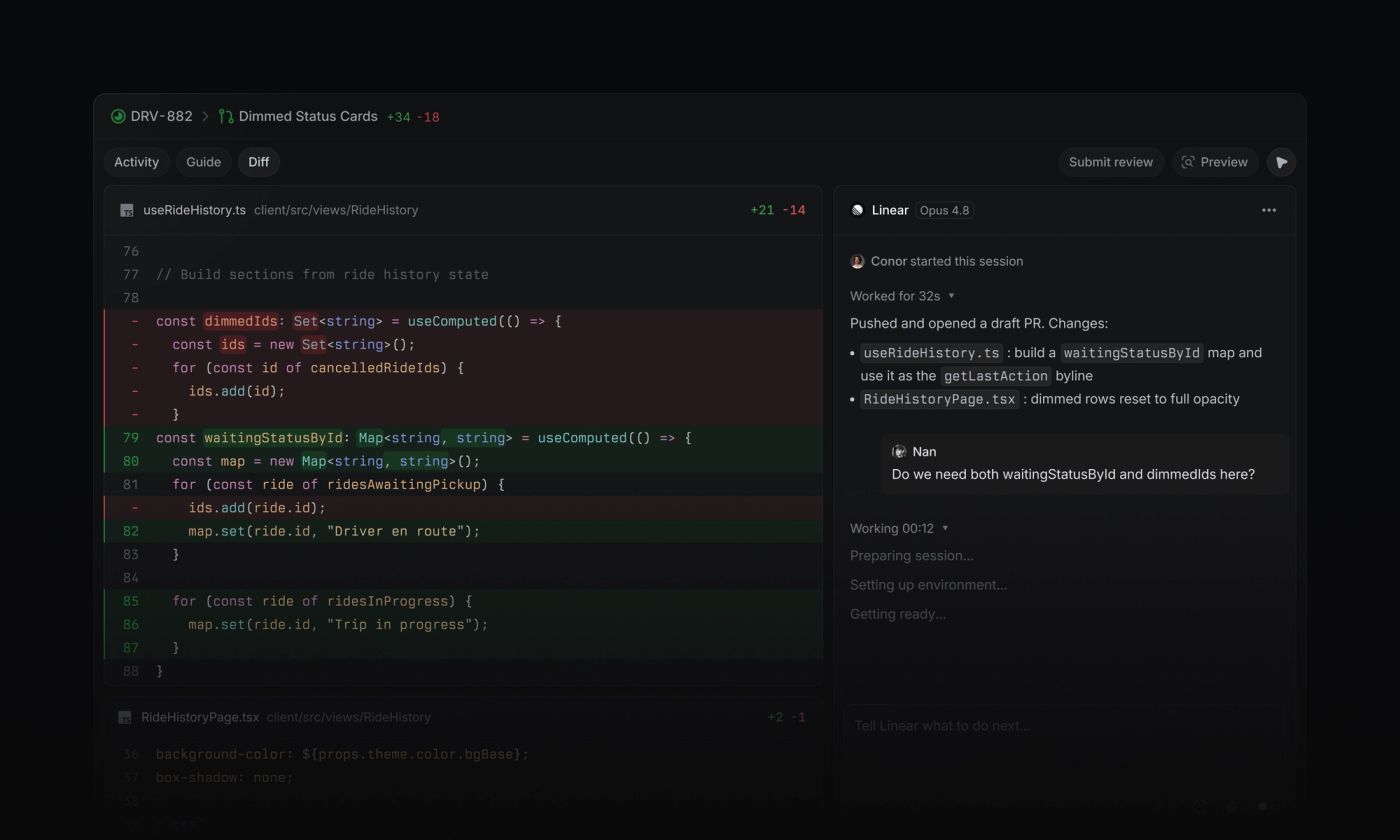
AI has made that shared record more consequential. Triage Intelligence suggests teams, projects, assignees, and labels for incoming work; administrators can choose whether suggestions auto-apply. Coding sessions let Linear Agent use workspace context and a connected GitHub repository to prepare code changes and open a pull request for human review. Loops run recurring coordination jobs, such as updating a launch plan and telling a Slack channel when a target date moves. These are concrete uses, not a promise that the machine will know what product to build.
Its paying customers include OpenAI, Coinbase, and Ramp, according to Linear. The expansion also changed the sales conversation. Saarinen initially resisted hiring salespeople. As Linear moved into larger companies, buyers wanted someone knowledgeable to explain security, purchasing, and rollout. The founders changed their minds. A beautiful interface could win a user; an enterprise purchase often required a human who understood the product as well as the buyer's process.
What the bet costs
For a customer, the entry price is plain. Linear has a free tier with 250 issues and two teams. As of September 2026, Basic costs $10 per user per month and Business $16 per user per month when billed annually. Enterprise pricing is negotiated. Some coding-session usage draws on additional AI credits. The more meaningful cost for a team moving from another system is migration: agreeing on a workflow, teaching people new habits, and deciding which custom fields and approvals they can live without.
For the company, the visible financing story began with a $4.2 million seed round in 2019, a $13 million Series A in 2020, a $35 million Series B in 2023, and an $82 million Series C in 2025. Linear says it has operated profitably since 2021. In August 2026, it announced a $99 million tender offer that let current and former employees sell some vested equity at a $2.5 billion valuation. It did not raise new primary capital in that transaction. The distinction matters: a valuation can be a price attached to liquidity, not a check deposited into the company's account.
There is a practical method here for anyone building a tool. Find a group whose repeated work you know closely. Watch how they do that work before drawing the interface. Put a usable prototype into a few real hands. Study the people who return daily; remove the barriers that stop similar people from joining. Then expand along the work they already need to do. Linear's path depended on founders with strong product taste, access to early software teams, and a market large enough to reward a narrow beginning. Those conditions are not universal. The method is still worth stealing.
“Quality is our first principle. Every other metric and decision flows from that.”
Karri SaarinenThe amusing part is the name. Saarinen has said software development is rarely linear; the word describes the order people wish they had. The company began by making an unruly job feel a little less unruly. Now that humans and agents can both add work to the queue, that old problem has become bigger. A clean list will not decide what matters. It can, however, make the decision visible - and leave fewer places for it to hide.
Keep exploring
Linear website · Company writing and news · Product updates · LinkedIn · X · GitHub · Videos and demos