A receipt is a small document with an annoying habit: it is rarely where you need it. Sometimes it arrives by email. Sometimes it sits inside a merchant's order history, behind a password, a menu, and a page designed for a person with time to spare. At Ramp, this nuisance became a browser problem at industrial scale. Its receipt workflows now touch more than five million receipts a month, according to a case study the finance company published with Browserbase. The less glamorous part of AI is often the most useful: getting into the right page and bringing back the right file.
- What it sells: managed cloud browsers and software that lets agents operate websites.
- Who buys: developers and companies automating finance, research, health care, commerce, and testing.
- The test: a completed task with a replayable trail, rather than a persuasive demo.
Browserbase exists because the internet still expects fingers. An API might tell software the price of a stock or the weather. It will not necessarily let it download a receipt from a supplier portal, open an insurer's claim form, or inspect a competitor's checkout flow. To do those jobs, software must use the same visible web that people do. Browserbase rents the browser, manages the fleet behind it, and gives developers a way to watch what happened when an automation succeeds or fails.
The browser was the missing employee

Founder and CEO Paul Klein IV knew the machinery. He had worked on headless browser technology at video company Mux, where browsers could be useful infrastructure rather than a window on someone's laptop. By early 2024 he had started Browserbase in San Francisco. The premise was direct: if an AI agent must do the work people do online, it needs a browser it can control. A local script can open Chrome. Running thousands of reliable sessions, in different places, with logs, persistence and recovery, is another profession.
The company's first layer is managed Chromium. A developer can connect with familiar tools such as Playwright, Puppeteer or Selenium and direct sessions to click, type, read, upload and download. The platform adds proxies, CAPTCHA handling, live view, session recording, logs and saved contexts. Those additions sound like plumbing until the first bot check interrupts a job, or a login disappears halfway through a run. Then the plumbing becomes the product.
Published plan terms were checked in September 2026; usage above included amounts is billed separately.
A missed click can be a systems problem
Browserbase's second layer is Stagehand, its open source framework for agents. Where a conventional automation script might say “click this selector,” Stagehand can ask the browser to act on a description of the page, observe possible actions, or extract structured information. That helps when a third-party site changes its layout. It also creates a new obligation: the agent must know what page is actually in front of it.
The Stagehand team published a precise example of what went wrong. In version three, a click could open a new tab before a remote domain policy arrived to block it. The tab briefly loaded, then got closed. The policy worked too late. Remote control also made stale page state more common: the script thought a target existed; the page had already moved on. Stagehand v4, released in August 2026, moved much of its state management and command dispatch into an extension running inside the browser. The fix was geographic as much as algorithmic. Put decisions closer to the page.
“The browser is the only real source of truth.”Browserbase, explaining Stagehand v4
That is a useful rule even for teams that never buy Browserbase. Start with a repeatable task, record what the site actually did, and distinguish a model's confident answer from a completed browser action. Use plain selectors for stable pages; spend model calls where the interface genuinely changes. Keep a replay. The first successful run is evidence that the task is possible. The hundredth tells you whether you built a product.
Five million tiny errands
Ramp supplies the most vivid case. Its agents retrieve receipts that live in merchant portals and gather information for procurement reviews. When an employee requests new software, an agent can visit the vendor's site, inspect security materials, collect contract terms and put the findings in front of an approver. In its case study, Ramp says receipt automation covers more than five million receipts per month. Browserbase says its finance agents save Ramp customers more than 4,200 hours of manual work monthly. These are company-published measures, useful for scale rather than a promise about every buyer's result.
The same machinery takes other shapes. ShopVision says it used 1.3 million sessions in 30 days to monitor retail sites and cut a per-site data pipeline from 13 hours to three. Amplitude used Stagehand to create tailored product demos. Health care company Commure used browser automation in insurance claims. These are different jobs, joined by one stubborn fact: the information sits in websites that were built for people to operate.
The passport problem
Early browser automation often looked like a costume department: rotate an IP address, tune a fingerprint, solve a CAPTCHA, hope the site lets the script through. Browserbase still sells those capabilities. But the company has begun arguing for a different bargain. Legitimate agents should be able to identify themselves and act on behalf of an authorized user. Its Web Bot Auth work with Cloudflare uses signed requests as a proof of identity. Collaborations with Fingerprint and 1Password address recognition and credentials. A September 2026 integration with Okta's Cross App Access ecosystem adds an enterprise path for scoped, auditable access.
There is a limit to that argument: an identity is only useful when the destination recognizes and accepts it. Browserbase says as much in its Cloudflare announcement. Until then, browser access remains a mix of permission, site policy and technical friction. A team automating its own portal has an easier path than a team depending on a third-party site that forbids automated access. The practical question is not whether the agent can click the button. It is whether it is allowed to, and whether the result can be trusted.
Rent the browser, keep the judgment
Browserbase is a usage business. Its published free plan offers an hour of browser time; Developer is $20 a month for 100 hours; Startup is $99 for 500; larger customers negotiate custom plans. Agent runs, proxy traffic, model use and API calls can add to the bill. Its competition includes teams running their own Playwright fleets and other hosted browser services. Stagehand is also not a substitute for a complete testing framework: its own migration guide says version four has no Playwright test runner or direct Playwright Page interop.
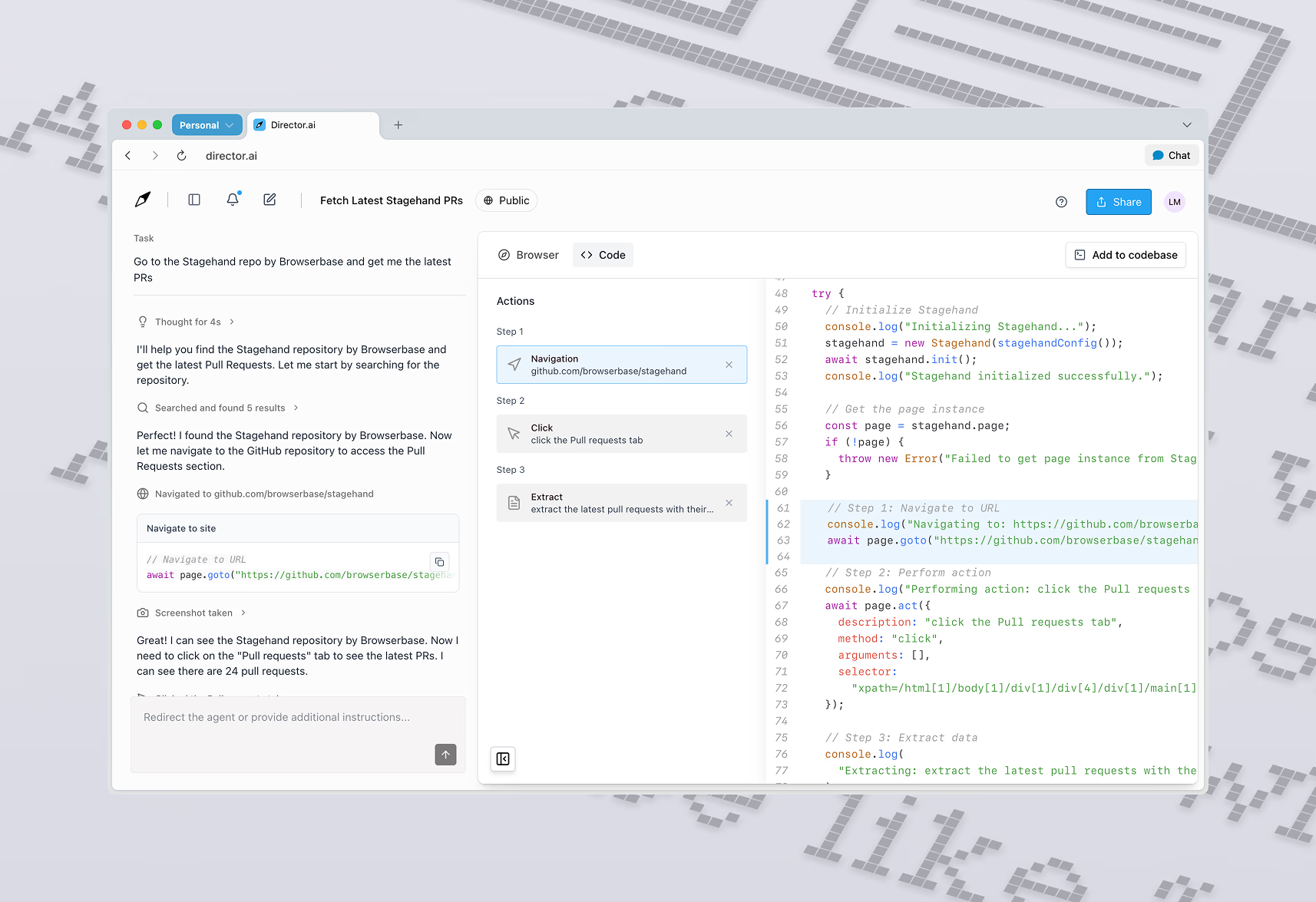
Klein's company has widened the entrance since its 2024 launch. Director lets someone describe a task in plain English and exports reusable automation code. Functions runs code next to the browser. Browserbase Agents, released in June 2026, turns a goal into a managed agent invoked with one API call. Search and Fetch cover jobs that do not need a full interactive session. The stack now runs from a single page request to an agent that can cross many sites.
A useful way to copy the idea is small. Pick one repetitive web task, such as retrieving a document from a known portal. Measure the time a person spends, the browser minutes an automated run consumes, the failure rate, and the cost of checking its output. Save a replay for every exception. If the page is stable and yours, a simple script may suffice. If the job crosses changing third-party interfaces, the managed browser begins to earn its rent.
The web was never waiting to become an API. Browserbase's wager is that it does not have to. A browser can still open the stubborn page, find the small document, and bring it home. The trick is to make that ordinary act repeatable, accountable and cheap enough to do five million times.