Adeola Adedewe applied for a credit card in the United States and was rejected. He tried again. Eventually, the count reached seventeen. He had moved from Nigeria to pursue an education and build a life, but the financial system wanted a biography written in a particular language: credit history. The life he had already lived did not supply the right paperwork.
There is a peculiar humiliation in being able to explain yourself to a person and remaining illegible to a computer. Adedewe could work, study and send money to his family. Yet those ordinary acts of responsibility did not automatically become evidence a lender could use. Another application could produce another refusal. Persistence, usually an admirable quality, was acquiring an expensive sense of irony.
His account of learning about credit contains an even smaller indignity. A colleague’s seven-year-old son mentioned wanting a high credit score. Adedewe had spent years in America without engaging with the system; here was a child already thinking about it. The lesson arrived without a lecture, which may have made it harder to ignore. A seven-year-old had identified a rule that an educated adult had missed.
Today, Adedewe runs Kredete, which connects international money transfers with credit-building tools. The question beneath the business remains personal: if someone reliably supports a family across an ocean, why should that person’s financial record at home remain so thin? It is a question about recognition as much as access. A payment can accomplish something meaningful and still leave almost no useful trace.
A number Adedewe has carried into his founding story.
An education on both sides of the counter
Adedewe’s route took him from Lagos to New York. He studied at the City University of New York; Brooklyn College’s 2021 commencement program lists Adeola E. Adedewe among its accounting master’s graduates. His professional background includes JPMorgan and WeWork. Before Kredete, he also built and sold an employee engagement platform. He had experienced financial services as a customer, an employee and an entrepreneur.
At JPMorgan, international payments gave him a view of the machinery behind the inconvenience. Money passed through institutions, currencies and operating schedules. A customer saw a transfer and a fee. Inside the process sat a chain of relationships that had to work before the recipient could use the money. For an aspiring founder, this was an education with very practical homework.
He also knew the experience from his own paycheck. Sending money back to Nigeria meant accepting delays and charges on funds intended for family. His joke was that cash might travel faster on a flight to Accra than through the payment system from New York. Aviation is a fairly elaborate benchmark for the performance of a bank transfer. The joke landed because the frustration was familiar.
The first answer was a lending marketplace
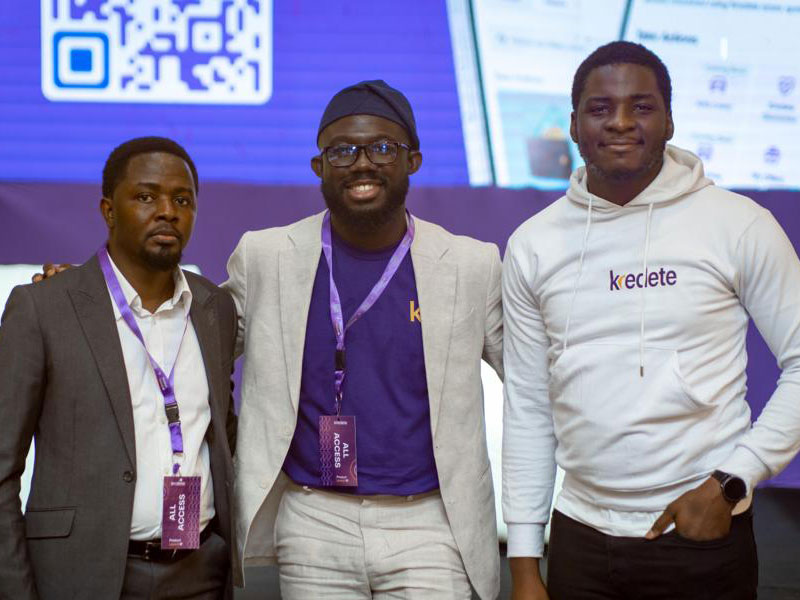
Kredete’s public launch in Lagos in April 2023 addressed access to borrowing. Adedewe appeared alongside chief technology officer Hakeem Oriola and product leader Ebuka Arinze. The offering included free credit scores, reports and monitoring, with technology intended to help lenders assess applicants and help borrowers find suitable products. The company was beginning with the problem of being understood.
Adedewe’s early explanation paid unusual attention to choice. A borrower should be able to compare terms and see the information used to assess them. He spoke about market women, artisans, students and small businesses. A score needed to be understandable to people who already dealt with numbers every day. Sophistication, in that account, meant making the information usable.
The initial approach ran into institutional difficulties. Adedewe later described fragmented identity data and financial partners whose readiness to change did not match his timetable. Building a credit system would take longer than expected. Kredete shifted toward serving Africans abroad through remittances and credit building. The earlier bank integrations still had a purpose: they could help connect the company to payments departments.
That change makes the story more interesting than a tidy founding myth. The original answer needed revision. Adedewe retained the concern with financial identity while changing the transaction around which the business operated. For a founder, this requires a particular sort of discipline: enough attachment to keep pursuing the problem, enough flexibility to abandon part of the first solution.
A transfer with something left behind
The revised proposition starts with a habit many immigrants already have: sending money home. Kredete combines that transfer activity with a system designed to report on-time payments and help establish a credit profile. Sending and building a record sit inside the same product. The intended benefit extends beyond the day the recipient receives the funds.
Adedewe has described an early user who had lived in America for twelve years without a credit profile because he paid for things in cash. After six months using Kredete, the customer could apply for a first credit card. It is his account of one customer’s experience, rather than a promise of an identical outcome for everyone. Its significance lies in the wasted years it describes.
In September 2025, Kredete announced a $22 million Series A involving AfricInvest, Partech and Polymorphic Capital. The announced use of the funding included expansion into Canada, the United Kingdom and European markets. By then, the company was combining transfers with a wider set of products, including spending cards and accounts. Adedewe’s starting point had become an argument for serving more of a customer’s financial life.
The ambition has an appealing domestic scale even when the business speaks in millions. A family gets the money it needs. The sender develops a financial record in the country where they live. Future borrowing decisions can then have more evidence to work with. Both ends of the transfer matter; the person pressing send has a future to finance, too.
- SendMoney goes to family abroad.
- RecordPayment activity becomes credit-building data.
- BuildThe sender develops a financial history.
The part of the job that requires a business card
Adedewe’s public writing offers a useful corrective to the glamour of financial technology. In an August 2025 field guide, he described visits across twenty African countries and meetings with more than a hundred banking and policy participants. He warned against treating the continent as one market. The writing is impatient with vague partnership announcements and product pitches that ignore local decision-making.
His practical recommendations include carrying business cards, finding people who can make decisions and leaving meetings with a checklist. These are agreeably physical instructions for a business built on digital money. Someone still has to enter the room, understand the institution and follow up. A frictionless app can rest on a considerable amount of shoe leather.
That preference for groundwork also appears in his account of paying for compliance before launch. He has said the early spending surprised people, but helped the company win banking partners and avoid later delays. In April 2026, he joined the Endeavor entrepreneur network. He described seeking experienced counsel and sharper thinking at a point when decisions could shape the company for years. The bank relationships and the founder relationships serve different purposes, but both require trust.
“I was a walking problem. I lived the problem.”Adeola Adedewe / Inside the Journey
A larger network, and a less visible engine
By July 2026, Kredete was described as serving nearly six million customers across sixty countries. It had also joined Mastercard’s Start Path program for blockchain and digital asset businesses. Those figures belong to that moment in the company’s development. They show how far Adedewe’s work had moved beyond a single lending marketplace in Nigeria, without turning every company milestone into a personal achievement.
In September 2026, Kredete acquired Gravv, a stablecoin infrastructure platform. The transaction brought more of the systems for settlement, foreign exchange, accounts and payment routing inside the business. It also opened a route to supplying that infrastructure to banks, developers and other financial companies. Adedewe was pursuing customers who might never open the consumer app.
There is a consistent thread here. A borrower needs institutions to understand a record. A sender needs institutions to exchange value. A business needs institutions to connect their systems. Adedewe’s work keeps returning to the joins between them. The more ambitious the network becomes, the more consequential those joins are. A polished screen cannot substitute for a payment that actually arrives.
What counts as a financial life?
His latest public ambitions extend to software acting for customers. In an October 23, 2026 television conversation, Adedewe described AI agents as a third customer group alongside people and businesses. He discussed automated payment routing, timing and oversight. He also expressed a desire to take the company to the New York Stock Exchange. These remain ambitions to judge through execution, rather than destinations already reached.
The same conversation included his claim to have visited seventy-five countries and taken two hundred flights during the year. Whatever happens to the software, the founder’s calendar appears stubbornly analog. He is selling connections between financial systems by making a great many connections himself. There is something fitting about that: the person trying to reduce the distance money travels spends so much time travelling.
For all the expanding geography, the most revealing detail remains the child talking about a credit score. Adedewe had encountered a system whose rules were familiar enough for a schoolchild to absorb, yet unfamiliar enough for a newcomer to miss. He has built a company around that distance in understanding. The useful test is still close to his original frustration: can a person who is already doing the responsible thing finally get a record that reflects it?
Follow the conversation
Read Adedewe’s writing, watch the interviews, and explore the company behind the story.
- Kredete ↗
- Adedewe on X ↗
- Adeola’s Substack ↗
- Inside the Journey: Endeavor video ↗
- The Afridigest founder conversation: video ↗
- FINTECH.TV: October 2026 interview ↗
- The 2023 Lagos launch ↗
- The Series A announcement ↗
- The Gravv acquisition ↗
- A Lagos-to-New York story ↗
- Credit and financial inclusion: interview ↗