Most companies do not find a new market because a strategy offsite produced the perfect two-by-two. Accelevation found one because the old market disappeared. In 2020, major customers halted orders, bills kept arriving and machines sat idle. Michael Rubiera built protective-barrier prototypes in his garage. The Ohio shop retooled to make clear partitions for offices, schools and hospitals, kept its employees working, and learned a material that would matter much more than anyone expected: polycarbonate.
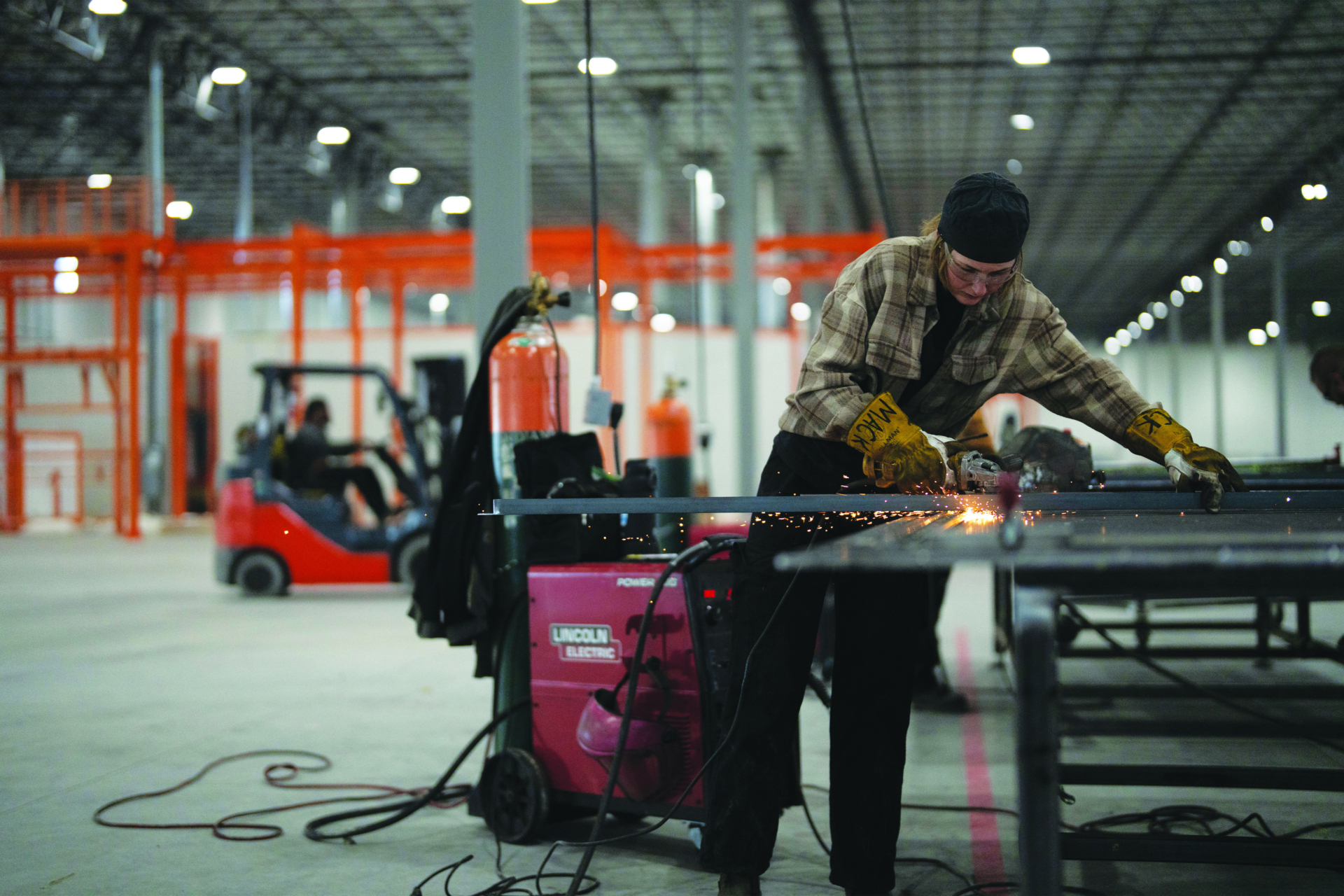
That emergency product led to a data-center containment idea. In 2021, a large customer said yes. The order was not a gentle pilot. It required a finished product, fresh suppliers, unfamiliar processes and another facility. Seven people turned a broom-swept floor into a functioning line, assembled their own worktables and sent panels to a customer within weeks. The first thing to fail, in other words, was the original order book. The thing that changed management's mind was not a forecast about artificial intelligence. It was a customer contract large enough to force a decision.
The product is the missing meeting
Today Accelevation occupies a peculiar place between factory, engineering firm and specialty contractor. It makes hot- and cold-aisle containment, caging, structural support, branch-circuit whips, power distribution units and remote power panels. Its crews also design white space, install hardware, pull structured cabling, perform electrical fit-outs, integrate racks, isolate them against seismic movement and decommission old equipment. The customers are hyperscale clouds, social platforms, large colocation operators, GPU-cloud providers, enterprises and government users. In 2025 Rubiera said the roster exceeded 50 organizations and named Microsoft, Google, the U.S. Department of Defense, Facebook and TikTok among them.
The parts matter. The more interesting product is coordination. A traditional data hall can divide structure, containment, cooling, power and low-voltage work among separate vendors. Each scope may be competent on its own; the risk lives at the border. A support clashes with pipe. A panel arrives before dimensions settle. A whip needs field work nobody priced. Schedules turn into a relay race in which every runner has a different contract.
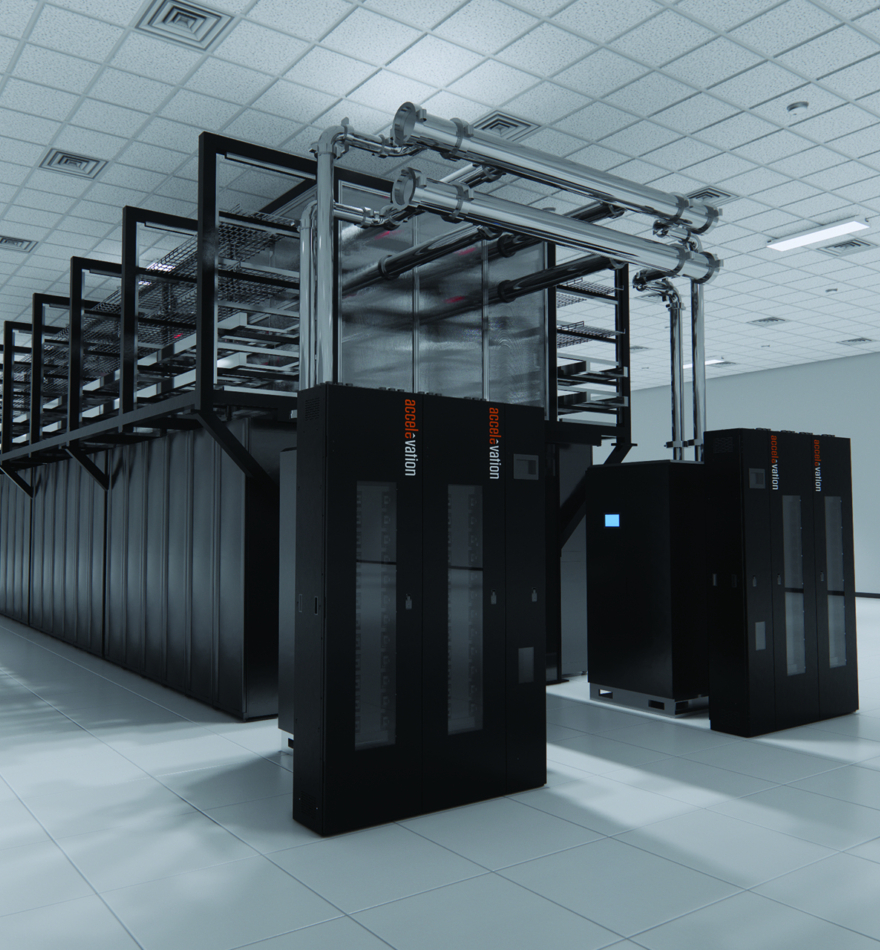
Accelevation's pitch is to put more of those borders inside one company. SkyBridge, its patent-pending modular platform, makes the argument literal: structural steel, overhead support, containment, liquid-cooling piping, high-density power panels and branch-circuit whips are engineered as one system. Components can be integrated and tested in a factory, where a missing hole is annoying, rather than discovered in a data hall, where it can delay several trades.
“Speed and scale are the new currency in today's data center market.”Michael Rubiera, CEO
A small detail with a large procurement shadow
The company's high-density remote power panel shows how this strategy reaches the component level. It is rated at 1200 amps and aimed at rows whose power demand can run from roughly 600 kilowatts toward one megawatt. The patent-pending chassis accepts breakers from ABB, Square D, Siemens, Eaton and LS. That is not glamorous. It is useful. A colocation operator can preserve a tenant's preferred breaker standard without commissioning an entirely different panel platform. Factory-wired whips arrive matched to the specification, trimming field terminations and another round of vendor choreography.
Containment attacks a more physical nuisance: servers inhale cold supply air and exhale heat. If those streams mingle, cooling equipment works harder and hot spots become harder to control. Accelevation customizes panels, sliding doors, access panels, drop-tile roofs and blanking systems around the geometry of a room. The company says a properly configured system can reduce annual energy expense by as much as 10 percent, citing an Energy Star figure. The exact saving depends on the room, load and cooling design. A clear plastic panel is not a climate strategy by itself.
Buying the capabilities around the wedge
Containment expanded into the steel that supports it and the cages that secure it. Plant capacity became the next constraint. LFM Capital invested in August 2022. The crucial move followed in 2023, when Accelevation bought Instor, a data-center integrator founded in 1996 with thousands of projects behind it. That deal supplied field design and installation knowledge - the pieces required to turn a manufacturer with adjacent products into a plausible single-source contractor.
The pattern continued. Accelevation launched power solutions in 2024, bought power consultancy and integrator Earnest Solutions in May 2025, and acquired SteelPro that October. SteelPro added design, fabrication and installation operations in Mississippi and Tennessee. Meanwhile, five heritage names - Conatech, Instor, Southeast Tool, Revolution Iron Works and Coach Tool & Die - were folded into the Accelevation brand. One name made the external promise match the internal ambition.
Capital supplied the lungs. LFM expanded facilities, product lines, operating systems and acquisitions before selling Accelevation to Olympus Partners in January 2025. The price was not disclosed. Olympus called the company its first investment from Fund VIII. Three months later, Accelevation opened a 264,000-square-foot factory in Miamisburg. The reported investment was about $50 million - $35 million for development and $15 million for machinery and product lines. It then secured neighboring land for another planned 300,000-square-foot building.
This was not expansion on a $13 million sales base, despite one widely circulated enrichment estimate. Public reporting republished by the company put 2024 revenue just under $200 million. A year-end company update said 2025 growth was 125 percent over 2024. Headcount moved just as quickly: Rubiera described roughly 350 employees at the start of 2025 and about 500 by late April; the year-end update said more than 850 people had joined during the year. LinkedIn now places the company in its 1,001-to-5,000 bracket. These are snapshots, not an audited trend line, but they explain the appetite for floor space.
What a reader can steal
The copyable move is not “buy seven companies.” It is to map the customer's delay, not merely the customer's shopping list. Accelevation entered through one stubborn material problem. It then watched what happened immediately before and after its product arrived. Steel support, security, power, cabling and installation were not random adjacencies; they were interfaces where the schedule could break. Bringing an interface inside the business creates information. Installers report what fails in the field. Engineers alter the design. The factory changes the part. That loop can be faster than a chain of purchase orders and blame.
The stealable playbook
Start with one painful, measurable bottleneck. Follow the work one step upstream and downstream. Integrate only where handoffs create expensive delay. Standardize the hidden pieces while preserving customer choice at visible ones. Add capital after demand strains capacity, not before a story strains credibility.
There is a second lesson in the five-brand breaker chassis. Standardization need not mean forcing the buyer into your favorite ecosystem. Accelevation standardizes the panel around multiple accepted components. A software company could do the same with data connectors; a logistics company with pallet formats; a clinic with payer workflows. Standardize your production while leaving a deliberate socket for the customer's existing standard.
When the factory becomes the risk
Vertical integration works under particular conditions: projects repeat, interface failures are expensive, customers value time more than a marginally lower component bid, and factories remain busy. AI data centers currently provide that environment. Rack density is rising, liquid cooling changes overhead requirements and operators want repeatable campuses delivered quickly. Domestic capacity can also reduce exposure to long supply chains.
The model weakens when those conditions reverse. A construction slowdown leaves expensive machines and buildings underused. A customer that wants best-of-breed suppliers may resist one provider across every scope. Local electrical licensing and skilled field labor can limit how quickly a national promise scales. Rapid acquisitions can produce duplicated systems, uneven culture and quality drift. Concentration among a few hyperscale buyers gives those buyers negotiating power. A single point of accountability is comforting to the customer; inside the supplier, it is a single point of pressure.
That is why the unglamorous evidence matters. Accelevation implemented an ERP system under LFM, hired operations leaders, added licensed technicians and kept investing in manufacturing controls. The company's stated culture favors fearless innovation and relentless speed. The next test is whether process can grow as quickly as square footage. “Move fast” is charming when seven people are improvising tables. At 1.4 million square feet, the tables need a system.
Accelevation fits the data-center market below the chip and above the concrete slab. It does not make the GPU. It makes the room ready to feed, cool, support, connect and protect thousands of them. The company began by saving jobs with a garage prototype. Its current wager is larger and cleaner: in the AI buildout, coordination itself can be manufactured.