An AI cluster can own a fortune in processors and still spend precious time waiting. The chips are ready. The next piece of information is somewhere else. Between those two facts sits a network, and a bill that keeps running whether the computation does or not.
- The job: connect AI processors and cloud infrastructure with Ethernet switches, software and optics.
- The customer: hyperscalers and NeoClouds, the operators selling purpose-built AI computing capacity.
- The wrinkle: co-develop the network around the customer’s operating system and engineering requirements.
- The stakes: $610 million in announced funding; a $4.2 billion valuation at the March 2026 Series B.
The expensive art of waiting
Buying more processors is an appealing response to a computing problem. It is tangible, photographable and easy to explain at a board meeting. Getting the processors to cooperate requires a less glamorous purchase: the fabric that carries data between them.
In distributed AI, processors exchange information as part of the work itself. Training means coordinating computation across machines, rather than letting each chip disappear into its own private assignment. A congested network can therefore become a constraint on the entire cluster. The investor Andreessen Horowitz made that bottleneck central to its March 2026 investment case for Nexthop AI.
Nexthop builds the equipment and software connecting those machines. The point is practical: help operators deploy networks that move data reliably while consuming less power and taking less time to bring into service. A switch is the object in the catalogue. Useful computation is the thing the buyer ultimately wants.
A supplier with fewer secrets
Anshul Sadana founded Nexthop in 2024 after serving as chief operating officer at Arista Networks. His career also includes high-speed switch development at Cisco. The leadership team draws on experience at Broadcom, Google, Juniper and other networking businesses. These are engineers familiar with the peculiarities of selling to customers whose own engineers may know exactly what they want.
That experience informs the company’s joint development manufacturer, or JDM, model. Nexthop works alongside customer teams on hardware, software and interconnects. The customer’s existing cloud stack becomes a design requirement. Hardware development and software integration are part of the same engagement.
“With Hyperscalers, you can innovate but not differentiate.”
Anshul Sadana · Founder’s blog · March 2026
Sadana’s phrasing sounds almost impolite in a business accustomed to advertising exclusive features. His argument is that hyperscalers want multiple suppliers. A clever feature available from only one vendor can become an operational dependency. Innovation must survive that customer’s ability to buy elsewhere.
The bargain is unusual but intelligible. A supplier can earn its place through engineering quality and execution while allowing the buyer substantial control of the software. The customer is paying for help with a difficult job, and has little reason to applaud a new obstacle to switching suppliers.
Three boxes, different jobs
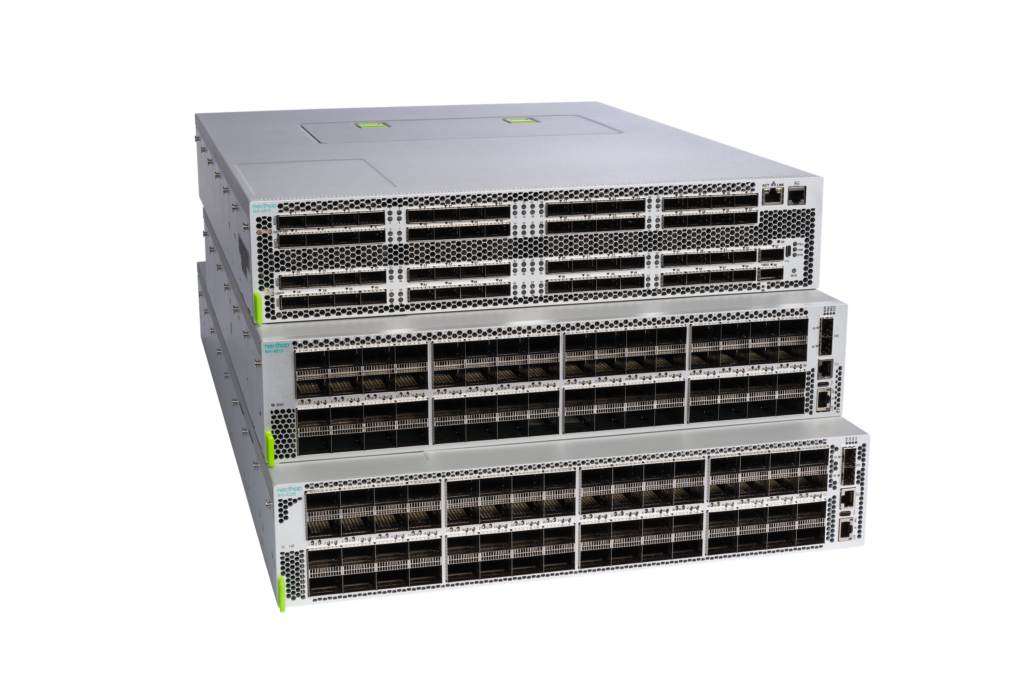
The March 2026 launch put three switch platforms on the table. Their names are admirably unromantic. Each describes a different place in the network, which is more useful than naming them after predators.
800G switching
Tomahawk 5
1.6T switching
Tomahawk 6
Deep-buffer switching
Qumran 3D
Advertised aggregate throughput. Different network roles; these bars do not compare AI job performance.
The 4000 family handles high-density 800G connectivity for AI fabrics and other cloud network roles. The 4200 doubles the advertised aggregate throughput in an air-cooled, two-rack-unit format. Nexthop’s design goal includes making a faster generation usable without disruptive changes to existing racks or fibre infrastructure.
The 5000 takes another route: deep buffers, large routing tables and line-rate encryption for connecting data centres. Here the question extends beyond how quickly neighbouring machines communicate. It includes how traffic travels between clusters.
Nexthop’s Disaggregated Spine, developed with a large hyperscaler, separates a traditional chassis into functional tiers: a fabric-facing leaf and an interconnect-facing spine. The company reports 30% lower cost and power consumption against legacy chassis-based systems. The comparison is an architecture claim, rather than a promise that every purchaser’s infrastructure bill falls by 30%.
The cable gets a vote
There is a temptation to regard optics as accessories. Nexthop treats them as part of the system. Its connectivity portfolio includes 800G and 1.6T options, with linear and fully retimed optical designs serving different power, reach and interoperability requirements.
The operational attraction is qualification. Switches and transceivers must work together, under actual conditions, before a deployment can be considered ready. Shipping qualified optics with a platform moves some of that work into the supplier’s preparation. The buyer gains an integrated purchase rather than a collection of components awaiting introductions.
800G-2DR4 optical module
Typical module power listed by Nexthop for its 500m optics. This comparison concerns module power, not whole-network consumption or interchangeable deployment suitability.
Hardware engineering vice president Prasad Venugopal’s optics essay goes further, examining near-packaged and co-packaged optics. Bringing optical engines close to the switch silicon can shorten electrical paths and reduce the need for power-hungry signal processing. It also changes how a system is assembled, tested and repaired.
That last detail deserves its seat at the table. Front-panel modules can be replaced individually. Integrated designs introduce different serviceability questions. Venugopal argues that manufacturing-time validation can improve reliability, but repair procedures and reliability are separate considerations. A lower power figure does not settle both.
Open source still needs someone on call
Nexthop supports community SONiC, its own supported SONiC-derived Nexthop NOS, and a bring-your-own-operating-system route. Hyperscalers can use software such as SONiC or FBOSS; NeoClouds can choose a turnkey combination of Nexthop hardware and supported software.
This is where a slogan about openness meets the maintenance calendar. Drivers need integration. Bugs need fixes. Releases need testing. Nexthop’s software portfolio includes platform packages, support, documentation, training and proof-of-concept labs. Open code does not excuse anyone from answering the telephone when a network misbehaves.
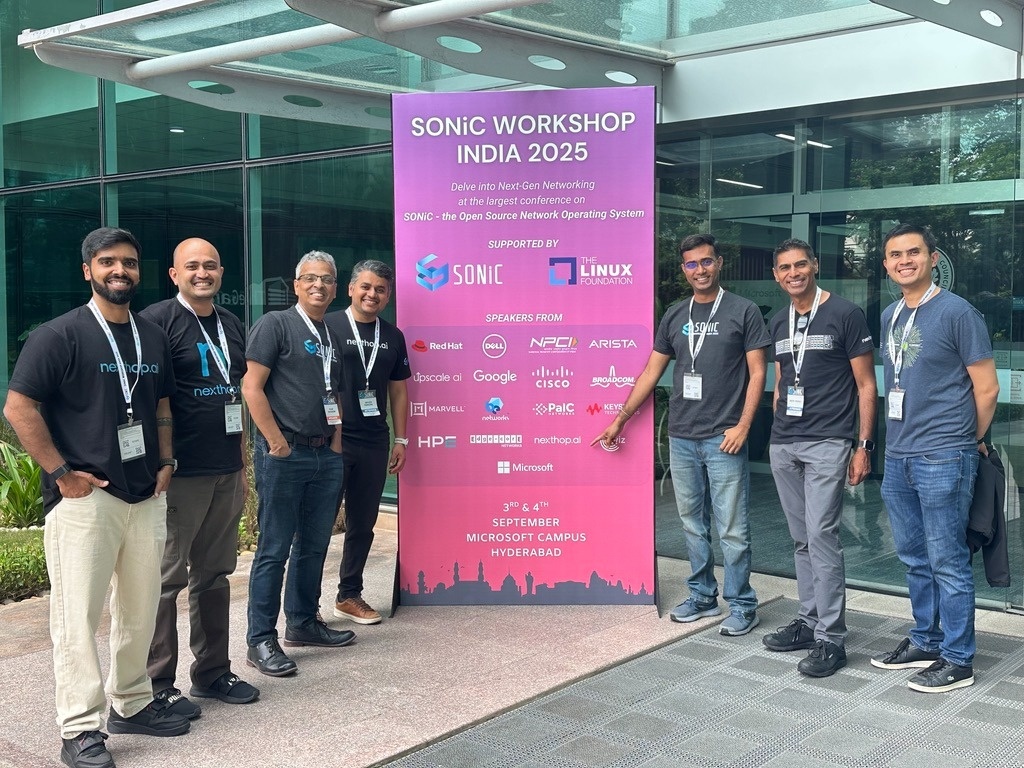
Torres describes software engineering that reaches beyond internal meetings into community workgroups with chip suppliers, operators and other vendors. In March 2026, he reported that Nexthop’s first three products were in the community SONiC repository and that the company ranked among the project’s top ten contributors over the preceding year.
The company also co-leads work on SONiC’s baseboard management controller capabilities, relevant to managing hardware as cooling technology changes. Its engineers use AI tools for coding, testing and workflow automation. In this business, adopting AI internally and building equipment for AI are distinct activities that happen to share an office.
A large cheque for a narrow customer list
Nexthop emerged from stealth in March 2025 with $110 million in funding led by Lightspeed Venture Partners, alongside Kleiner Perkins, WestBridge Capital, Battery Ventures and Emergent Ventures. A year later, Lightspeed led the $500 million Series B, with Andreessen Horowitz, Altimeter and existing investors participating.
$610 million combined. Funding is capital raised, rather than sales or a measure of customer savings.
The money supports an ambitious hardware and software business. Its commercial offering spans customized switching for large operators and turnkey products for NeoClouds. The funding announcement also sets out plans to expand research, development and infrastructure capabilities.
In the wider market, buyers can consider established networking vendors such as Arista and Cisco, NVIDIA’s AI networking offerings, or hardware from manufacturing partners integrated by their own teams. Nexthop occupies the space where an operator wants both engineering assistance and control of its stack.
That arrangement requires a suitable customer. Co-development consumes attention, and custom hardware needs enough volume to justify the work. A buyer seeking a standard purchase with minimal engineering involvement may find the turnkey route more useful. An organisation committed to another networking ecosystem must assess migration and support as seriously as the switch specification.
The part you can borrow
The useful lesson does not require buying a Nexthop switch. Start procurement with the workload and the operating environment. Ask who qualifies the optics, who maintains the drivers, how faults are diagnosed, and what has to happen before the equipment can enter production.
Then compare suppliers using the same conditions. A throughput number, a module’s wattage and a proposed deployment date describe different things. Measure the job you need done. Count the engineering work. Write portability into the requirements early enough for it to influence the design.
Nexthop’s proposition puts those chores inside the product conversation. For a company selling extraordinarily fast networking, the interesting promise is quite ordinary: less time spent waiting for everything to work together.