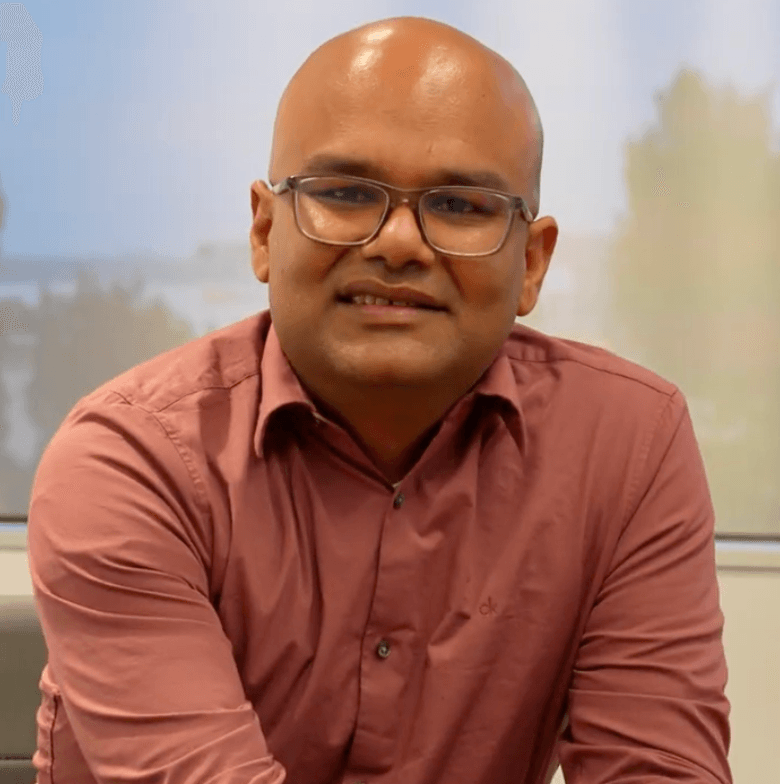
The Open Bet
In 2019, Vishal Shukla joined an open-source community that most enterprise buyers had never heard of. The project was called SONiC - Software for Open Networking in the Cloud - and it had been quietly running inside the world's largest data centers. Outside those walls, almost nobody was using it. Shukla saw an opening. He and co-founder Chid Perumal started Aviz Networks to bring hyperscaler-grade networking to everyone else.
By then, Shukla had already spent two decades inside the industry he was about to challenge. His resume reads like a tour of networking's biggest names: Nortel Networks, Cisco, IBM and its BNT unit, MobileIron, and Mellanox - the high-performance interconnect company later acquired by NVIDIA. Across those roles he shipped hardware, software, and SaaS products, and led global teams spanning R&D, product, marketing, and customer support.
That line captures the thesis of the company. The pitch is simple to state and hard to execute: let organizations network the way the hyperscalers do - open, disaggregated, multi-vendor - and give them the same choice, control, and cost savings. Instead of buying a closed stack from a single vendor, a customer can mix ASICs, switches, network operating systems, and cloud platforms, with Aviz providing the support, visibility, and management layer that ties it together.
Two decisions for the AI era
Shukla frames the current moment around two choices every infrastructure leader now faces. The first is building networks that can carry AI workloads, where traffic patterns and bandwidth demands look nothing like the enterprise applications of the past. The second is using AI to actually run and secure those networks - the observability, telemetry, and automation that keep them healthy.
He put the argument into a book, Deciding the Future: Building New Networks for the AI Era. It is not his first. Earlier in his career he authored technical volumes on SDN, OpenFlow, and OpenStack - the open technologies that were, in their moment, doing to the network what SONiC is doing now. Writing while running a fast-growing startup is unusual, but it fits a pattern: Shukla tends to think in terms of the long arc of open infrastructure, not the next quarter.
Funding trajectory
Validation arrives
In November 2024, Aviz closed a $17 million Series A led by Alter Venture Partners. What made the round notable was the company it kept. Cisco Investments joined - the venture arm of the very incumbent Aviz positions itself against - alongside Qualcomm Ventures, Celestica, Wistron, Accton, and Moment Ventures. When a market leader's investment arm backs a company built on open, vendor-agnostic principles, it signals the idea has moved from fringe to foundational.
The numbers behind the round told a growth story. In the year prior, Aviz reported quadrupling its revenue and expanding its product portfolio from two offerings to four. The total raised across rounds reached roughly $31 million. For a company built on an operating system that ships for free, the traction came from the layer Shukla had been betting on all along: the support, the visibility, the automation, and increasingly the AI that enterprises need to run open networks with confidence.
The builder's instinct
Shukla studied at Duke University's Fuqua School of Business, but his identity is rooted in engineering. The 25-plus patents to his name span software-defined networking, IoT, cloud orchestration, automation, and performance monitoring - a portfolio that maps almost exactly onto the problems Aviz now solves commercially. He is, in the language of the industry, a builder first and a CEO second.
That instinct shows up in how he talks about the company. The mission is not framed as disruption for its own sake. It is framed as leveling a field: giving a mid-sized enterprise or a regional data center the same architectural freedom that a hyperscaler has enjoyed for a decade. Open source, in his telling, is not a cost play alone. It is a way to keep control in the hands of the customer rather than the vendor.
Whether SONiC becomes the default operating system of the AI-era data center is still an open question. But the trajectory Shukla started tracing in 2019 has bent his way. The community has matured. The investors have arrived. And the argument he has been making for years - that open, customer-driven infrastructure has staying power - is now being tested at scale, with real money and real deployments behind it.
For a career spent inside the biggest names in networking, the second act is fittingly contrarian. Shukla is not trying to build the next Cisco. He is trying to make the closed stack that companies like Cisco perfected less necessary - and doing it, so far, with Cisco's own money in the bank.