The person reading your pricing page at 11:47 p.m. does not want your ebook. They do not want a nurture sequence, either. They may not even want you to know they exist. This is the awkward theater of modern B2B buying: committees research quietly, shortlist vendors privately, and introduce themselves after much of the decision has already happened. 6sense was built to spot the movement backstage.
Its pitch is straightforward. Gather the clues scattered across your website, CRM, marketing automation platform, ad campaigns, third-party research sites, company news, and contact databases. Resolve those clues to accounts. Use machine learning to estimate which companies fit, which are shopping, and where they sit in the journey. Then give marketing and sales the same list of places worth looking.
That makes 6sense most useful for B2B companies with a long sales cycle, a known ideal customer profile, thousands of possible accounts, and enough revenue per deal to justify enterprise software. Demand generation leaders, ABM teams, SDR managers, sellers, and revenue operations people can all find a job inside it. A founder with eight target customers and one spreadsheet probably cannot.
The product is a radar room, not a crystal ball
6sense calls its signal network the Signalverse. The company says it monitors and interprets more than one trillion signals a day. Those can include anonymous website visits, keyword-level research, funding events, job changes, third-party intent, and a customer's own CRM and marketing activity. Its 6signal identity graph attempts to connect anonymous visits with companies, while predictive models classify account fit and buying stage.
The famous output is the 6QA, or 6sense Qualified Account. It is an account that crosses a readiness threshold configured for the customer. That can become a useful shared noun: marketing builds audiences around it, sellers receive alerts, managers inspect pipeline, and operations teams route action. The acronym is clunky. The organizational effect can be elegant.
Crucially, a signal is evidence of activity, not proof of intent from a named human. A company may be researching for a student project, a competitor check, an existing contract, or curiosity. Large accounts also contain many people. The responsible use of 6sense is prioritization: decide where a thoughtful human should investigate next. Treating an account surge as permission for an overeager cold email is how good data acquires a bad reputation.
“It’s good at whittling down which accounts you should be focusing on... but it’s a guide - not foolproof.”A seller discussing 6sense on Reddit
What you can actually do with it
Marketing teams can identify account traffic, build segments, run display and social audiences, shift campaigns as buying stages change, automate cross-tool workflows, and measure account engagement against pipeline. The platform coordinates with familiar systems such as Salesforce, HubSpot, Marketo, Salesloft, Gong, LinkedIn, Google Ads, and The Trade Desk. This breadth is the point: 6sense wants to be the intelligence layer underneath the go-to-market stack, not another isolated dashboard.
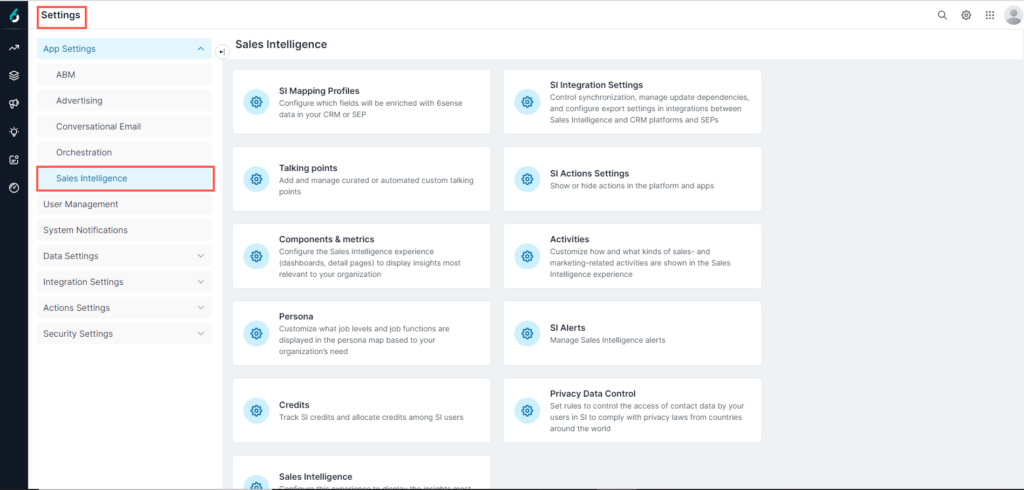
Sales Intelligence brings the account map closer to reps. It offers company and people search, persona maps, technographic and psychographic data, contact details, account summaries, alerts, recommended actions, and a Chrome extension. Data credits unlock and export emails, phone numbers, and enriched records. Sellers can work in the browser, CRM, sales engagement platform, or 6sense itself.
AI Email agents can draft personalized outreach, send messages, manage replies, qualify leads, and hand promising conversations toward meetings. The product descends from Saleswhale, which 6sense acquired in 2022. This is useful for high-volume follow-up, but it deserves the same guardrails as any automated outbound system: clean suppression lists, regional compliance, honest sender identity, and a human owner for tone and escalation.
RevvyAI puts the map behind a chat box
Introduced in November 2025, RevvyAI is the newest front door. Instead of hunting through tabs, a marketer can ask for ad performance trends, a 6QA breakdown, accounts visiting particular pages, or keyword recommendations. Sellers can request an account brief, find contacts, prepare a talk track, or sketch an outreach plan. The important part is not the chat interface. It is that answers can be grounded in 6sense buying signals plus the customer's CRM and marketing context.
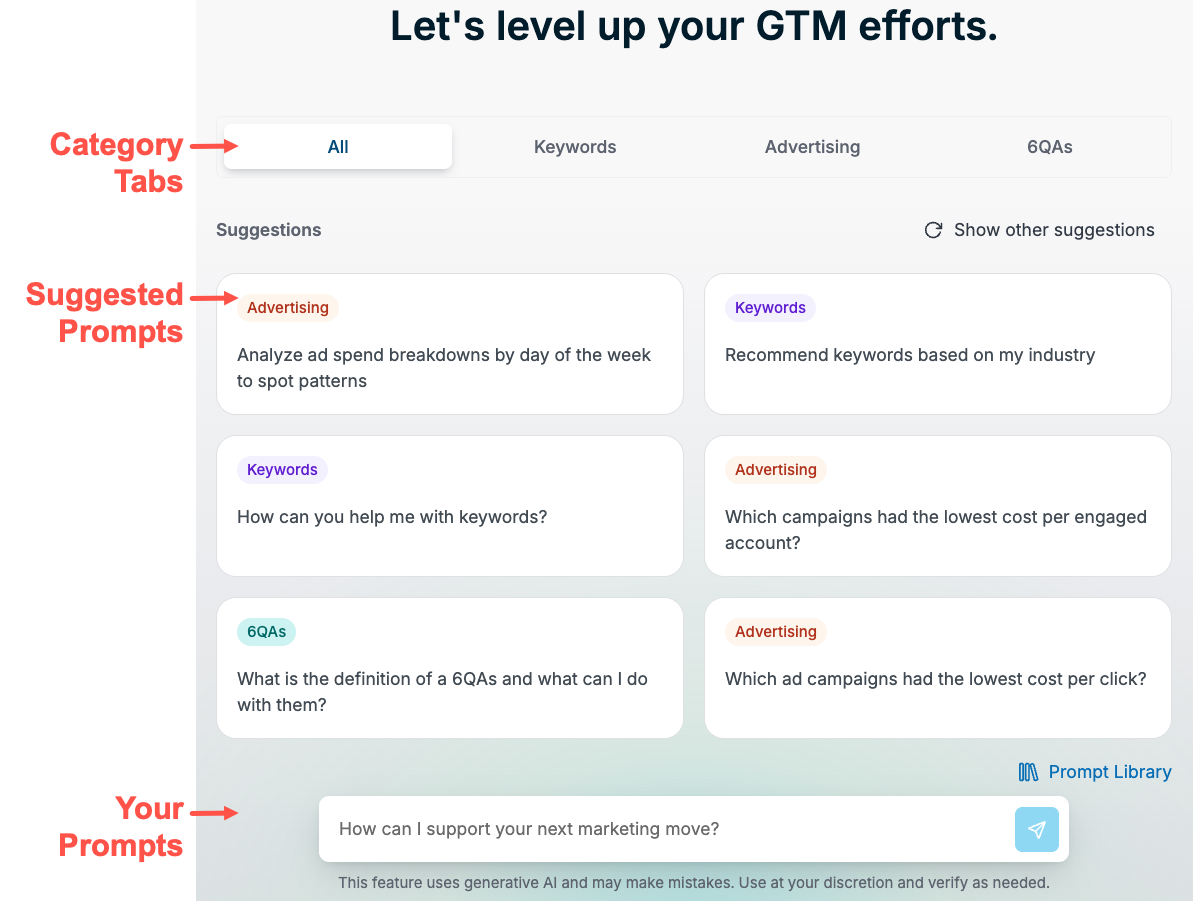
RevvyAI became generally available to Revenue Marketing customers in July 2026, after opening in beta in May. It is also generally available to entitled Sales Intelligence customers. Its documented scope includes analysis, filtering, keyword actions, account research, and support. It can decline questions beyond that scope. This boundary is healthy; a command center is more useful when it admits which switches are not connected.
Users like the focus. They notice the friction.
Independent reviews converge on a recognizable pattern. TrustRadius summarizes praise for in-market account identification, detailed intent signals, segmentation, predictive prioritization, and integrations with CRM and marketing tools. Its review synthesis says 74 percent of recent reviewers affirmed that 6sense effectively matches anonymous buying signals to accounts. Sellers describe seeing account activity in their existing workflow as a practical way to choose where to spend the morning.
The complaints are equally consistent. Reviewers mention stale or inaccurate contact records, weaker coverage in some international markets, an interface that takes learning, reporting that can feel rigid, and signals that occasionally arrive noisy. Reddit discussions add a sharper financial complaint: for smaller teams, the platform can feel like enterprise machinery hired for a neighborhood route. Several users stress that configuration, tracking coverage, training, and sales adoption determine whether the signal becomes action.
| Question | 6sense is a fit when... | Pause when... |
|---|---|---|
| Market shape | You sell to a large, defined universe of B2B accounts. | Your list is tiny or your ICP changes every month. |
| Economics | Deal value and cycle length make earlier prioritization meaningful. | A few extra wins cannot cover software, media, and operating time. |
| Data | CRM and marketing records are governed, mapped, and maintained. | Duplicates, missing domains, and inconsistent stages are normal. |
| People | RevOps owns the plumbing and leaders own adoption. | No named operator can spend time on models, segments, and enablement. |
| Motion | Marketing and sales agree on what happens after a signal. | Alerts will land in inboxes without a service level or playbook. |
Customer stories published by 6sense show what strong operations can produce. FullStory reported 27 percent more net-new opportunities in one quarter. Ivanti reported a 154 percent year-over-year win-rate increase. Rithum revived a dormant installation and, within 90 days, said 6QA opportunities accounted for 58 percent of Q2 opportunities. These are individual customer outcomes, not a forecast for every buyer. They do reveal a theme: the tool pays when teams operationalize it, not when they merely license it.
The price question comes before the prediction question
6sense does not publish dollar prices. Its official Sales Intelligence page shows packages combining Predictive AI and data credits, but the number arrives through sales. Public buyer discussions describe annual contracts ranging from tens of thousands of dollars into six figures. Those accounts differ in seats, products, data, ad spend, services, geography, and term, so the anecdotes are warnings about scale, not a menu.
Bring this list to the demo
- Ask for an itemized quote: platform, seats, credits, media, implementation, support, and renewal uplift.
- Run a pilot against a held-out account set and define success before the model scores anything.
- Test account matching and contact accuracy in your hardest regions, not only the home market.
- Map one complete play from signal to owner, deadline, message, and pipeline measurement.
- Speak with two references that resemble your size, stack, sales cycle, and data maturity.
- Budget operator time. Software cannot clean a CRM, settle a routing argument, or coach a skeptical rep by itself.
Demandbase is the closest broad ABM alternative. ZoomInfo leans heavily into company and contact intelligence. Bombora specializes in intent data. RollWorks and Terminus address account-based advertising and orchestration, while UserGems centers on relationship and job-change signals. G2 Buyer Intent can be useful when review-site research is the signal that matters. A serious evaluation should compare the full operating system with a narrower stack assembled from two or three products. Breadth saves integrations, but only if you use the breadth.
The verdict: buy the operating habit
6sense is compelling because it gives scattered teams a common view of accounts before those accounts volunteer their names. Its predictive stages, 6QAs, audiences, seller context, workflows, and RevvyAI can turn a mess of clues into a manageable queue. The product has also grown into a substantial company: 6sense reported passing $200 million in ARR in fiscal 2024, after a 2022 funding round valued it at $5.2 billion.
Shortlist 6sense if the mystery of “which accounts now?” costs your team real money. Skip it if the organization lacks clean data, a stable ICP, cross-functional ownership, or the budget to act on what it finds. The platform can make a disciplined go-to-market motion faster. It can also make an undisciplined one more expensive.
The cleanest buying test is simple. If 6sense disappeared after six months, could you name the decisions that would become slower or worse? “We would lose our daily ranked account queue” is an answer. “We would lose a dashboard” is not. Buy the former. Leave the latter in the dark.