Imagine buying a laptop by being asked how you intend to live with it. Travel? Video editing? Work far from a socket? These are ordinary questions. Yet an online catalog often responds with processor names and memory capacities, as though the shopper had arrived for an examination. The merchandise is available. The meaning requires assembly.
- Zoovu translates complex catalogs into buying guidance.
- Brands and retailers pay; shoppers use the experiences.
- Its AI depends on product data, relationships and rules.
- The lesson to borrow: ask about the task before the specification.
Zoovu sells software for that gap. Its customers include manufacturers, retailers and brands serving consumers and business buyers. The platform helps them clean product information, build guided questions, interpret searches, configure combinations and explain recommendations. It occupies the stretch of ecommerce between arriving with a need and knowing what to put in the basket.
First, teach the catalog to speak
The company’s useful distinction is its attention to the unglamorous material underneath the conversation. Product enrichment connects technical attributes to the language of needs. A buyer may care about portability; the catalog records weight, dimensions and battery information. Zoovu helps make those two vocabularies meet.
The interfaces come afterward. Conversation Studio builds selection journeys. Search Studio handles search. Configuration Studio lets people assemble products and bundles visually. Advisor Studio builds Zoe, the generative AI shopping assistant that answers product questions. These are related ways of consulting a catalog, with different jobs to do.
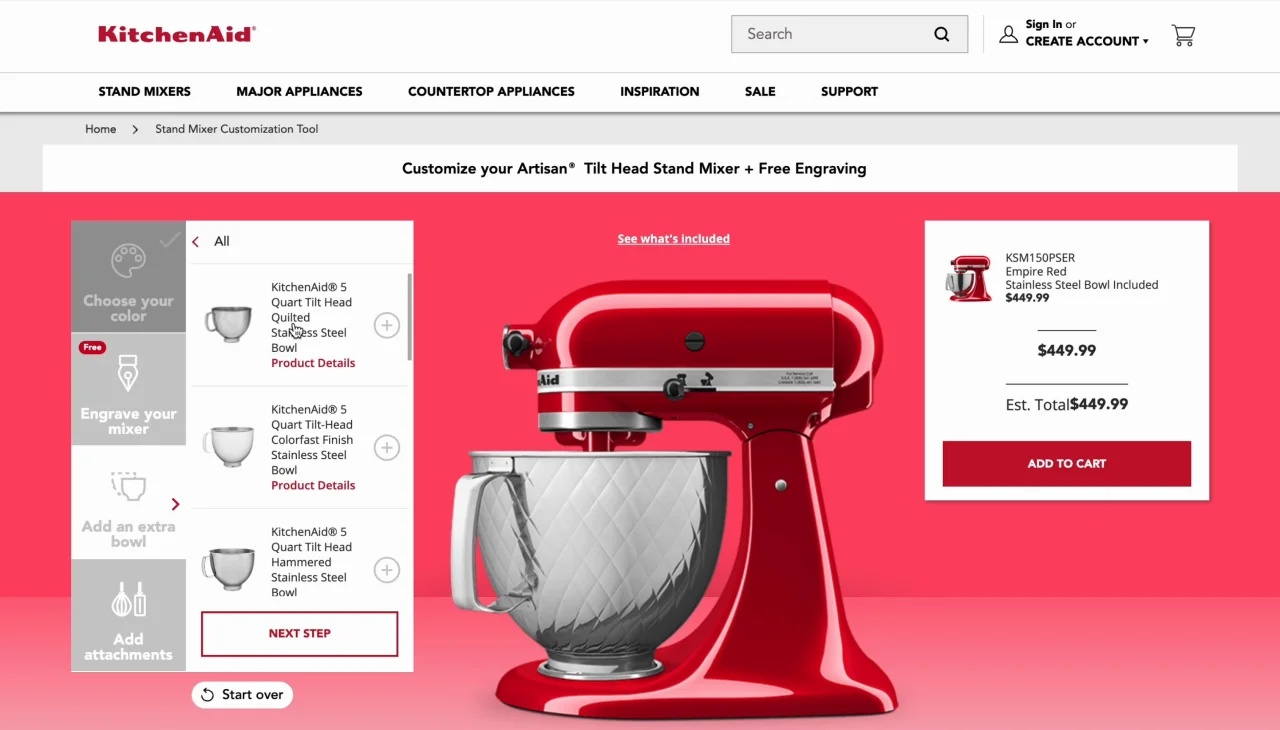
A visual configurator makes the idea pleasantly concrete. KitchenAid’s mixer example lets the shopper work through colors, engraving, bowls and attachments. The product is still a mixer. The purchase has become a sequence of manageable decisions, with the resulting combination visible. Even domestic machinery benefits from a little diplomacy.
A salesperson in a hundred shop windows
Microsoft’s case is more revealing because the difficulty extends beyond one website. Its Zoovu case study describes transforming laptop specifications into shopper-friendly descriptions, then using guided questions about intended use, battery life and budget. Those assistants were translated and distributed across retail partners.
The reported deployment spans more than 250 experiences on more than 100 retail sites. Microsoft added Zoe in late 2023 to handle follow-up questions, and also deployed it on store kiosks. Zoovu reports a 25% conversion uplift on Zoe-enabled product detail pages. That is a particular reported outcome, rather than a forecast for every merchant.
buying experiences
partner sites
Distribution matters. A brand that sells through other people’s storefronts needs its expertise to travel. Zoovu’s syndication makes guidance a channel asset: a reusable experience that retailers can host alongside the products. The software becomes a way of maintaining the conversation wherever the sale happens.
Pure Electric found a smaller version of the same difficulty: people were leaving scooter product pages. Research pointed to uncertainty about which model to choose. The retailer introduced a “Help Me Choose” experience at several entry points. Its case study reports a 20% rise in average order value and fewer customer-service inquiries.
The founders were early. Then the job changed.
The predecessor business began in Vienna in 2006 with founders Markus Linder, Martin Schliefnig and Svetlana Hollerer. Linder later described a services business that became a self-service software platform. In his 2019 departure post, he acknowledged poor traction in the early years: the team had arrived too soon.
His eventual change of mind concerned leadership. Exploration was giving way to processes and scale. He and Schliefnig asked for an experienced SaaS scaling CEO. The admission is useful: seeing an opportunity and organizing a larger company around it require different skills.
“We initially started off as a services business.”
Markus Linder / April 2019
By June 2022, Zoovu could announce a $169 million Series C led by FTV Capital. The stated uses included its American go-to-market team and product platform. Investor Beringea also made a partial exit while retaining a stake. A financing headline can conceal several transactions; it should never be mistaken for customer revenue.
The price of a useful answer
Zoovu’s customers buy enterprise SaaS through a tailored proposal. Its pricing combines a product fee with a usage or experience-based fee. Catalog, channels and chosen capabilities shape the offer. The practical purchasing question is therefore how much of the discovery journey a merchant wants the platform to handle.
There is homework. Zoe’s own documentation says compatible-product recommendations require compatibility relationships configured in Data Platform. Variants need variant data; document answers need the relevant knowledge sources. Switching on a tool cannot supply the missing evidence. A charming assistant still needs to know which spare part fits.
For a merchant evaluating this approach, a sensible starting point is one confusing category. Translate attributes into use cases, put guidance where hesitation occurs, and compare outcomes for similar visitors. Measure completed purchases, support demand and returns alongside clicks. This is an editorial inference from the deployments, not a promised implementation recipe.
The fit is less persuasive when a catalog is tiny and choices are obvious. Incorrect compatibility data also undermines recommendations. Zoovu operates alongside alternatives including Algolia, Constructor and Bloomreach. Its case rests on how well enriched data, guidance and configuration solve the merchant’s actual buying problem.
Now the aisle is being joined up
In May 2026, Zoovu acquired XGEN AI, broadening search, merchandising, personalization and recommendations. The announcement promises shared data and analytics across buying experiences, with combined capabilities expanding over time. That timing matters: an acquisition announces a direction as well as a finished transaction.
Its December 2025 MCP Server follows the same logic, giving compatible AI agents access to product intelligence and configuration rules. Jonathan Taylor, previously CTO, became CEO in January 2026. In June, Zoovu announced Gartner Visionary positioning for search and product discovery; the assessment excluded the later XGEN acquisition.
The recurring problem is wonderfully stubborn. A product has properties. A person has a purpose. Zoovu’s business depends on helping the two understand each other before the person closes the tab.