Consider the shopper who wants drinks for teetotallers. A supermarket has plenty to offer: alcohol-free beer, sparkling alternatives, something festive that will not require an apology tomorrow. But the shopper has described a person, while the catalogue has described products. Somewhere between those two vocabularies, a perfectly ordinary sale can vanish.
When Waitrose announced its use of Netcore Unbxd in January 2024, this was its example of a more complex search. The intended result was a selection of alcohol-free drinks. It is an unusually good explanation of a software company: the shelves are full, the customer is willing, and the missing ingredient is understanding.
- The job: connect shoppers’ requests with products a retailer actually sells.
- The tools: search, recommendations, catalogue enrichment and merchant controls.
- The deal: Netcore invested close to $100 million for majority ownership in 2022.
- The lesson: search failures can reveal what your catalogue has forgotten to explain.
A customer should not need your filing system
Netcore Unbxd sells product-discovery software to ecommerce businesses. Its expertise sits at the intersection of natural-language interpretation, product data and shopper behavior. A retailer supplies a catalogue; the platform helps interpret queries and decide which products deserve the shopper’s attention.
That last decision matters. Returning a thousand technically matching items is easy to admire from a distance and exhausting to use. Someone still has to put the useful options first. Unbxd combines query understanding with ranking, filters, autosuggest and personalization. Its query-understanding documentation describes using clickstream and conversion signals to resolve ambiguity and connect uncommon searches with more familiar ones.
The customers span very different shopping missions. Waitrose has groceries. Mattress Firm has mattresses. Advance Auto Parts has automotive products. Restaurant Equippers sells to people outfitting kitchens. A shopper looking for a pleasant drink and a buyer checking equipment specifications need different forms of assistance. Both need a catalogue that can answer the question they asked.
The distinction is practical rather than mystical. The software does not create an alcohol-free product. It helps a customer discover one. For a retail team, that means improving the path from a vague request to a specific product page, rather than forcing the customer to guess the store’s preferred terminology.
The machine ranks. The merchant still has opinions.
A retailer has reasons to intervene. Stock changes. A seasonal collection needs attention. A promotion has a deadline. Search relevance and commercial judgment meet on the same screen, and neither is much use if changing that screen requires a long queue of engineering tickets.
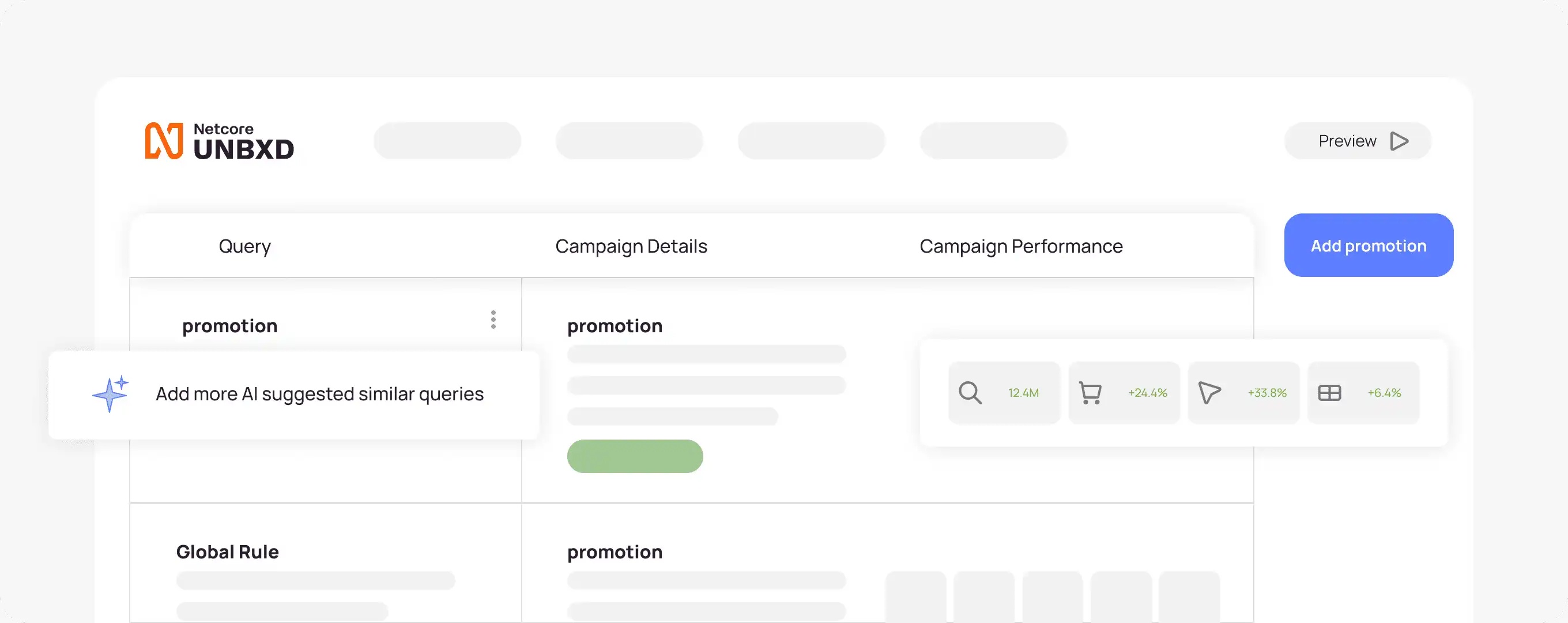
Unbxd’s Visual Workbench exposes those choices through no-code controls. Merchandisers can boost or bury products, pin them to positions, apply filters and create landing pages. They can preview changes before publishing. Dynamic collections update through rules; static collections contain hand-picked products. The vocabulary is pleasingly candid: sometimes a merchant wants an item to rise, and sometimes an item really ought to disappear from the front row.
Recommendations extend discovery beyond the search box. Catalogue enrichment addresses the information underneath it. Product Information Management organizes product content across channels. Together, these tools give the company a broader brief than returning a list of blue links: help retailers describe, arrange and suggest their merchandise.
That places it in a busy market alongside alternatives such as Algolia, Bloomreach, Athos Commerce and Nosto. Its particular pitch combines commerce-focused discovery, merchant controls and access to Netcore’s engagement products. Those features form a buying proposition, not proof that every competitor is less capable. The useful comparison is what each platform does with your own catalogue.
The 21-day detail that deserves attention
For Jerome’s Furniture, the obstacle included buying the system in the first place. The published customer account describes the statement of work and proof of concept as early sources of friction. Integrating a third-party product, preserving the storefront experience and understanding personalization were all part of the decision.
The account says Unbxd’s team worked through business use cases and an execution plan, then took the solution live in 21 days. Scott Perry, Jerome’s executive vice president of digital, credited the technology, personalization and the people involved with giving him confidence. What changed his mind was a combination of product fit and a believable route to implementation.
“so customers find the best products.”
Scott Perry, Jerome’s Furniture, on why the complex search decision matters
Restaurant Equippers’ more recent story begins with search failures: gaps in word handling, synonyms and irrelevant results, accompanied by manual work. Its published account describes an intent-aware model, merchandising controls and a conversational Shopping Agent. The company reports a 12-20% improvement in add-to-cart rate within weeks. These are vendor-published customer outcomes, tied to a particular deployment.
Jerome’s reported time to launch its search replacement.
Restaurant Equippers’ reported add-to-cart uplift.
Implementation time and performance uplift measure different things. Neither is a forecast for another store.
The pattern is instructive: establish what fails, show how the replacement handles the actual business, then get it into use. A software demonstration is more persuasive when it survives contact with the unglamorous parts of a retailer’s catalogue.
Why Netcore wanted the search box
Unbxd’s founders, Pavan Sondur and Prashant Kumar, built a business around that problem before conversational AI became the fashionable answer to almost every software question. In June 2017, it raised a $12.5 million Series C led by Eight Roads Ventures, with existing investors participating. The stated use of the capital was investment in its AI-powered platform.
In March 2022, Netcore announced an investment close to $100 million for a majority stake. Netcore founder Rajesh Jain subsequently described a 90% stake and the buyout of Unbxd’s investors. This was an ownership transaction; counting the whole payment as fresh operating capital would tell the wrong story.
The strategic logic was clear enough. Netcore had customer communications and engagement tools. Unbxd understood what people sought inside the store. Joining those capabilities offered a way to connect product discovery with subsequent marketing. New York & Company’s customer story now reports an 8% conversion-rate uplift from a combined search and personalized-email approach. It is a concrete expression of the acquisition thesis, though it does not isolate the contribution of each component.
Now the search box can ask a question back
By August 2026, Unbxd’s product roundup described six agentic commerce products. The internal trio is especially revealing: an Insights Agent helps inspect performance, a Debugger Agent explains unexpected rankings or missing products, and a Merchandising Copilot helps turn an intended change into merchandising rules. The work moves from spotting a problem to understanding it and preparing a fix.
For shoppers, the AI Shopping Agent holds a conversation across turns, with image, text and voice capabilities described in the roundup. Catalogue enrichment and MCP/ACP connectivity address the outward-facing ambition: make product information accessible to other AI shopping environments. A useful assistant needs more than agreeable prose. It needs product facts that support its answer.
On July 1, 2026, the company announced its third consecutive Leader placement in Gartner’s Search and Product Discovery Magic Quadrant. Recognition supplies a reason to put a vendor on a shortlist. The trial on your catalogue supplies a reason to keep it there.
Start with the searches that went nowhere
The business model is enterprise cloud software sold through service agreements. Its North American terms place fees in the sales order form. A buyer’s calculation therefore needs the quoted software fee, implementation effort and the value of recovering failed shopping journeys.
One lesson is available before purchasing anything: inspect your zero-result queries. Separate requests for products you stock from requests you cannot fulfil. Check whether important attributes live in structured fields. Test long queries, spelling variations and genuine constraints. Let those failures shape the evaluation.
Unbxd’s A/B testing tools support traffic splits, a chosen performance metric and a default option when there is no clear winner. That is a sensible discipline to copy. Decide what improvement means before looking at the result. More clicks can be encouraging; more completed, worthwhile orders are another matter.
The approach needs accurate product data and enough evidence to judge changes. It will struggle where specifications are missing, inventory is stale or the team cannot check the results. For a small, easily browsed catalogue, the added cost and operational work may outweigh the gain. The test is whether discovery is a material bottleneck.
Waitrose’s teetotaller is a useful person to keep in mind. The request is ordinary. The merchandise exists. The opportunity belongs to the retailer that can connect the two without asking the customer to become a database administrator.