
The usual project-management bake-off begins with three browser tabs and a dutiful checklist. Can the tool draw a Gantt chart? Track time? Automate an approval? Show a portfolio? After an hour, Zoho Projects, Smartsheet and monday.com start to blur into a familiar parade of boards, dependencies, dashboards and colored status pills. The useful distinction appears only when the evaluator closes those tabs and opens the company software bill.
Zoho Projects is a standalone product. Its official pricing page lists Free, Premium, Enterprise and Ultimate tiers, so the notion that it exists only inside a suite would be wrong. Yet its strategic pitch changes inside Zoho One. There, Projects sits among more than 45 applications spanning sales, marketing, finance, human resources, communication, collaboration and operations. The buyer is no longer deciding which app should hold a task. The buyer is deciding how much of the company should run through one vendor.
The bundle is the feature
A project rarely stays inside project software. A won deal becomes an implementation. Hours become an invoice. A new client needs a shared folder, meetings and support. A contractor needs limited access. Management wants the margin, staffing load and delivery risk in one view. Every handoff creates a choice: integrate another specialist product, copy the data manually or keep the work inside a broader suite.
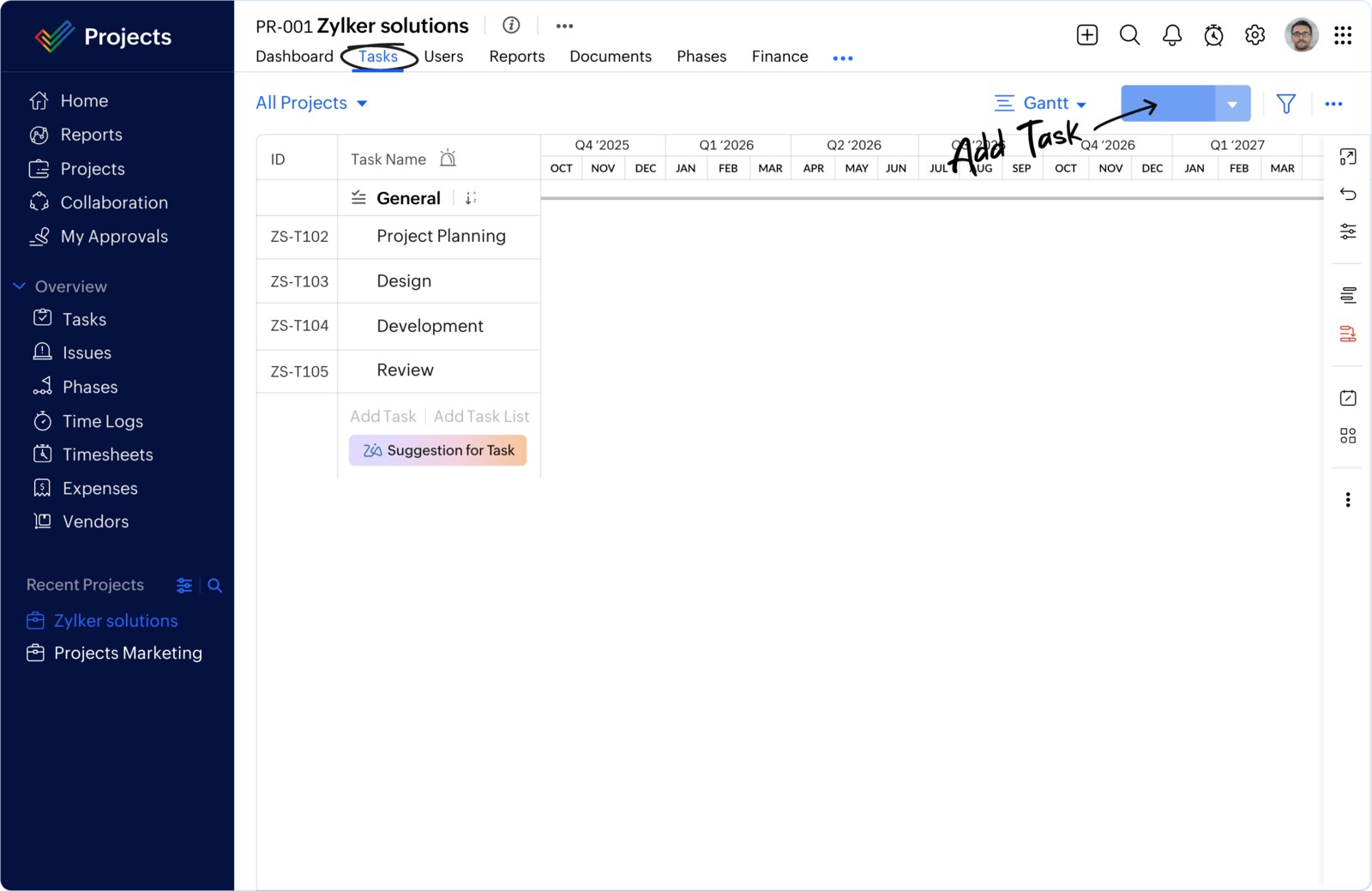
Zoho One turns those handoffs into its argument. Zoho's current plan details list Projects with unlimited projects, cross-project dependencies, time logs and timesheets, budgeting, issue tracking, reports, automation and a sandbox. Around it sit Zoho CRM, Books, Invoice, People, Desk, Cliq, Meeting, WorkDrive, Analytics and Flow. An agency could move a deal from CRM into delivery, track labor, invoice the client and monitor profitability without assembling that path from unrelated subscriptions.
The deciding feature may be the invoice you can remove, not the view you can add.
This is bundle economics rather than a declaration that every Zoho app beats every specialist. One supplier can mean fewer contracts, fewer identity systems, fewer connectors and less duplicated data. It can also mean accepting the suite's opinion about how information should move. The saving is clearest when a company uses several included applications. A team that wants only project management should still compare the standalone product on its own merits.
What the buyer is really buying
Three products, three organizational instincts
Monday.com begins with malleability. Boards can represent projects, processes, clients or other structured work. Its Standard tier adds timeline and Gantt views, a calendar, guest access, automations and integrations; higher tiers expand those limits and add time tracking, private boards, portfolio management and resource management. The appeal is visual and composable. A team can model the way it already works, then turn that model into repeatable workflows.
That freedom has a tax. Flexible systems accumulate local dialects. Marketing builds one status vocabulary, operations builds another and executives inherit a dashboard that needs translation. Monday.com's value rises when someone owns the architecture, not merely the boards. Its current pricing also uses seat counts, workflow limits and AI credits, details that matter once a playful pilot becomes shared infrastructure.
Smartsheet starts from another familiar object: the spreadsheet. Its rows and columns reduce the distance between ad hoc planning and governed work management. Current plans progress from Pro and Business to Enterprise and Advanced Work Management. The surrounding portfolio includes capabilities such as Control Center, Dynamic View, Data Shuttle, Resource Management and connectors, some packaged as add-ons or higher-tier features. That makes Smartsheet legible to program offices that care about repeatable project creation, roll-up reporting, controlled views and connections to established systems.
Smartsheet's trap is also familiar: a grid can conceal a complicated operating system behind the comfort of cells. Governance features and premium capabilities need to be priced against the actual deployment, not the friendly first sheet. The right Smartsheet buyer usually knows that a project template is only the beginning; consistency, permissions and portfolio visibility are the work.
Teams need adaptable visual workflows and are prepared to govern how boards, automations and templates proliferate.
Spreadsheet fluency, portfolio roll-ups and controlled enterprise processes outweigh the desire for a broad business suite.
Project delivery should connect naturally with several Zoho systems already in use or planned for the company.
The discount has a shape
Zoho One offers two important licensing ideas. Its all-employee model requires licenses for every employee, while flexible-user pricing lets a company buy licenses only for selected users. That distinction prevents a lazy cost claim. A small delivery team inside a large organization may find the all-employee commitment disproportionate. A company standardizing broadly across CRM, email, finance, HR and projects may find the same rule attractive because more departments can use the suite.
Price pages are snapshots, and the numbers shown can vary by country, currency, billing term, tax and negotiated enterprise terms. A durable comparison therefore uses scenarios. Price a delivery team with editors and guests. Price the whole employee base. Add the specialist products that each option leaves in place. Include implementation, data migration, premium support, required add-ons and the internal labor of maintaining integrations. Then repeat the calculation for the second year, after promotional discounts and patient workarounds have disappeared.
Listed prices and limits change. The official pages linked below were reviewed on August 27, 2026. Confirm currency, billing cadence, minimum seats, guest rules, add-ons and AI allowances before buying.
A test worth stealing
Skip the generic demo script. Give each vendor the same living project. Start with a deal that has just closed. Create the project, assign a mixed team, invite a client, change the deadline, log time, approve an expense, raise a risk, invoice a milestone and show management the new margin forecast. Ask an administrator to remove a departing contractor and trace what data remains. Finally, ask finance to count the paid systems still required.
Score the exercise twice. The first score measures the worker's experience: speed, clarity, mobile access, notifications and the number of clicks needed to update real work. The second measures the company's experience: administration, permission control, reporting, data portability, integration maintenance and vendor count. A tool can win the first score and lose the second. That tension explains why project teams and procurement teams often champion different products.
Run one more test after the workshop. Leave the pilot alone for a week, then ask a colleague who missed every demo to find a late project, its accountable owner and the reason for the delay. Ask that person to change a permission without calling the consultant who configured the system. Good software should survive ordinary absence. This exercise exposes the hidden labor behind a flexible board, a governed sheet and a connected suite. It also reveals whether the company's process is genuinely encoded in the product or merely remembered by the person who built it.
The suite route carries concentration risk. Changing one specialist tool is manageable; changing a shared operating stack is an organizational event. Buyers should test exports, APIs, identity controls and the practical boundaries between applications. They should also ask whether an apparent integration is a shared data model, a sync or simply a link that opens another tab. “Included” describes licensing. It does not guarantee adoption, clean data or a painless process.
Still, Zoho has identified a pressure point that a feature matrix misses. Companies are tired of reconciling SaaS sprawl, yet they remain wary of surrendering choice. Zoho Projects benefits whenever the desire to reduce sprawl is stronger than the desire to pick every component independently. Smartsheet benefits when governance and portfolio discipline dominate. Monday.com benefits when teams prize a canvas they can shape.
There is no context-free winner. There is a better opening question. Before asking which product runs the project, ask what surrounds the project now, what should surround it next and how many vendors the company is willing to coordinate. By the time those answers are on the table, Zoho Projects may already have won. It may also have ruled itself out. Either result is more useful than another afternoon spent comparing colored boards.
Read the primary material
Common questions
Is Zoho Projects sold separately?
Yes. Zoho offers standalone Free, Premium, Enterprise and Ultimate plans for Zoho Projects.
Is Zoho Projects included in Zoho One?
Yes. Zoho One's published plan details include Projects with unlimited projects and features for planning, reporting, time tracking, budgeting and automation.
What is monday.com best for?
It fits teams that want adaptable visual boards and workflows, provided the organization is ready to govern templates, automation limits and board design.
What is Smartsheet best for?
It fits spreadsheet-familiar organizations that need repeatable project structures, portfolio reporting and enterprise governance.
What should buyers compare beyond features?
Compare licensing rules, minimum seats, guests, permissions, add-ons, automation limits, implementation, data portability, support and the other subscriptions each option could replace.