A bad engineering project rarely announces itself with a klaxon. It leaks. A senior person spends too many hours on work priced for someone junior. A scope change sits unbilled. A deadline moves, then the staffing plan does not. By the time finance closes the month and the ERP reports the damage, the useful question is no longer “What should we change?” It is “How did we miss this?” BST Global has spent 55 years living inside that question.
The Tampa company makes business software for architecture, engineering and consulting firms, the people who design transit systems, towers, water infrastructure and campuses but must also keep thousands of labor hours, contracts and invoices pointed toward a margin. Its suite combines enterprise resource planning, work management, staffing and predictive analytics. More than 120,000 architects, engineers and consultants in 65 countries use its products, according to the company. The average client relationship lasts 18 years.
Those numbers describe a particular kind of software business: narrow, sticky and largely invisible outside its customer set. BST Global is not trying to run every company. It wants to understand one awkward economic machine better than generic software does.
A vertical before vertical SaaS had a name
In 1971, engineer Carlos A. Baldor Sr. and two colleagues, Sosa and Triana, started BST Data Systems with $100 in working capital. The initials became the name. The original product was not a product at all but a data-processing service bureau, back when access to computing could itself be the service. The two partners left early; the Baldor family took full ownership.
What happened next is the useful part. BST did not spend half a century protecting its first technology. It protected its proximity to a customer. In 1978 it renamed itself BST Consultants and shifted toward software development. Its management information system went global in 1980, moved to networked microcomputers in 1985 and gained multi-company, multi-currency support in a single relational database in 1992. BST8 arrived in 1999 as what the company calls the industry's first completely web-enabled application. Global expansion followed in 2000; the BST Global operating name arrived in 2006; project-based BST10 launched in 2014.
The container kept changing: service bureau, MIS, relational database, web app, cloud ERP. The durable object was the project. That is the pattern worth stealing. Pick a customer whose workflow is complicated enough to reward specialization, then keep solving the workflow when the computing platform changes.
“Building software is a privilege. Trying to understand what clients are up against and how to make things easier for them is an honor.”Barry Lawrence · Product Director, Platform & Integration
Four products and one change of mind
BST11 ERP is the center of the current lineup. It records projects, finance, people, performance and client relationships, but its pitch is less accountant's cockpit than consumer-grade collection of focused apps. A project can begin with five required fields. The interface works on phones and tablets. That matters because the employee deciding whether a project goes well is often at a client site, not waiting beside a desktop for month-end.
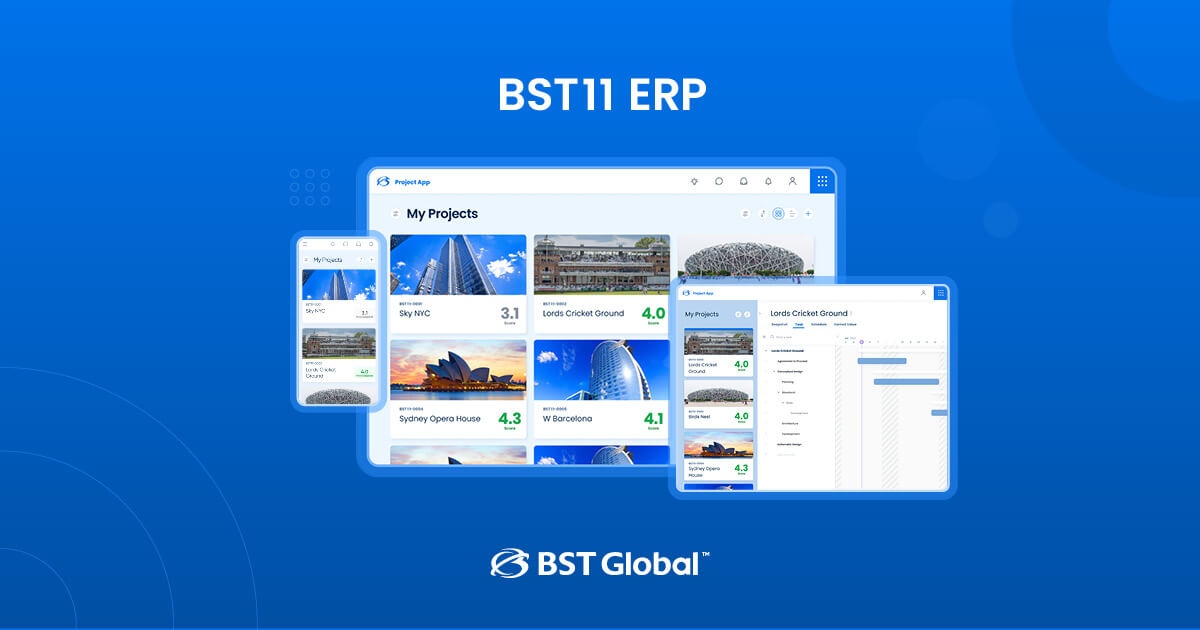
Around it sit three more tools. BST11 Work Management tracks delivery and resources. Audere replaces staffing spreadsheets with live capacity, assignment views and “Smart Suggestions” based on role, workload and schedule. BST Insights applies machine learning to more than 35 signals already sitting in ERP data, with special attention to net labor multiplier, a measure connecting labor cost to project economics. The goal is not another immaculate postmortem. It is an alert while a manager can still change the team, chase a change order or correct a budget.
The project intelligence loop
The initial vision, presented in 2021 and launched as a suite in 2023, centered on a smart, collaborative next-generation BST environment. Then market feedback widened it. Firms wanted the new intelligence and resource tools without replacing Deltek, Oracle, SAP or another financial ERP. BST responded by making Insights, Audere Premium and Work Management complementary to other systems. In 2024 it added BST Connect, a subscription integration platform using APIs, webhooks and Microsoft tools to move data between products.
That change is strategically sharper than a feature launch. A rip-and-replace sale asks an enterprise to endure migration, retraining and political combat before it receives the first prediction. An add-on can enter through the missing capability. BST went from selling a new house to selling a useful room that connects to the old one.
What did it cost, and what failed first?
BST does not publish a standard price list. Sales begin with discovery and a tailored demonstration; cost depends on users, modules, deployment, migration, integration, customization and services. That is normal enterprise procurement, but it means no honest public dollar figure can describe a typical deal. The bill is not only software. It is the organizational work of cleaning project data, mapping finance processes, training internal champions and persuading busy professionals to stop keeping a shadow system in Excel.
The relevant cost equation is license or subscription + implementation + migration + integration + internal change. If a vendor comparison shows only seat price, it has cropped out the hard part.
What failed first was not BST Global as a company. Its original service-bureau model became the wrong container, so management shifted to software. Later, the assumption that the new suite should live primarily around BST's own ERP proved too narrow. Customer demand changed the boundary. The persistent failure inside the customer workflow is late knowledge: an ERP ledger reports history, spreadsheets fragment staffing plans and duplicated systems disagree. BST's newer products are an attempt to move the moment of truth forward.
The revenue model follows that complexity. BST is a private B2B vendor selling software subscriptions or licenses alongside implementation, training and consulting. It supports cloud and on-premise choices, while BST Connect has Standard and Premium subscription levels. Support is included, according to the company's support sheet, but a large rollout can still consume internal time from finance, IT and project leaders. Buyers should calculate value against fewer write-offs, better utilization and faster billing, not against the price of a task app. The relevant comparison is the cost of preventable project leakage. If the buyer cannot measure that baseline, even a successful deployment will struggle to prove itself.
There is an important caveat in the AI claim. BST has marketed Insights as predicting outcomes with greater than 95 percent accuracy. That is the company's figure, attached to its models and use cases, not a universal law of project management. A model trained on incomplete time sheets, inconsistent project codes or a firm's unrepresentative past can produce confident clutter. Prediction works when signals are timely, definitions are stable and managers can act on the warning. It becomes decoration when the underlying data is weak or nobody owns the intervention.
The practical AI product is not a robot project manager. It is one expensive decision arriving early enough to become a cheaper decision.YesPress analysis
The moat is service wearing a software badge
Competitors range from AEC specialists such as Deltek Vantagepoint and Ajera to Unanet, Oracle, SAP, Microsoft Dynamics 365 and Sage. For pieces of the job, Smartsheet, Monday.com and the immortal spreadsheet also compete. BST's difference is not that rivals lack dashboards, AI or project accounting. It is the density of AEC assumptions already baked into the product: labor multipliers, multi-discipline engagements, resource conflicts, billing rules and a project manager's need to see a portfolio without becoming a finance analyst.
The other distinction is human. BST says implementation and support are staffed in-house, data migration has moved thousands of users and average support response is under one hour. Training follows a train-the-trainer model so client firms can teach new employees themselves. Product teams use client ideation sessions to influence roadmaps. Several employees have served more than 40 years, an almost comical tenure in software, while some customer relationships approach 50.
That culture descends directly from the Baldor family. Carlos Sr. led the business until his death in 2020. His sons now run it: Javier A. Baldor is chief executive and Carlos A. Baldor Jr. is president and chief technology officer. Family control can produce insularity or unusual patience. In BST's case, the public evidence points to patience: multiple platform transitions, international offices and a willingness to keep support as a cost center close to the product.
Where the thesis breaks
This model is not for everyone. A small studio with a few uncomplicated projects may get more value from clean accounting software and a disciplined spreadsheet. A retailer, manufacturer or subscription business does not share the project economics BST has spent decades encoding. A consultancy unwilling to standardize time, scope and project data will not become predictive merely by buying a model. And a firm seeking instant, self-serve setup will collide with the reality of enterprise implementation.
It fits when…
- projects are numerous, long and multi-disciplinary
- labor allocation drives margin
- finance and delivery data can be standardized
- managers can act on an early warning
It strains when…
- work is simple or not project-based
- source data arrives late or inconsistently
- teams reject shared workflows
- the buyer expects plug-and-play pricing
The broader market is moving toward BST's premise. AEC firms are consolidating, private capital is interested in their performance and clients expect faster, more transparent delivery. Yet BST's 2026 industry survey found only 22 percent of respondents described their AI readiness as mature or advanced, and just 1 percent reported widespread adoption of AI-enabled processes. The gap between interest and operating readiness is the market.
BST has also turned that gap into a media and convening strategy. It formed an AI + Data Consortium in 2024 with technology leaders from AECOM, Arup, AtkinsRéalis, Gensler, Parsons, Ramboll, Stantec and WSP. It runs an annual AI Summit and publishes survey research with the consortium and the American Council of Engineering Companies' Technology Committee. Frost & Sullivan named BST Global a company of the year in relevant AEC software categories in 2024, 2025 and 2026. Awards are marketing; the consortium is potentially more valuable. It puts BST in the room where large customers decide what trustworthy AEC data and AI should mean.
The thing to copy
Do not copy the phrase “project intelligence.” Copy the sequence. Start with a high-value workflow that produces structured data. Earn trust through implementation and support. Turn the accumulated history into a specific prediction. Then make the prediction work with systems you did not sell. Each step widens the opportunity without abandoning the niche.
BST Global's longevity can look like the headline, but age is not the accomplishment. Plenty of old software survives because leaving hurts. The more interesting fact is that a data-processing bureau founded before the personal computer can credibly pitch machine learning to a global engineering consultancy. It got there by changing its answer while staying loyal to the question: where is this project going, and can we still do something about it?