Young Zhao had found a rather expensive way to hear encouraging things. His team had built an AI livestreaming product, recruited about 200 users, and paid people $20 or $30 a session to keep testing it. When the payments stopped, so did the enthusiasm. Software usually aspires to collect money from its customers. Here, the cash was traveling in the less reassuring direction.
Inside that disappointing product was a clipping feature. It helped people reuse moments from a broadcast. Users wanted that part on its own. Zhao and his colleagues listened, separated it from the larger application, and built OpusClip around the task people actually wanted done. By the end of 2023, Zhao said, the product had reached five million signups and nearly $10 million in annual recurring revenue, seven months after launch.
It is an unusually tidy result for a career that has involved several untidy beginnings. Zhao, OpusClip’s co-founder and CEO, has worked on social software, restaurant technology, and the labor of making videos. His recurring problem has been figuring out where an appealing idea meets a customer’s Tuesday afternoon.
The designer before the clipper
Zhao attended the University of California, Berkeley, from 2010 to 2014, studying computer science and human-computer interaction. The pairing suits the work that followed: making something function, then worrying about what happens when an actual person touches it. His public professional biography lists earlier work at LinkedIn and Totango. A former Totango colleague, Maksim Ovsyannikov, remembered him as a talented product designer whose mobile work quickly received industry recognition.
His record also includes co-founding Zaihui, with a tenure running from May 2015 to August 2021, and founding OneBowl. These are useful details in a story often compressed into an AI success arriving on schedule. Before the clipping product, there were other organizations, other customers, and other attempts to make software earn its place.
One earlier venture was Sober, a social app built around disappearing content and connections. It failed, he has recalled. The experience nevertheless left him wanting to keep building companies. Even the name contains a little of his humor: the introvert creating an alternative route into social life. It is a more human origin than a founder discovering a market in a spreadsheet.
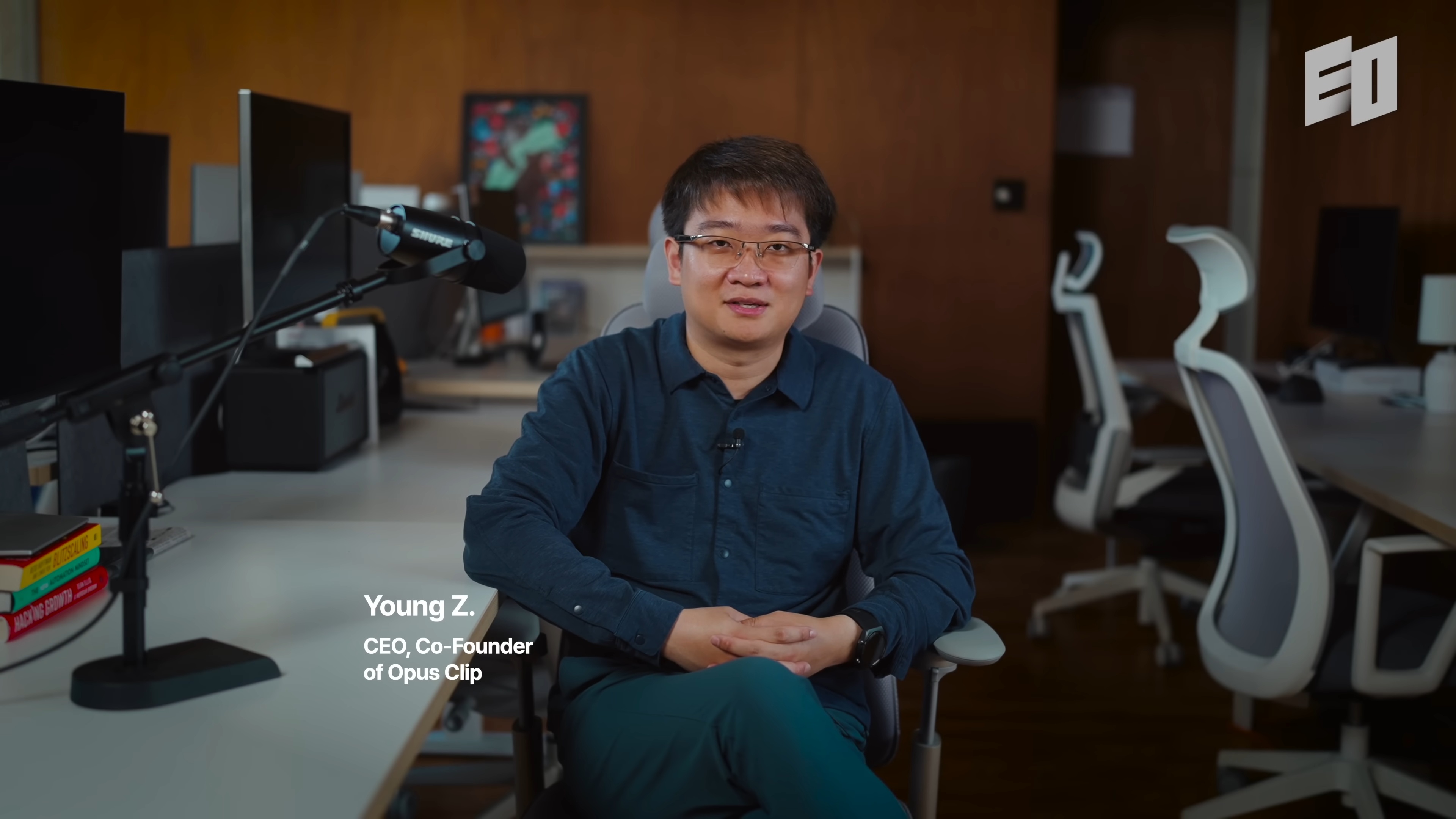
When the creatives wanted their own names on the work
Running a talent agency brought Zhao closer to the practical business of content. For roughly four years, he worked on promoting local businesses, where producing video meant coordinating people and spending time on edits. He describes editing as a constraint on the agency’s ability to scale. The problem was familiar before it became a software opportunity.
There was another complication. Talented creatives wanted to build their own businesses. Managing a team could give way to supplying tools that independent creators might use themselves. That change in perspective matters: a creator’s ambition can be larger than the assignment currently on the desk. Zhao’s later product would have to serve that ambition without requiring a whole production department.
Restaurant marketing and AI video editing may look like distant occupations. They meet in the same small transaction: someone has something to say, a business to promote, and too little time to package it for an audience. The agency years gave that transaction faces and deadlines. A laborious edit is especially easy to understand when it sits between finished footage and a customer waiting for the result.
A small door into a large problem
For the clipping idea, Zhao’s team tested the output before insisting on a polished application. Early delivery involved email and then a Discord bot. It was a deliberately modest way to learn whether the result had value. A creator could judge the clip without having to admire the software surrounding it.
The distinction still runs through Zhao’s advice to founders. He encourages a passion for building and solving problems, paired with a rational understanding of a particular customer’s work. Passion alone cannot tell a team which button belongs on the screen. A person repeatedly trying to get a job finished offers a much more useful design brief.
Company founded around AI livestreaming.
OpusClip becomes a standalone product.
Video agents become the next test.
That modest entrance also helps explain the later breadth of his ambition. A narrow first task can provide somewhere to begin, a clear result to inspect, and a reason to come back. Expansion then has a customer to answer to. For a founder with several businesses behind him, the attractive part is the chance to learn something definite before the organization becomes attached to a grander plan.
The audience outside the pitch room
At a 2024 startup panel, Zhao described three different audiences for his company’s mission. Customers could often explain the value themselves. Employees needed the vision repeated and clarified as the product changed. Investors could be harder to convince because many had little experience of being creators. The same company required different conversations depending on who was listening.
His emphasis on employees is revealing. A product moving into new territory gives a team plenty of room to disagree about what should come next. Communicating the purpose becomes part of the CEO’s work, alongside deciding what to build. The customer’s apparent simplicity can conceal considerable coordination inside the company.
He also acknowledged a less comfortable consequence of making clipping easy: people repurposing other creators’ work. Zhao described warnings about account bans and changes to the workflow intended to discourage infringement. A product built to help people tell stories must also contend with people taking someone else’s. Wider access brings responsibilities along with signups.
A customer becomes an investor; an archive gets another life
In August 2024, OpusClip announced $30 million in funding across its Series A and earlier seed rounds. Millennium New Horizons led the Series A. Jason Lemkin, the SaaStr founder, had used the product before investing. For Zhao, it was a particularly concrete connection between the two audiences: someone who could assess the tool from the customer’s chair before taking the investor’s seat.
The announcement accompanied ClipAnything, which expanded clipping beyond dialogue alone by considering visuals, actions, audio, and emotion. That broadened the kinds of footage the software could address. A spoken transcript can be helpful; it cannot, by itself, describe every reason someone might want to watch a moment again.
Then came another variation on the original problem. A creator with years of recordings may already possess the material for a new video, somewhere. On March 11, 2025, the company announced backing from SoftBank Vision Fund 2 and introduced OpusSearch. Its task was to help professional creators and businesses find and reuse material in their existing catalogs.
The archive changes the creative starting point. Instead of beginning with a blank page, someone can begin with a question about work already made. A timely observation in an old conversation might have another audience waiting for it. The useful invention is partly a better memory.
By June 2025, OpusClip reported more than 12 million creators and brands and over 229 million clips. Its second-anniversary account described podcasters, educators, marketers, editors, and event hosts putting the tool to different uses. Those are company-reported figures, attached to that moment in its development. They also show why Zhao’s original clipping task could become a recurring job across several professions.
“Editing isn't the end goal. Delivering views and audience growth is.”
Young Zhao, August 2025
The person should survive the process
Zhao’s view of automation leaves a central job for the creator: having something recognizably their own to communicate. He has argued that authenticity involves preserving a person’s purpose, personality, original stories, and real footage. That is a demanding brief for software designed to rearrange material. Speed is useful only if the result still says what its owner meant.
He describes a product that can proceed automatically while letting people intervene. This gives the creator a continuing role in setting direction and making judgments. It also acknowledges an everyday truth about creative work: a technically finished video can still feel wrong to the person whose name will appear beside it.
His newer ambition stretches toward a creative team of AI agents, covering work such as research, scripting, storyboarding, and editing. Agent Opus makes the organizational metaphor explicit. The founder who once managed creative labor is now building software that divides creative tasks among agents. His experience of the work remains relevant even as the proposed machinery changes.
Another takeoff, with the instruments switched on
By September 2026, OpusClip’s public company figures stood at more than 20 million creators and businesses, over 440 million clips, and more than 160 billion views from clips posted by users. These measure different things: people and organizations using a service, outputs created, and audiences reached. They belong beside dates, rather than floating around as interchangeable proof of success.
In October, Zhao returned publicly to the memory of the unwanted livestreaming product. Discussing agentic video editing and AI Producer, he said the team saw an opportunity but had yet to find product-market fit. A large installed audience had not removed the need to establish demand for the next idea. The old lesson was still available for use.
There is a pleasing detail in his answer about an alternative career. Asked what he would do outside OpusClip, Zhao said he would fly planes. He calls himself an aviation enthusiast and imagines being a pilot. It gives the familiar language of startup takeoffs a welcome literal possibility, although it would be unwise to turn a casual answer into a theory of his management style.
For now, he is building another kind of cockpit: software intended to let people direct more of the work without performing every operation themselves. His own career supplies the caution that belongs beside the controls. The plan can be persuasive, the technology can be interesting, and the passengers may still prefer a different destination. Zhao has already changed course once by listening to them.