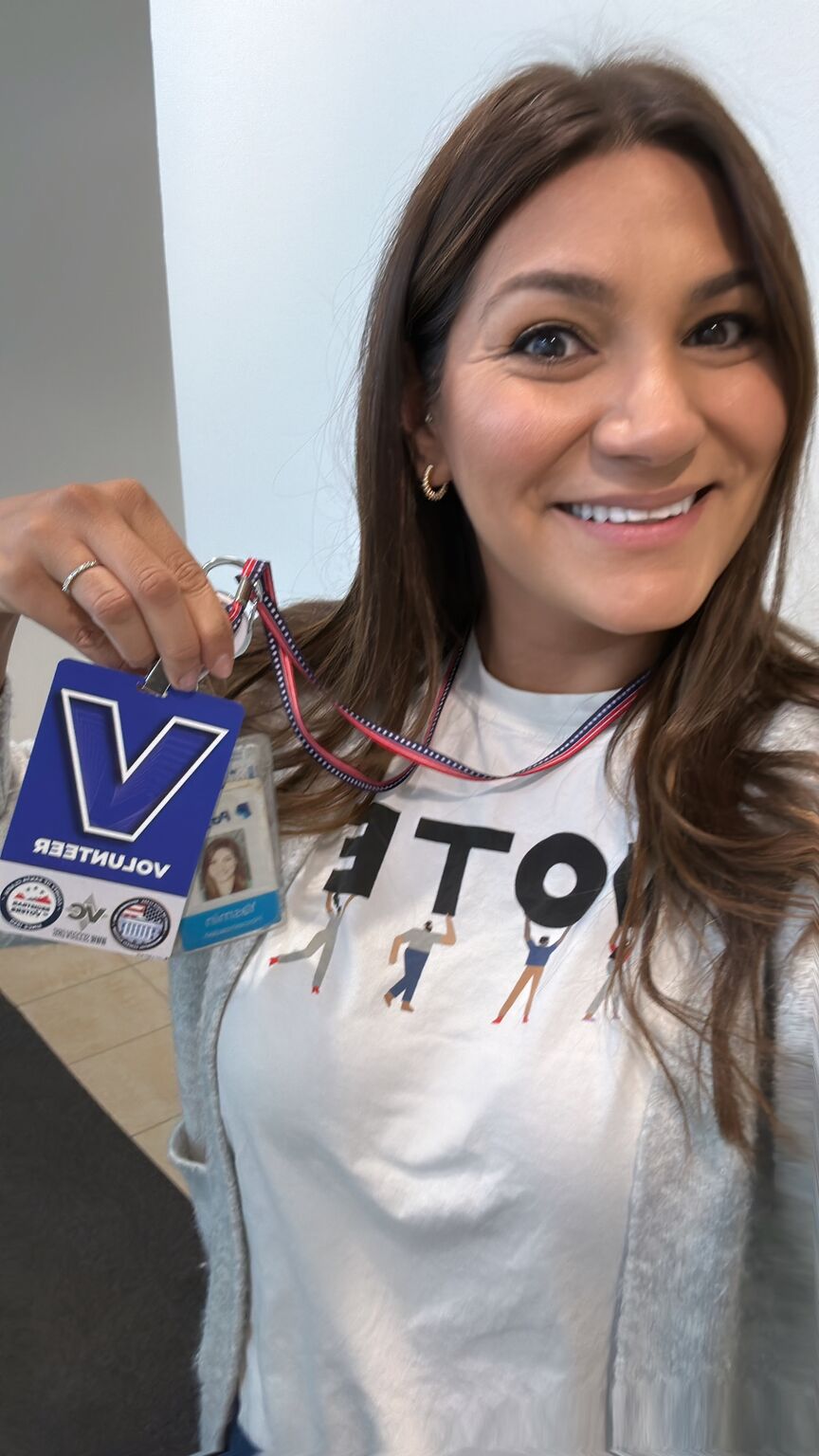
At a polling center in San Jose, Yasmin Hosseinzadeh had an eleven-hour shift to work. It was November 5, 2024, and the polling place was PayPal headquarters. She was there as a volunteer. Her photograph from the day shows a large blue volunteer badge held up for the camera, an unusually literal accessory for someone whose professional life involves communications.
She remembered going to vote with her parents as a child. There were neighborhood garages, signatures to be checked and a family habit of making sure that those old enough had cast their ballots. “My parents always did their research,” she recalled. During her own shift, she watched people fit voting around work. The family ritual had become a day spent helping other people participate.
The story before the speech
Hosseinzadeh is based in San Jose and works at PayPal, where her career has included consumer content, corporate communications and corporate affairs. Her public professional profile describes more than fifteen years of communications experience. That is a broad description of work whose outputs can be remarkably different: a readable travel guide, a revealing interview, an event that gives colleagues time to talk.
The earlier writing offers a useful place to begin. In February 2016, her PayPal byline appeared above a guide to getting around the Bay Area for the big game. Its organizing device was football penalties. Travel problems became fouls; the reader progressed through flights, accommodation and transportation toward a figurative touchdown.
It was brand writing with a specific job: make payment options intelligible through plans people were already making. A flight needed booking. A visitor needed a bed. Someone had to get to the stadium. The joke about remembering an ID and perhaps a foam finger belonged to that setting. Payments arrived inside the outing, alongside the practical business of getting there.
The piece also shows how much communications can depend on the scale of the example. Explaining a platform is an abstract task. Explaining how a visitor might arrange a weekend provides a sequence, a setting and a reader with somewhere to go.
Chicago, with room for a camera
By June 2016, another assignment took readers to Chicago. Hosseinzadeh’s guide, developed in partnership with Lonely Planet, moved through the city’s architecture, lakefront and public spaces. It was a list of things to do, written for people choosing where to spend their time.
There is a small personal detail in the image credits. Photographs of the Jay Pritzker Pavilion and fireworks over Navy Pier carry her name. Alongside the written guide, there was a contribution made through a camera. The resulting page gives us more than a line on a résumé: there is work to look at as well as work to read.
A city guide asks its writer to choose. A skyline may contain plenty of buildings; an itinerary has limited room. Public spaces, food and familiar landmarks compete for attention. Her Chicago piece belongs to that practical editorial form, where usefulness depends on giving the reader a route through abundance. It is an early example of her work turning a broad subject into an organized experience.
Questions with consequences
The same month, her writing addressed a considerably different subject. An interview with PayPal government relations colleague Devin Whitney examined workplace equality and the company’s decision to withdraw plans for an operations center in North Carolina.
Her questions followed the work behind the decision. What did his job involve? How had the team considered its options? What did equality mean in the organization’s conduct? Whitney described the research and deliberation that preceded the withdrawal. The interview gave readers a colleague’s account of an issue that had business, employment and public-policy consequences.
For a profile of Hosseinzadeh, the distinction matters: she was the interviewer. The policy work and decisions described belonged to Whitney and the wider leadership team. Her contribution was to ask for an explanation and shape a conversation around it.
Placed beside the travel pieces, the interview demonstrates the range of her published assignments. One required an inviting route through a city. Another required readers to follow a consequential corporate choice. Both needed a structure; the subjects demanded different kinds of attention.
Letting a leader explain the turns
In May 2017, Hosseinzadeh interviewed Peggy Abkemeier Alford for the Women Leaders of PayPal series. Her credit identified her as Corporate Communications + Digital Content Manager. The conversation began with family and early life before moving into professional experience.
Alford’s career supplied plenty of turns: accounting, finance, operating responsibilities and leadership across different functions. Hosseinzadeh asked what had enabled her to keep learning, what challenges female leaders faced and what advice she would offer first-time managers. The questions made room for the choices behind the titles.
It is an interview worth distinguishing from a collection of career tips. Hosseinzadeh asked about personal management style, then allowed Alford to explain how context, complementary skills and confidence figured in her approach. The reader could follow a person reasoning about work.
Those were Alford’s lessons. Hosseinzadeh’s own professional development would later produce another chapter, with a less glamorous setting than an executive interview: coursework after the working day.
The second shift was coursework
In August 2022, she announced that she had completed Berkeley Law executive education coursework and PayPal’s Emerging Leaders Program. She described six months of late-night coursework, readings and meetings alongside her day-to-day responsibilities.
Her announcement thanked sponsors, colleagues and fellow participants. She named the people who had supported the process, including members of her global Emerging Leaders Program team. The achievement appeared as something she had worked for with other people’s help.
“I’m looking forward to applying lessons learned once back from leave,” she wrote. It is an admirably practical ambition for the end of a course. The learning still had somewhere to go.
Her account captures an ordinary difficulty of professional education: it has to occupy actual hours. Courses can appear as neat entries on a profile long after the readings and meetings are finished. Her description leaves the work visible. Six months is long enough for an initial intention to need a repeated place in the week.
Eleven players, several priorities
Another classroom came with a soccer ball. In May 2024, Hosseinzadeh reflected on coaching eleven under-six players across two seasons with AYSO. The group offered immediate evidence that people on the same team can want different things.
Some wanted particular roles. One wanted to take the kickoff. Her own child repeatedly asked about snacks. Even a shared objective leaves room for an individual agenda, especially when that agenda is edible.
She described learning how to position players around their strengths and understand their motivations. Recognition became part of the routine: high-fives, fist bumps and encouragement for everyone on the field. Players came to expect the moment of acknowledgement and sought her out for it.
“Meeting players where they’re at.”Yasmin Hosseinzadeh, reflecting on coaching
She connected the experience to her professional work and described the feedback from parents and players as rewarding for her own development. The coach was still learning. Her account gives leadership a pleasingly concrete scale: eleven individuals, two seasons and a recurring need to notice who was in front of her.
People who had worked together finally met
In March 2025, PayPal colleague Joseph Gallo described a Corporate Affairs gathering in Scottsdale, Arizona. He had been at the company for eight years and wrote about the significance of bringing the group into the same city and room. The gathering included learning, exchanging ideas and getting to know teammates.
He thanked Hosseinzadeh, Jackie Renna, Sabrina Burke and Casey Merritt for organization and logistics, and Amy Bonitatibus for bringing the team together. It was a shared credit for a shared undertaking. The concrete outcome was a chance for colleagues to spend time together beyond their usual working arrangements.
Jordun Lawrence’s account added another perspective. After nearly five years at PayPal, Lawrence met some Corporate Affairs colleagues from the United States and elsewhere in person for the first time. Existing working relationships acquired a different setting. There was also time to get to know colleagues with whom Lawrence had worked less closely.
Lawrence thanked the same organizers. In those accounts, the event’s value was expressed through participants’ experience: whom they met, what they learned and how they felt on leaving. Organizing is visible here through the opportunity it created for other people. That is a useful way to understand this part of Hosseinzadeh’s work, without pretending that a room full of people assembles itself.
A moderator’s place in the room
Hosseinzadeh has also described moderating the opening panel of the inaugural Money20/20 Rise Up engagement in 2018. In a later public recollection, she remembered both that professional assignment and winning $100 on the casino floor with Louise Pentland. A conference memory can apparently accommodate a panel and a modest improvement in one’s spending money.
The detail sits comfortably alongside her other public accounts. They contain specific people, practical responsibilities and occasional amusement. Her career can be followed through things she has written, questions she has asked and gatherings she has helped organize. Outside those assignments are a volunteer badge and a youth team whose members needed different kinds of encouragement.
Together, these episodes invite a reading of communications as work that helps people take part. An interview gives someone room to explain. A guide gives someone a way through. A gathering gives colleagues time together. The scale changes, and so does the task. Hosseinzadeh’s accounts keep returning the attention to the people involved.