Yann Le Bihan began with a useful reversal of the usual software ambition. He found a product worth selling before he came to own the business behind it. In 1986, he established Le Bihan Consulting to distribute PSN project-management software in France. By 2008, he was Sciforma’s CEO in the United States. The distance between those two jobs is the heart of his story: a customer relationship that grew into responsibility for the product itself.
Project management is an occupation with limited opportunities for glamour. Its vocabulary includes capacity, schedules, resources and costs, words unlikely to cause a queue outside a bookshop. Yet the question underneath them is quite lively. Which of our ideas can we actually carry out? A magnificent plan can survive almost anything except the arrival of Monday morning.
Le Bihan made a career in that gap between intention and delivery. His business concerned the machinery that helps organizations choose projects and organize their execution. There is a pleasing irony in his own description of himself: a dreamer whose commercial life involved helping other people make their dreams answer to a calendar.
A customer becomes the owner
The route began before the French consultancy. Working for COMEX in Indonesia in the 1980s, Le Bihan encountered the shortage of project-management software in international organizations. After returning to France in 1985, he discovered PSN, developed by the American business Scitor, and secured French distribution rights. Within three years, his consultancy had become Scitor’s largest customer worldwide.
Later came the acquisition of the software business, the combination of the operations and, in 2008, his move to the United States as CEO. His education included École Centrale de Nantes and an MBA from HEC Paris. But the business sequence has its own interest: first learning to take a product into a market, then taking charge of its future.

A distributor’s story had become an owner’s story. Yann Le Bihan, pictured in 2012.
Distribution deserves a little respect here. It is easy to treat it as the uninteresting corridor leading to the room where products are invented. Yet a distributor works at the point where a product must persuade somebody to buy it. That makes the progression particularly revealing. Le Bihan’s experience of selling the software preceded his authority over the company that developed it.
French distribution
Move to the US
Leadership transition
French corporate history supplies another view of the transition. A 2008 registration notice for Le Bihan SA recorded Sciforma as its commercial name, Jerome Anres as chairman and chief executive, and Le Bihan as a director. The French entity and the international operating story had their own titles and responsibilities. A company biography becomes more intelligible when those distinctions are allowed to remain.
In 2011, Sciforma Group’s registration named Le Bihan chairman and managing director, with Anres as deputy managing director and a board member. Agnes Faure was also a director. Behind the simpler public title of CEO stood a corporate structure and colleagues with defined responsibilities. The business had several people in the picture.
A dreamer with a dislike of bureaucracy
“I have always been a dreamer.”
Yann Le Bihan · Sciforma 7 introduction
His signed introduction to Sciforma 7 gives that brief confession some substance. He described enjoying invention and new projects while recognizing how difficult execution could be. He also raised a familiar organizational hazard: each problem can provoke another process, another measure and another layer of complexity. A remedy can acquire quite an appetite.
His argument allowed a place for controls and consistency, while putting people, transparency and adoption at the center of improvement. His stated ambition was software that users would enjoy, could adapt to their circumstances and could change with their needs. For enterprise software, enjoyment is an unusually hospitable word. It admits that the person opening the application has a vote.
Read as a product philosophy, this is a practical constraint on the maker. The tool has to earn repeated use. A system that requires heroic patience from everybody who touches it has made patience one of its hidden costs. Le Bihan’s emphasis on adaptability also acknowledges a simple complication: organizations differ, even when their software purchase orders look remarkably alike.
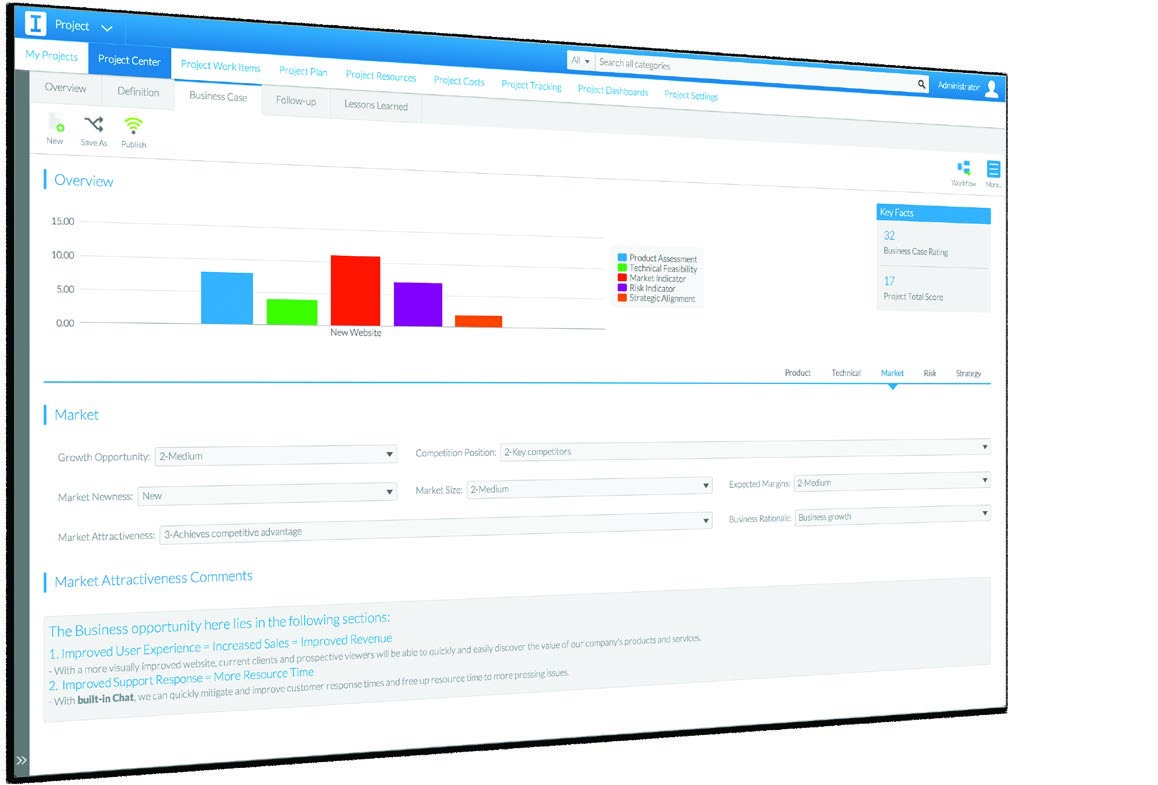
The dream meets the columns. An archival product view from the Sciforma 7 era.
For the reader, this makes a useful way to judge the business. Consider the person who must enter information, the colleague who needs to understand it and the manager deciding what happens next. Each has a different reason to open the same tool. Making their needs coexist is part of the product problem. The work of coordination begins inside the software before it can help coordinate anything outside it.
The browser gets a vote
That emphasis gained a concrete technical expression at the April 2015 launch of Sciforma 7. The company introduced an HTML5 version after earlier moves through DOS, Windows and Java. Le Bihan explained the attraction in terms of compatibility across computers, operating systems and devices, without browser plug-ins. A technical migration was being presented through the ordinary circumstances of use.
The release also described responsive extensions and configuration intended to be accessible without HTML5 or CSS knowledge. Le Bihan wanted administration to reach beyond a small group of specialists. That is a specific product decision, with an understandable human consequence: more of the people responsible for a system could have a hand in adjusting it.
There is something instructive about the modesty of those concerns. A browser, a screen size, an administrator trying to change a setting: none sounds like the grand subject of a founder’s biography. Together they explain how product philosophy becomes work. Ease of access is made out of decisions small enough to disappear when they succeed.
A French accent in California
Le Bihan’s career also placed him in the conversation between French business and California’s technology economy. The IHEE’s 2014-2015 program listed him, as Sciforma CEO, among the speakers for its California seminar. The program examined the region’s capacity for reinvention and brought participants into contact with entrepreneurs, technology businesses and universities.
His name appeared in a varied company of speakers that included Eric Hautemont of Days of Wonder, Emmanuel Marot of Lending Robot and Philippe Guglielmetti of Zeepro. This places him within a documented professional setting, without turning a shared program into a claim of friendship. For a French entrepreneur running an American software business, the setting makes a fitting footnote to the transatlantic career.
It also widens the portrait beyond the product announcement. Software businesses have to explain themselves to customers, prospective partners and other businesspeople. In this instance, Le Bihan was part of an educational encounter with the California economy. The business that began with bringing American software to France had put its founder on the other side of that exchange.
The handover, and the company beyond it
On March 31, 2021, STG announced its acquisition of Sciforma. It identified Le Bihan as founder and co-CEO alongside Jerome Anres, and set out an intended transition of operations to Doug Braun as CEO and Laurent De Kimpe as CFO. Le Bihan’s comment looked toward the financial resources available for the company’s next stage.
The handover matters to the shape of this biography. Leadership is a period of responsibility, with a beginning and a succession. In Le Bihan’s case, the sequence had run from establishing a distribution business to owning and leading the software operation. The 2021 announcement marked a further change in who would provide the capital and run the organization.
Sciforma’s later history continued under that new leadership. On February 18, 2025, Planview announced its completed acquisition of the company. Braun was identified as Sciforma CEO. The transaction emphasized European reach and continuing service for customers. This belongs to the company’s subsequent chapter, following the operating transition announced four years earlier.
Today, Planview identifies the former Sciforma Vantage product as ProjectAdvantage. Names and ownership can change while a software business continues to address the work its customers have to deliver. That continuity gives Le Bihan’s earlier concern a certain durability: people still need to choose among possible projects, organize their resources and finish what they begin.
There is a further perspective in the scale of the inherited business. Planview describes Sciforma’s customer reach across 22 countries, spanning functions that include IT project offices, product development and public agencies. These are different working environments, with different obligations. The range makes the older emphasis on adaptable tools easy to understand. A product that travels has to accommodate more than a change of language; its users bring different priorities to the same screen.
The appeal of his story lies in its progression. A distributor became an owner. An owner explained why the product should be easier to use. A founder participated in a handover. Through those changes runs the same practical subject: making an idea workable. The dream may deserve the first sentence. The calendar will insist on having a few words of its own.