A trade has an afterlife. Someone agrees a price, and then other people must value the position, measure its risk, arrange collateral and settle the obligation. The commercial decision may take seconds. Keeping every department in agreement is a continuing job. Orchestrade has built its business around that less glamorous stretch of the transaction.
- One shared model: trading, portfolio risk and operations work from the same underlying structure.
- Institutional customers: banks, hedge funds and energy businesses, including Mizuho and ENGIE.
- Real migration work: interfaces, workflows and internal models still need attention.
01 The argument is in the plumbing
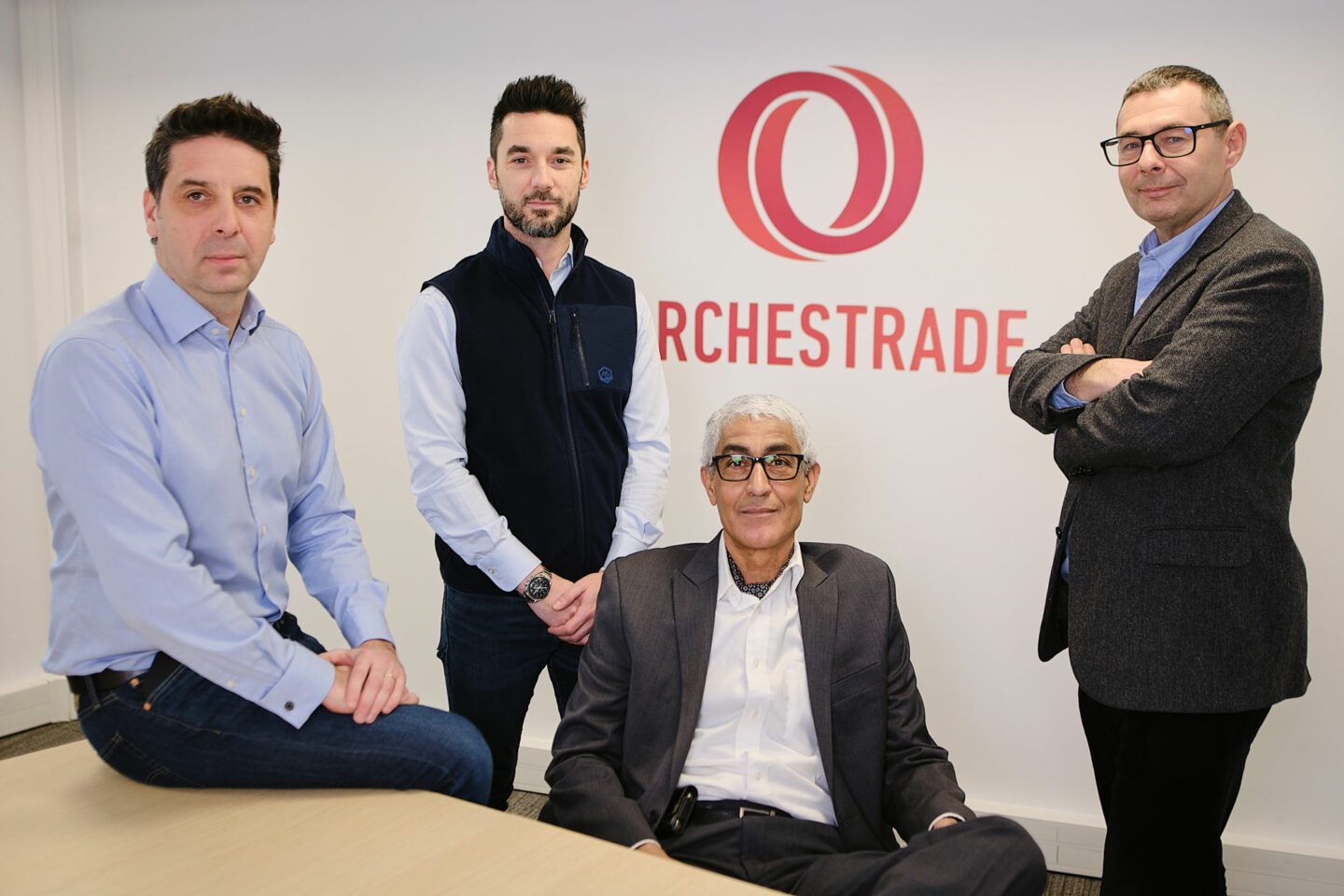
Founded in 2009 by Hakim Erhili and Paul Bardavid, Orchestrade sells software for institutions managing portfolios and trading operations. Its territory stretches from financial derivatives to physical energy contracts. The product connects trade capture, valuation, profit and loss, risk and downstream processing. A portfolio manager can inspect exposures while an operations team follows the events that turn a deal into payments and settlement.
The distinction Orchestrade emphasizes is architectural: different instruments share one data model. Imagine the difference between several departments keeping compatible spreadsheets and those departments working from the same record. That analogy simplifies the engineering, but catches the operational ambition. Fewer translations should mean fewer opportunities for disagreement. Whether that happens depends on implementation.
The company’s founders described an engineering-led, self-funded business in a 2024 interview. Their attention had gone heavily into the product before sales and marketing. The name itself points to an orchestra: distinct parts coordinated into something coherent. It is an unusually appropriate metaphor for software whose customers must make many specialized teams agree.
02 Nine months to a clearer picture
Mizuho Bank London supplies a concrete example. Its trading and risk information lived in multiple systems. Producing a consolidated view quickly enough for business and regulatory needs was difficult. In December 2018, Orchestrade announced that the bank had brought its consolidated risk platform into production after a nine-month project, measured from selection.
The stated benefits were less manual processing and reconciliation, lower running costs through automation, and more flexibility in presenting risk to different businesses. The announcement described completion within budget. Those are reported project outcomes, rather than a promise that another bank will finish on the same schedule.
Mizuho Bank London’s reported journey from selection to production, announced in December 2018.
Orchestrade’s banking proposition also allows a narrower beginning: one desk or use case, connected to existing systems, followed by further migration. That matters because institutions have investments in their own models and processes. A replacement that demands abandoning every useful piece at once faces a harder organizational argument.
03 ENGIE brings the hard part into view
Energy makes the coordination problem more interesting. A power purchase agreement carries obligations over time; physical gas and electricity bring delivery considerations alongside financial exposure. Orchestrade’s energy offering covers physical and financial products, environmental instruments and structured contracts, including PPAs and battery storage agreements. Its users need to connect commercial terms with valuation and risk.
Collaboration with ENGIE began in 2017 after a successful proof of concept. By March 2019, the company announced production use at ENGIE Global Markets in Paris, Singapore and Brussels. Technical design and cross-asset coverage helped make the case. ENGIE also brought commodity expertise into the development relationship.
The revealing detail is the work around the software. ENGIE executive Alexandre Cosquer described replacing information systems, revisiting processes before and after trading, and rewriting proprietary quantitative libraries. Teams from operations, finance, trading, technology, quantitative analysis and risk participated. The commitment involved people and existing intellectual property as well as the application.
“We wanted to have one user-friendly system with a real-time view of risk and P&L.”
Nigel Eastman / Finisterre Capital
Company-published customer testimonial
That experience suggests a useful buying discipline: follow a real contract through its entire working life before judging a demonstration. Include an amendment, a valuation change and a settlement event. A neat screen proves relatively little if the next department still has to reconstruct the transaction.
Record the instrument and its contractual terms.
04 A platform with open doors
Orchestrade’s technology page lists more than 140 ready-made connections and API access through C#, Python and REST. Customers can bring proprietary models and applications into the environment. Deployment options include public clouds, private clouds and on-premises infrastructure. The practical appeal is room to preserve useful systems while changing the machinery around them.
Its July 2023 partnership with Rebar illustrates that approach. Rebar’s ROME supplies order and execution management; Orchestrade contributes portfolio and risk capabilities. A common internal model can coexist with specialist external tools. Buyers still need to establish which party owns each workflow, connection and operational handoff.
The business is enterprise software, sold through a sales-led process with pricing by quotation. For a prospective customer, the relevant economic comparison includes configuration, integration, migration, upgrades and operating effort. ENGIE’s experience makes that wider accounting especially persuasive. A procurement spreadsheet focused solely on the software bill would miss much of the project.
05 Buy for the handoffs
Orchestrade sits in the institutional trading and risk market alongside providers such as Murex and ION, with the relevant alternatives changing by workflow. Its case rests on shared data, lifecycle automation and extensibility. Buyers can test those claims against their own instruments, transaction volumes and exceptions.
In May 2026, Orchestrade announced deployment at Singapore-based macro hedge fund Southern Ridges Capital. That adds a recent customer example to the older bank and energy cases. The company also reported portfolio-management and risk-technology awards in June and July 2026. The deployment provides the more practical question: what work can a customer now do with greater consistency?
The lesson travels beyond trading. Find where people repeatedly translate the same information, then test whether a shared model removes that work. Orchestrade’s proposition becomes compelling when those handoffs consume meaningful time. A straightforward portfolio with few operational complications has a weaker reason to undertake the migration. The starting point is the work itself.