Sameer Soleja’s first good idea had an awkward follow-up question. He had built a natural-language tool for entering energy trades into software. Type the transaction, let the parser handle it: an elegant improvement to an irritating job. Then prospective customers asked what happened after the transaction was captured. A better entrance was useful. They still needed the rest of the building.
Molecule began in Houston’s first Surge Accelerator class in 2012. Soleja remembers lying on the accelerator’s floor a month into the program, wondering whether starting the company had been a terrible mistake. The first customer arrived roughly eighteen months later, after reading about Molecule in the Houston Chronicle. In 2024, that customer was still with the company. Soleja had lunch with them on his calendar.
Those two scenes belong together: a founder on the floor, then a founder going to lunch with a customer more than a decade later. They give his business a human scale. Beneath the market data and software terminology sits a rather old-fashioned ambition: make something useful enough that people keep coming back.
The twenty-million-dollar irritation
Before Molecule, Soleja spent about a decade developing and implementing energy-trading systems. At SunGard, he worked inside the industry he would eventually try to change. His dissatisfaction had a price tag. He recalled helping a gas company implement OpenLink Endur at a cost of up to $20 million, while watching people leave work frustrated day after day.
The money bothered him, but so did the experience. Enterprise software could command a substantial budget and still make the ordinary working day unpleasant. On a phone, meanwhile, inexpensive apps were teaching users to expect clear interfaces and quick results. The comparison was almost impolite. A business system costing millions ought to have something to say for itself beyond the invoice.
Soleja saw several practical openings: cloud infrastructure, better open-source components, improved design, and natural-language processing. Together, they made a different kind of product possible. His stated aim was to help people finish their work quickly and enjoyably, then go home early. That last detail gives the technical program its point. Nobody buys back an evening by admiring a database.
An education in other people’s markets
Soleja holds a BBA from the University of Texas at Austin and graduate degrees in business and public policy from the University of Michigan. His studies included sukuk and Turkish financial clearinghouses. These are unusually specific interests for someone whose later company would concern itself with the particulars of commodity contracts. They belong to the same broad territory: how institutions turn agreements into things that can be recorded, valued, and administered.
His consulting career included SunGard, BearingPoint, and Stryve Advisors. He also worked at Constellation Power in Baltimore. That background matters because his complaint about trading software came from time spent around its users. He had seen the implementation work, the constraints, and the expensive compromises. He returned from business school believing the underlying technology had advanced far enough to permit a better approach.
The career did not provide a shortcut around every difficulty of starting a company. It did provide a vocabulary for the difficulties. A founder selling software to energy companies has to understand what happens when the contract leaves the sales presentation and enters somebody’s working day.
Nine years, then twelve million dollars
On May 6, 2021, Molecule announced a $12 million Series A. Mercury, the Houston venture firm, participated in the investor group. For a company founded in 2012, the announcement marked nine years of work before that financing milestone. The interval is more revealing than the round’s label. It puts a sensible brake on the idea that enterprise software becomes a business as soon as the demonstration looks convincing.
The planned spending was concrete: physical and financial power, renewable credits, accounting, settlements, and other back-office functionality. These were the jobs waiting beyond the clever trade-entry tool. A customer needed the position calculated, the contract handled, and the resulting information carried into the next process. The useful product had to cover a working sequence.
In his announcement, Soleja described ambitions that reached from electricity trading to the wider ETRM market. He also listed the unglamorous work required to get there: product management, counterparty management, enterprise features, and additional deal types. A funding announcement makes an agreeable occasion for a victory lap. His included a substantial to-do list.
Electricity refuses to sit still
By 2020, power represented more than half of Molecule’s customer base. Soleja and the team chose to invest further in it. Elektra, their power-focused offering, became central to that effort. The decision gave the company a clear place to concentrate resources as electricity and renewables became a larger part of trading portfolios.
The names can sound abstract until a contract arrives. In June 2025, Soleja described power purchase agreements that might cover a share of a wind facility’s output, or even a share of one turbine’s output. The quantity changes with generation. A decades-long agreement may settle hourly. Each apparently simple commercial promise brings a great many entries behind it.
He said one trade, represented in Molecule’s native structure, had been estimated to require half a billion rows. The team had to optimize its processing. That number is useful precisely because it describes a problem rather than a trophy. The deal is singular; the records are multitudinous. A trader wants an intelligible position while the software has to preserve the detail underneath.
The promise has to survive Tuesday
Soleja is attentive to the uncomfortable distance between what software can be sold as and what it actually does. He describes a crowded vendor market in which substantial contracts encourage substantial promises. His chosen competitive ground is usability and technology. He has also acknowledged that focus can become too broad or too narrow: one leaves customers insufficiently served, the other leaves too little product to sell.
The practical test comes after the polished demonstration. In a 2023 discussion of ETRM buying, he advocated extended paid proofs of concept. A buyer can work with the system before making the larger commitment. The vendor gets paid for the effort. Both sides have a chance to discover whether the advertised feature behaves properly with the customer’s actual requirements.
He described another boundary in the engineering: a core application surrounded by an API, with customizations outside it. That structure lets the central product move forward while other work connects through defined interfaces. It is a plain answer to a familiar enterprise predicament. Every customer has something particular in mind; every shared product needs enough consistency to remain maintainable.
“You can’t be everything to everyone.”
Sameer Soleja, August 2024
A good interface has to keep its word
In June 2024, Soleja was talking about trust as well as technology. He believed Molecule’s reputation benefited from underselling. The same discussion covered frequent releases, its Bigbang data service, and work on a new user interface. The themes fit together. A pleasing screen is only the beginning of usability. Updates, reporting, and access to the underlying information determine whether people can keep doing their work.
Molecule’s current product brings in trades from exchanges, spreadsheets, and APIs, alongside plain-English entry for over-the-counter deals. Market data supports valuation; the system calculates positions, profit and loss, and risk. Reports can be used within Molecule or connected to tools such as Excel and Power BI. The early entry mechanism now belongs to a broader workflow.
There is a certain satisfaction in that progression. The initial customers’ question was reasonable, and the product’s development has had to take it seriously. Entering the transaction matters because of the decisions, reconciliations, and reports that follow. Good design must continue beyond the first click, into the parts of a job that seldom make a fetching conference slide.
A larger company, a familiar argument
Molecule announced a Series B led by Sundance Growth in July 2025. Its customer footprint included the UK, Europe, Canada, and South America. Nuveen was among the European customers named. Elektra and Hive, its renewable-certificate module, had received GlobalData’s 2025 Power Technology Excellence Awards. The company also operated a dedicated European production environment.
In July 2026, Molecule acquired Trilogy Energy Solutions, a provider of software for physical natural-gas operations. The acquisition brought pipeline nominations, scheduling, allocations, and producer settlements into the company’s wider plans. The announcement identified Soleja as Founder and President and Patrick Smith as CEO. Soleja described the combination as extending Molecule’s mission from the trading desk into physical gas operations.
The ambition had acquired a larger set of practical responsibilities. A financial position and the movement of physical gas have to meet somewhere. Bringing the platforms together was intended to reduce manual closing work and improve the connection between those records. It returned to the question that had followed the first trade-entry demonstration: what happens next?
Right enough to send the bill
In September 2026, Soleja appeared with Molecule sales engineer Barry Lowe to discuss modern power trading. His distinction between an analytics system and an ETRM was crisp: analytics deals in probabilities; a system of record supports predictable daily reporting. The two can work together, but their responsibilities differ. A useful forecast and an authoritative record are doing different jobs.
He also discussed the temptation to model a complicated power agreement as a monthly strip. Such a representation might give a trader an adequate broad view. It could still lose details needed for billing or omit the choices embedded in the agreement. Getting an approximate position is one problem. Preserving enough information to settle the contract is another.
That is where Soleja’s story has arrived: still arguing over what software owes the people using it, with a much more complete answer than he had on the accelerator floor. The original wish was modest in human terms and demanding in technical ones. Let someone finish a complicated job without the system becoming another complication. Then let them go home.
Capture → Value → Report → Settle
A simplified trading workflow. Each step has to keep the next one possible.Continue the conversation
- Molecule website ↗
- Sameer on LinkedIn ↗
- Sameer’s blog archive ↗
- A conversation with Jonathan Kingsman ↗
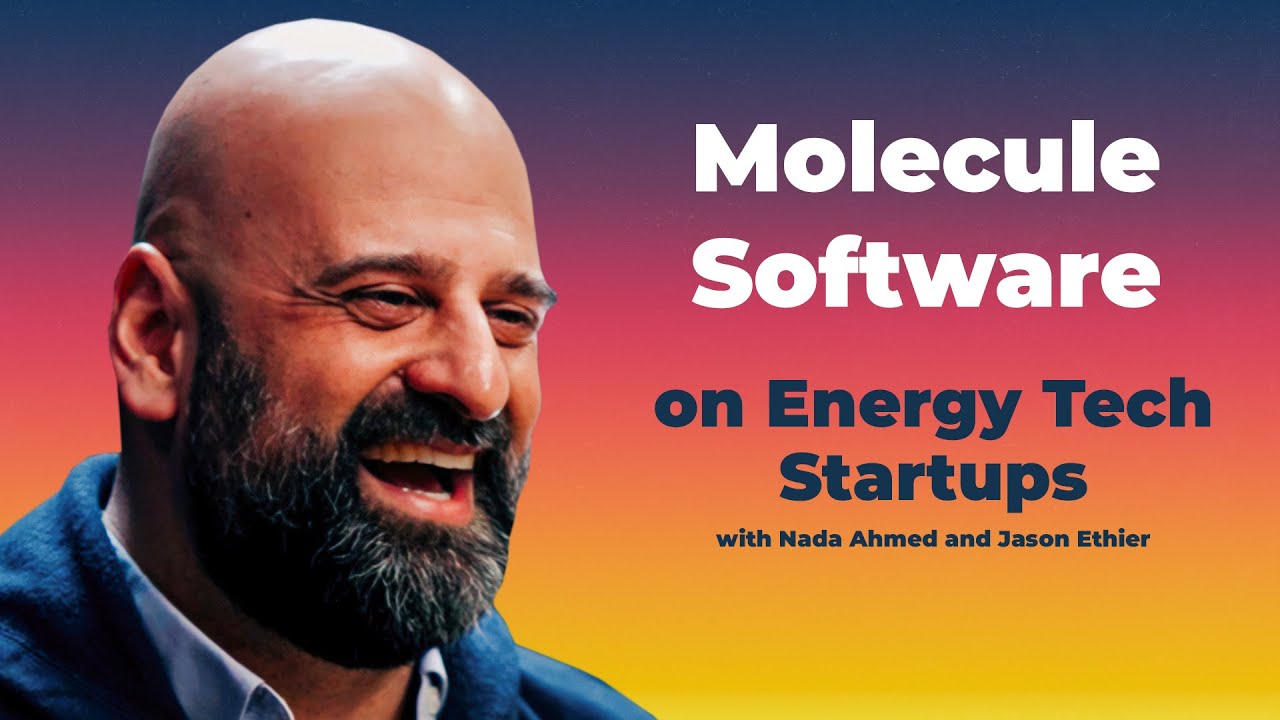
- Watch: Energy Tech Startups ↗
- Watch: CTRMRadio ↗
- The 2017 interview ↗
- The $12M Series A ↗
- The Series B announcement ↗
- Trilogy acquisition and current leadership ↗
- The Power Problem, September 2026 ↗
- The Frontier biography ↗
- Paid proofs of concept ↗
- Molecule’s 2024 product discussion ↗