David Ryland has a useful prescription for people who make software: give the customer a speaking part. He co-founded Streamline Healthcare Solutions with Javed Husain in 2003, after an earlier venture together at Askesis Development Group. Across that history, the interesting thread is the distance between building a system and making it agreeable to use. A computer can be perfectly satisfied with a piece of software while the person sitting in front of it is considering a change of career.
Ryland’s career has crossed design, development, sales and implementation. Those jobs encounter the same product at rather different moments: when it is an idea, when it is a promise, and when someone must actually get it working. His story is worth following through those changes of perspective. It offers a view of company building measured in years of practical decisions, shared work and the unglamorous business of keeping a product useful.
Before Streamline, there was Askesis
In 1993, Ryland co-founded Askesis Development Group, where he served as chief operating officer. Husain was also a founder. Askesis was sold in 2002; the following year, the pair established Streamline. The dates matter. Streamline began with partners who already had a company behind them, rather than two people introducing themselves over a speculative business plan.
Ten years separate the two founding dates. Nine separate Askesis’s founding from its sale. A chronology like this has a pleasing resistance to the overnight-success story, that obliging literary invention which removes most of the work to improve the plot. Ryland’s business history includes an earlier operating role, a sale and a second beginning. Each is a distinct chapter, and the second company deserves to be understood in that sequence.
Ryland earned a Bachelor of Arts at Northwestern University. His subsequent responsibilities took him across both the making and the delivery of software. That range is particularly relevant to an enterprise product: a design decision eventually becomes somebody’s implementation problem, and a sales promise eventually acquires a user. The handoffs are part of the product’s life, however little space they receive in its brochure.
A product has to survive the working day
Streamline’s SmartCare became an enterprise software platform bringing an organization’s work into a shared system. Its 2023 product overview described a cloud-based application with a single-platform approach. For a founder, that is a continuing obligation. The more work a system brings together, the more people have reasons to care about its smallest inconveniences.
There is an obvious attraction to putting information in one place. There is also a difficult design question: how does each person find what matters without navigating everything that matters to everybody else? Enterprise software lives inside that question. A unified platform can simplify an organization’s architecture while still asking a great deal of the individual using it. The daily experience is where the proposition meets its examiner.
In his introduction to Streamline’s blog in 2017, Ryland concentrated on users, practical guidance and communication. He discussed the Go! feature for one-click access, SmartView for seeing information without interrupting work, and the company’s commitment to mobile and offline access. These are revealing examples of his product interests. They concern the little interruptions that make a long day feel longer.
He also set out an editorial purpose for the blog: explain features, share ways to use the system and address customers’ operating demands. That gives the company’s writing a practical job alongside its software. A feature needs an explanation; an explanation needs to respect the reader’s time. Even a helpful tool can become a nuisance if its introduction requires a small expedition.
“Listen to the customer - invent for the customer.”David Ryland, 2017 • punctuation normalized
Two founders, one continuing conversation
Ryland and Husain’s partnership runs through both Askesis and Streamline. They were publicly identified as Streamline’s co-CEOs in 2017. A joint leadership title tells us how the company presented their responsibility; the longer connection tells us something more specific about its origins. They had built together before, and they chose to do so again.
In their 2017 discussion of Streamline, the pair described a development approach shaped by customers’ requests. Ryland emphasized listening and invention. Husain described working directly with customers on new functions and an ambition for customers to share what they developed. Together, those ideas suggest a useful division of attention: hear the particular difficulty, then consider whether the answer can travel.
That is an appealing possibility for a shared software platform. A request from one organization might lead to something useful elsewhere. It also creates a demanding editorial task for the people building it. Every suggestion arrives with its own urgency, and a product must somehow remain intelligible after accommodating many of them. Saying yes is delightful. Maintaining the resulting menu requires considerably more discipline.
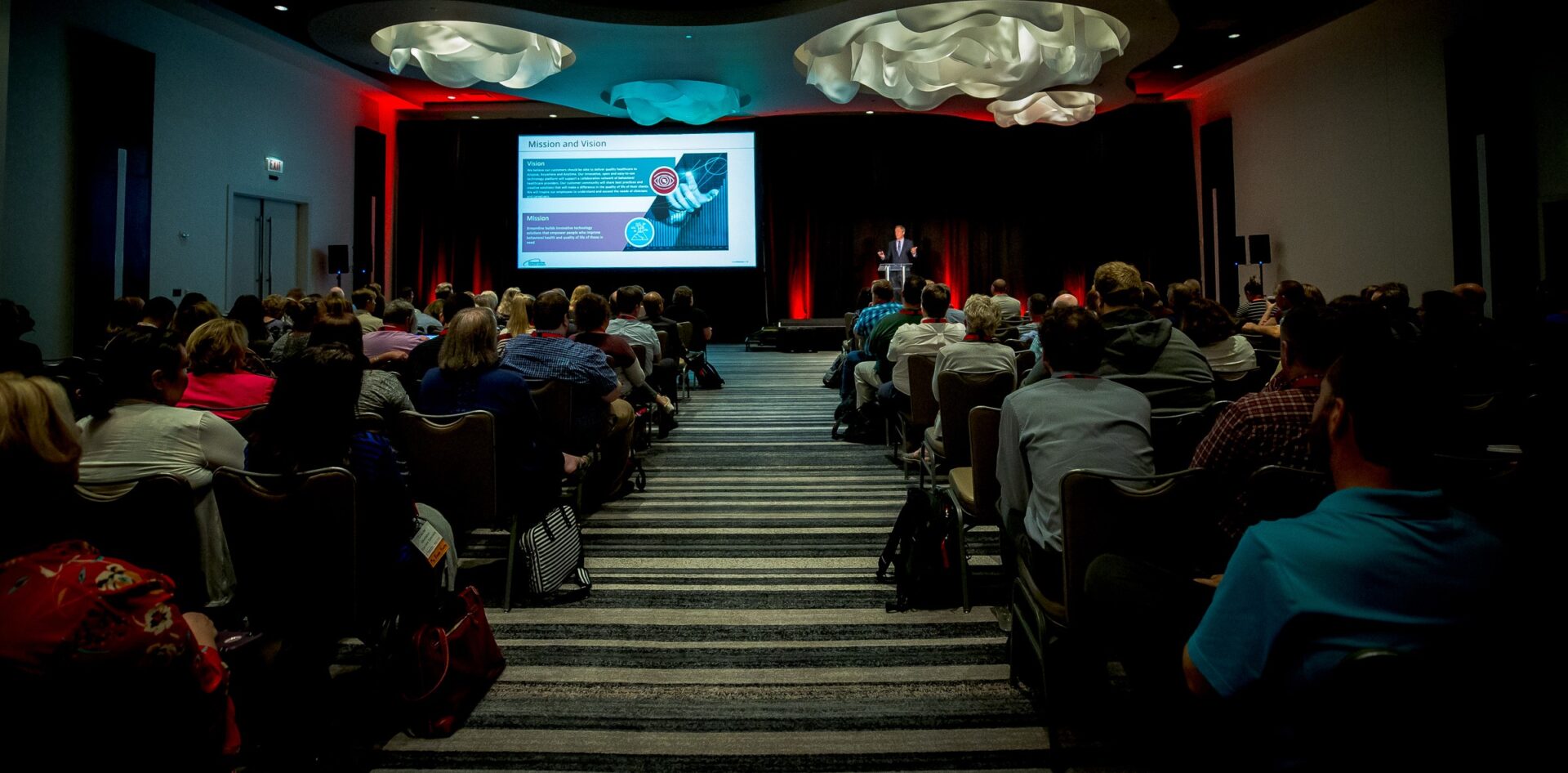
The company’s community conferences gave this customer relationship a physical setting. The photograph shows the familiar apparatus of a working conference: rows of attendees, a projected presentation and a speaker at the front. There is something reassuringly concrete about it. Software may arrive through a browser, but its users still have questions that benefit from a room, an agenda and another person answering them.
What twenty years looked like
By 2023, Streamline was marking its twentieth anniversary. The anniversary included a new company and product brand. A visual change is an unusually visible milestone for a software business whose work ordinarily disappears into everyday routines. For Ryland, the date also marked twenty years since the second venture he had founded with Husain.
The company’s 2023 overview supplied a more substantial snapshot: over 100 customer organizations, operations serving more than 25 states, and over 350 employees. It described roughly 90 percent of employees as customer focused. These are historical figures, and they belong to that anniversary-era picture. Their value here is to show the scale of the organization that had developed around the original partnership.
A headcount can occupy a single line on a page while implying a considerable change in a founder’s working world. More people bring more handoffs, more customer relationships and more decisions that cannot all pass through the same desk. The interesting management question becomes how an early approach survives that wider organization. Listening is easy to announce; arranging enough attention to do it repeatedly takes structure.
In May 2023, the anniversary branding announcement still placed the two founders at the beginning of the company’s story. Husain was identified as co-founder and CEO. That distinction is useful when reading Ryland’s career: co-founder is a lasting relationship to a business, while executive titles describe responsibilities at particular times. The timeline continues even as the nameplate changes.
Capital arrives, and the cast widens
On March 7, 2023, Gauge Capital announced an investment in Streamline in partnership with its founders and management team. The transaction provided growth capital and recapitalized the business. It introduced another set of participants into a company that had been operating for two decades.
The plans accompanying the investment included infrastructure, product development, execution capabilities and an expanded service offering. Ryland expressed confidence in the next stage of the company’s development and in Gauge’s experience working with founders. His comments looked forward to participating in that growth. The moment adds a further chapter to the career: building a business, then considering what additional resources might allow it to become.
Four Gauge representatives joined the board: David Friedman, Stan Dennis, Sam Smith and Colin Santoro. Capital arrived with a governance change as well as an investment announcement. A company’s next phase acquires more voices, and its founders must conduct their work within that broader conversation. In Streamline’s case, the announcement explicitly connected the investor with the existing founders and management.
The next name on the door
On March 11, 2024, Streamline announced Navid Asgari as chief executive officer. Ryland welcomed him, connecting the appointment to the vision he and Husain had brought to the company in 2003. The announcement emphasized customer experience and further investment in the platform. For a story that began with two recurring partners, it is a meaningful widening of the leadership picture.
The sequence is clear: an earlier company, a sale, a second founding, two decades of development, outside investment and a new CEO. Ryland’s place in it is both specific and durable. He is Streamline’s co-founder and a former co-CEO, with a working history spanning the commercial and technical sides of software.
His most useful contribution to the wider conversation may be the plainness of that customer-first instruction. It leaves the builder with a task, rather than an adjective to admire. Ask a question. Hear the answer. Make something that helps. A feature can be announced in an afternoon; earning a place in someone’s working day takes longer. Ryland’s career gives that longer interval its proper share of the story.