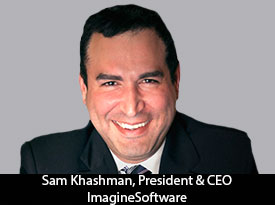
An early customer supplied Sam F. Khashman with something a branding agency would have been delighted to invoice: a name. The customer’s observation was that this young software business could build what its clients imagined. The thought stuck. Technology Partners became known as ImagineSoftware, carrying a small piece of customer feedback into every subsequent introduction.
It is a pleasing origin for a company concerned with removing unnecessary steps. No elaborate mythology is required. Someone described what the team did, and the description became useful. Khashman has returned to the anecdote in interviews over the years, treating the customer’s experience as part of the company’s identity rather than a footnote to it.
Founded in Charlotte in 2000, ImagineSoftware grew around workflow: the sequence of tasks through which a business gets something done. Khashman brought experience with high-volume transactions in manufacturing, finance and insurance. He was interested in what happened between the beginning of a process and its completion, especially the places where people had to repeat themselves.
There is a particular sort of ambition in that choice. Repetition rarely gets a launch party. Duplicate effort does not announce itself as a grand business opportunity. Yet Khashman made a career of examining it. His recurring subject is the work that software asks of people, and whether all of it deserves to exist.
The German degree in the software story
Before the company came a degree that adds an unexpected turn to the usual technology-founder biography. Khashman graduated from the University of North Carolina at Charlotte in 1995 with a bachelor’s degree in German. In 2024, his university celebrated his inclusion in the Charlotte Business Journal’s Power 100 list of innovators.
His public biography describes him as a native of Germany and fluent in five languages. Those details broaden the portrait without requiring a tidy explanation for everything that followed. Studying German did not come with an ImagineSoftware business plan attached. It does, however, belong in the story of someone whose working life extends across software, education and aviation.
He later completed a master’s in Intelligence Studies at American Military University. In discussing that choice, he has described an interest in analysis and thinking through outcomes. The connection to his business is direct enough: before deciding what to improve, someone has to work out what is happening, what matters and what a better result would look like.
Khashman describes himself as a perpetual student. That is a more revealing self-description than another executive title. It leaves room for curiosity after the company has been established and the founder has acquired the authority to stop asking questions. His education is part of an ongoing interest, rather than merely the opening entries on a résumé.
An assembly-line question for the office
Khashman has described the early team’s approach as bringing a manufacturing mindset to administrative work. The targets were waste, rework and duplication. ImagineSoftware eventually concentrated on the complicated business of billing, where a single transaction can pass through several systems and require several people to intervene.
The appeal of that approach is easy to understand. An office can be busy while its underlying process remains awkward. A person copying a detail from one screen to another is doing real work; the software designer still has to ask why the copying is necessary. Activity alone is an unreliable measure of progress.
In a later interview about product development, Khashman described spending considerable time understanding clients’ processes during implementation and continuing to collect feedback afterward. The product roadmap combined those observations with the team’s own thinking about what should come next. The relationship continued after the software was installed.
That creates an interesting obligation for a founder. Listening to customers means hearing how the product behaves away from the demonstration. A feature may sound sensible in a meeting and still make someone’s Tuesday more difficult. His stated approach gives those ordinary encounters a place in the development process. The person using the system gets a vote.
- ObserveHow does the work happen?
- RemoveWhere does effort repeat?
- MeasureDid the result improve?
Growth brings more people to the table
ImagineSoftware’s progress can be followed through a series of business milestones. Inc. lists eleven appearances on its Inc. 5000 ranking through 2021, including an appearance in 2009. These are company achievements, shared with the people who built and sold the products, supported clients and kept the operation running.
Outside investment brought another set of relationships. Mountaingate Capital partnered with Khashman and ImagineSoftware in 2018. In November 2021, Mountaingate sold its position as Marlin Equity Partners completed a majority-control growth investment. Khashman was still the founder and CEO speaking for the company as that next phase began.
A founder’s story changes when ownership changes. More people now have an interest in the company’s direction, while customers still expect their software to work. In announcing the Marlin partnership, Khashman emphasized the platform and entrepreneurial culture the team had built, along with the opportunity to continue developing the business.
The chronology matters because it shows a career conducted over many business cycles. Khashman’s current role follows the original launch, years of product development, growth recognition and successive investment partnerships. The company has changed around him. His continued presence gives the story continuity, though continuity still requires decisions about what to preserve and what to revise.
The founder keeps saying “serve”
One of Khashman’s shortest explanations of his leadership philosophy is also one of his plainest: “We are servant leaders.” He has consistently placed clients, partners and colleagues at the center of that description. The idea is to understand executive authority through the people who rely on its decisions.
In 2018, his acceptance into the Forbes Technology Council added another forum for exchanging ideas with technology executives. He described the opportunity in terms of sharing expertise and working through business challenges with peers. Even in an announcement about membership, the emphasis was on what a group could help its participants do.
His responsibilities extend to Marymount University, where he serves as a trustee and appears on the University Advancement and Investment committees. Those are concrete assignments within an educational institution. They put the software executive in discussions about an organization whose purpose, constituencies and timescale differ from those of a commercial software business.
He also founded EPIC, the Executive Partnership for Integrated Collaboration, which his company describes as a nonprofit focused on learning opportunities and the technology skills gap. Developing future entrepreneurs is a stated aim. Alongside his business, it supplies another expression of his interest in helping people acquire the capacity to do something for themselves.
“We are servant leaders.”
Sam Khashman
A roomful of people behind the platform
The customer relationship that helped name the company eventually grew into gatherings large enough to need a conference hotel. In 2024, close to 300 participants came to ImagineSoftware’s client conference at Gaylord National Harbor in Maryland. Khashman and Chief Software Engineering Officer Chuck Kauffman opened the event with a discussion of strategy and the company’s direction.
The following year, clients and partners gathered at The Cosmopolitan of Las Vegas from May 20 to 22 as ImagineSoftware marked its twenty-fifth anniversary. The program included workshops, conversations about automation and an Experience Room where attendees could try features. The software had a room; its users had questions.
Khashman received a proclamation recognizing twenty-five years of innovation and support for the Radiology Business Management Association’s community. Nicole Jones-Gerbino and Steve Kahn presented it on behalf of RBMA President Peter Moffatt. The detail is useful because recognition, like product development, involves other people with names and long working relationships.
Outside that professional circuit, Khashman is a pilot. His personal professional profile also lists him as a co-founder of Victory Lane Aviation. It is an interest with its own demands and vocabulary, separate from the software company. A founder can spend a career studying systems and still have reasons to look up from the screen.

In 2026, a harder question for AI
By 2026, Khashman was applying his old interest in unnecessary work to a newer generation of software. In a discussion with Rob Gontarek, ImagineSoftware’s senior vice president of data science, he warned against expecting artificial intelligence to repair an already disordered process. Faster execution is useful only when the work being executed makes sense.
His approach begins with knowing the existing process well enough to measure a change. Teams need a baseline before they can claim an improvement. The practical questions concern how long work takes, how often it goes wrong and how much must be done again. These are less theatrical than predictions about the future, and more useful for deciding what to buy.
That emphasis continued in the company’s October 2026 webinar listing, which featured Khashman discussing ImagineApex, the AI engine within ImagineOne. The subject was movement from assistance toward coordinated action. It placed a current product initiative within a much older ambition: reducing the amount of manual intervention needed to finish a task.
The language of software changes quickly. Khashman’s central question has proved more durable. After a degree in German, a company launch, investment partnerships and twenty-five years of customer conversations, he is still concerned with the distance between an intention and a completed job. A customer once helped ImagineSoftware find its name. The people doing the work, with their questions and requests and practical experience, continue to give that name something to live up to.