Andy Maurer started Macro Helix at his dining room table. It is a wonderfully unceremonious address for a software company that would end up inside McKesson. The table has one advantage over a corner office: it offers very little protection from the question of whether anybody actually wants what you are making.
Maurer remembers the beginning with an admission that would rarely survive a corporate communications meeting. He credits its growth despite his early ignorance about running a business. There is more personality in that admission than in a cabinet full of leadership awards. The experienced executive is willing to leave the inexperienced founder in the picture.
His career has since taken him through two company sales and into the chief executive’s job at RedSail Technologies. Along the way, he has worked in banking, consulting, subscription software and operating services. Pharmacy has been the recurring business setting. The questions have changed with the chair he occupies: which problem deserves a company, how should that company grow, and what does it owe the customers who depend on it?
Today, those questions arrive with a rather direct invitation: Ask Andy. RedSail uses the name for conversations between its leadership and pharmacy operators. For a founder accustomed to explaining a new idea, answering for existing software is a different sort of examination.
A finance education, followed by the awkward questions
Born in Minneapolis and now based in Atlanta, Andrew Maurer studied at Emory University’s Goizueta Business School, earning a finance degree and an MBA. His early employers included Provident Corporate Finance, Ernst & Young and Navigant Consulting. He also worked with the Advanced Technology Development Center.
That is a practical education in the distance between a spreadsheet and a working business. Banking asks whether a transaction makes sense. Consulting asks how an organization could perform better. Running a company requires someone to stay after the recommendations have been delivered.
By 2011, Maurer’s advisory work had involved roughly 130 organizations, with assignments covering costs, revenue and operating efficiency. That early record matters because the dining room origin can otherwise give the impression of a newcomer stumbling upon an unfamiliar market. He had spent years studying how businesses in the sector worked before attempting to build one himself.
One former colleague, Joyce Thomas, described him on LinkedIn as having “a questioning attitude.” It is a small phrase, but an apt one for this sequence of jobs. A questioning attitude is useful to a consultant; it becomes rather more expensive when the questions are about your own payroll, product and contracts.
Three years from startup to McKesson
Maurer co-founded Macro Helix in 2009 and served as CEO until 2012, when McKesson acquired the business. He then became vice president and general manager. The transaction changed his job as well as the company’s ownership: the founder stayed to run the business inside its new parent.
Macro Helix built software around a difficult administrative problem. Its customers needed to reconcile purchasing information, eligibility rules and records that were easy to mishandle manually. The company’s commercial opening lay in making that work easier to manage and repeat.
There is a particular sort of enterprise software that never makes a dazzling dinner-party demonstration. Its appeal becomes apparent on the working day when someone no longer needs to chase a discrepancy through several systems. Macro Helix belongs to that practical tradition.
Maurer’s responsibilities reached across product development, marketing and contract negotiations. The work joined the technical and commercial halves of the business: deciding what to build, explaining why it mattered and agreeing to deliver it. A founder cannot enjoy the flattering half of that conversation indefinitely.
The move from CEO to general manager is an easily overlooked chapter in a founder’s biography. A sale supplies a satisfying date for a timeline. Staying supplies the less decorative work that follows. Maurer’s path includes both.
The second company came with company
At Trellis Rx, Maurer worked with Francisco Partners and a wider founding and operating group. He became co-founder and CEO of a business built around helping partner organizations establish and expand pharmacy operations. This time, the story had an institutional investor and an existing network of collaborators.
His own description gives some of the credit away. “The foundation Alon and Brian set for Trellis Rx was quite impressive.” He was referring to Alon Krashinsky and Brian Lovett of Healthcare Foundry. The compliment is useful evidence of how he recounts the company’s beginnings: other people were already building before he took the chief executive’s seat.
Trellis reached the Inc. 5000, placing No. 60 in 2021 and No. 754 in 2022. These are company rankings, rather than individual medals. They give a public marker to a period that otherwise risks disappearing into the vague executive phrase “grew the business.”
On June 1, 2022, CPS Solutions closed its acquisition of Trellis. The announcement the following day identified Maurer as co-founder and CEO and said he would join the CPS management team. The financial terms were undisclosed. Once again, an ownership change came with an operating role, rather than simply a departure photograph.
Two sales make an appealing headline. The continuity after them is more revealing. Maurer’s career keeps returning to the work of making a business function under its next arrangement.
A familiar investor, a different assignment
The Francisco Partners relationship continued into RedSail. Maurer joined its board before becoming CEO in summer 2024. Unlike the dining room venture, this assignment involved an established group of software businesses, with customers already using their systems to get through the day.
The brands include PioneerRx, BestRx, QS/1 and Axys. Their histories precede Maurer’s arrival. That distinction matters: his task is to lead the group forward, carrying the responsibilities attached to products that other people built and customers chose long ago.
His April 2025 appearance on Beyond the Scripts, alongside Josh Howland and host Will Tuft, ranged across software platforms, transaction infrastructure and merchant services. The breadth of the discussion showed how far the assignment extended beyond one application. An operator might encounter RedSail through the software at the counter, the processing of a transaction or the mechanics of accepting a payment.
Those are connected services, but customers experience each one separately. A useful feature in one product does little to console somebody waiting for help with another. The larger portfolio gives Maurer more ways to serve a business and more places where that business can expect an answer.
The queue at the other end of the strategy
Ask Andy makes that expectation unusually explicit. In a November 2025 conversation with independent pharmacy owner Scott Pace, the agenda included support delays, software lag, unstable applications, problematic updates and communication gaps. These were customer frustrations being put to the chief executive in public.
They also bring the early consultant’s questions back in an uncomfortable form. Where is the process failing? Which part needs rebuilding? How will customers notice the improvement? A strategic presentation can offer a handsome view from above; a delayed support response is experienced at ground level.
The discussion covered reorganized support, quality assurance and the longer-term direction of the product family. Holding the conversation does not, by itself, establish that every problem has been fixed. It does give the promises an audience that knows exactly what a fix ought to feel like.
“It grew in spite of ignorance about how to run a business.”
Andy Maurer, recalling Macro Helix
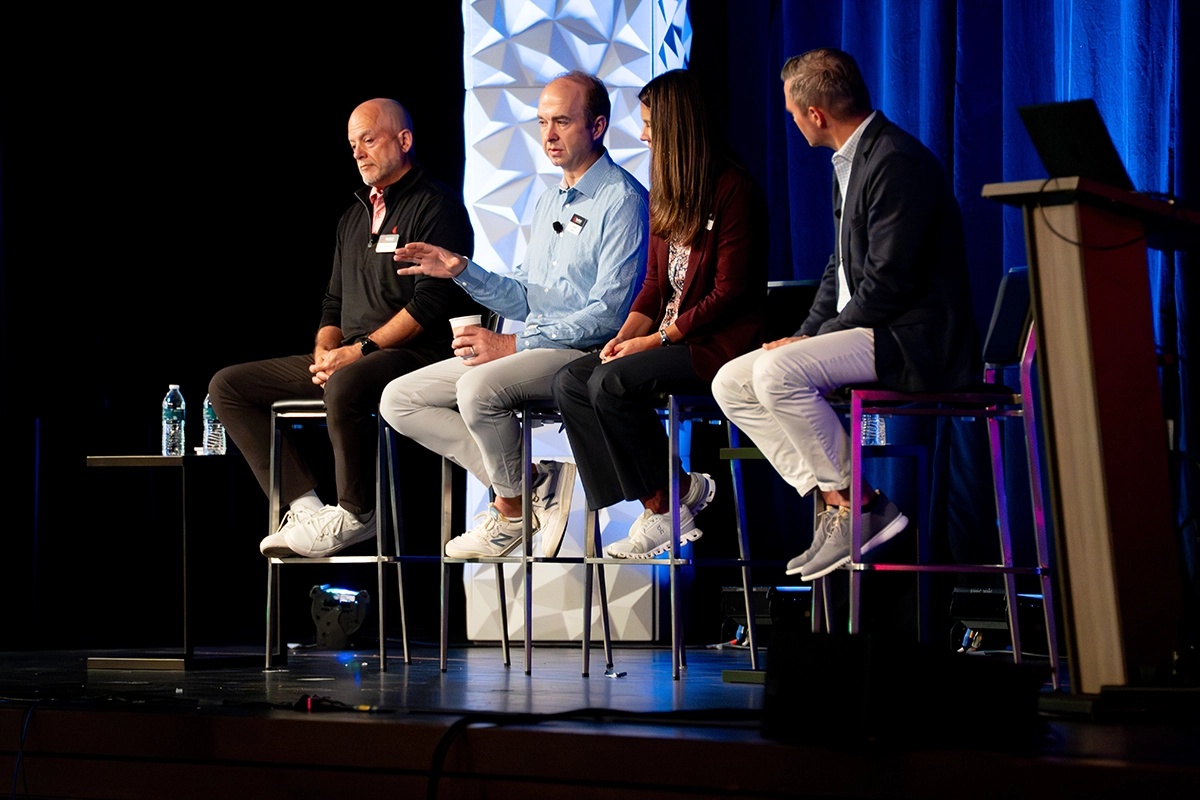
At Connect 2026 in Nashville, Ask Andy became a live forum with Maurer, Melanie Christie and Anthony Cinalli, moderated by Troy Trygstad. Customers could ask about product direction and the company’s plans. The person whose name was on the session had to share the stage with both colleagues and questions.
That is a more useful setting for understanding an executive than a list of agreeable adjectives. Maurer’s public work places him between the investor’s expectation of growth and the operator’s expectation that tomorrow’s software will behave. Both parties have perfectly respectable reasons for being impatient.
More products, and a sharper test of usefulness
RedSail’s recent activity gives those conversations a concrete backdrop. It acquired PrimeRx in February 2026 and appointed Joy Neely chief growth officer in March. In May, it launched RxMarket under its new name, following the acquisition of the business that previously offered PrimeRx Market.
The marketplace brings supplier options and pricing information together. Its commercial argument is plain: purchasing takes time, inventory absorbs cash, and an operator benefits from seeing available choices more clearly. This is territory a finance graduate and former consultant should recognize.
In July, PioneerRx completed an integration with InfiniTrak, bringing additional recordkeeping and supply-chain compliance functions into its existing workflow. Here the promise is less about adding another destination to somebody’s working day and more about reducing the number of separate steps.
Then, in October, RedSail publicly released The Power of Independent Pharmacy, a documentary following three independent businesses. The camera turned toward the owners using different operating models to make their companies sustainable. After years of building and selling businesses himself, Maurer now leads a supplier whose prospects are tied to how well many other owners can run theirs.
That connection gives the dining room story its continuing relevance. A small beginning teaches very little unless the memory survives the larger organization. Maurer still tells the story with its awkwardness intact: a table, an idea and an admission of ignorance. His customers now have a standing invitation to ask what he has learned.