The consequential part of Apu Pavithran’s startup story happened before there was much to demonstrate. Three friends had been talking about starting a business. They were IT professionals; they met for coffee; the idea kept returning. Eventually, one evening, they decided to act. Pavithran left his job first. The others followed. A conversation had acquired consequences.
He had worked as a technical consultant at Zoho. That background puts him in a particular branch of entrepreneurship: people who have seen the ordinary machinery of business software and decided there is room to improve it. The ordinary machinery matters here. His eventual business would concern the devices people use to do their jobs, and the administrators responsible for keeping those devices usable and secure.
Mitsogo began in 2013. An IT conference in the United States helped the founders settle on endpoint management. The opportunity was already walking into offices in people’s pockets. Phones were becoming work equipment. Someone had to configure them, give them access to company resources and take that access away when necessary. A useful business could be built around making that someone’s afternoon less difficult.
There is a pleasing mismatch between the setting and the subject. Coffee-house entrepreneurship usually sounds glamorous until the founders explain the product. Device administration takes a little longer to explain. Yet a misplaced phone with company data on it supplies a persuasive demonstration. The glamour can wait; the administrator needs a button that works.
More room to work.A recurring idea from mobile management to agentic AI.
A bank loan is a rather direct vote of confidence
In March 2016, Pavithran wrote about financing a startup through loans. He said the team had obtained loans from government institutions, and he made the trade-off explicit: borrowing increased the founders’ personal exposure if the business failed. He advised entrepreneurs to research the market and test the product before committing.
That account is more revealing than a funding announcement. A loan puts a date on optimism. The repayment obligation survives a disappointing demo, an indifferent prospect and a feature that takes longer to build than anyone expected. His advice had little of the romance often attached to leaving a salary. Belief in the company needed homework behind it.
His early account of testing Hexnode had a similarly practical streak. Friends in the industry liked the alpha version. He treated their enthusiasm cautiously. Encouragement became more convincing when people outside the founders’ circle tried the online demonstration and responded to its simplicity. Friendship is an excellent reason to buy someone coffee; it is a less dependable purchasing committee.
Together, these episodes suggest a founder interested in what survives contact with an outsider. A lender expects repayment. A customer expects software to solve a problem. Neither obligation disappears because the founding team had an excellent evening discussing entrepreneurship. For Pavithran, the point of the idea was what it could do once somebody else had to use it.
“I was the first to quit my job”
Apu Pavithran, recalling the beginnings
The ambition hidden in an uncomplicated screen
The first problem was mobile device management, usually shortened to MDM. As the product evolved, Hexnode moved into unified endpoint management, or UEM. The vocabulary grew because the workplace inventory grew: desktops, laptops, phones and other connected equipment, running different operating systems. The administrator’s responsibilities followed the equipment.
Pavithran’s competitive argument has repeatedly centered on accessibility. In 2022, he described a product intended for small businesses as well as large organizations, with an interface usable by people who might have only basic IT knowledge. His examples included a teacher. The person responsible for a device fleet need not have spent a career preparing to administer one.
This is a demanding promise. A simple screen has to accommodate complicated decisions: which applications belong on which devices, what access is appropriate, and what restrictions are required. Removing a click is useful only if the person still understands the result. Ease of use becomes part of the responsibility of making the product, rather than an attractive extra at the end.
He has also tied the proposition to support. In August 2022, he said customers received the same support service regardless of their pricing plan. That detail gives his idea of accessibility a second dimension. A small organization may buy fewer licenses, but the person trying to get a device working still needs an answer. Software simplicity is tested most honestly when something has gone wrong.
A global business, with an Indian building site
By November 2021, Pavithran described Mitsogo as a 250-person company with five offices across four countries and customers in more than 120 countries. Those are historical figures, but they establish the distance traveled from the founders’ small room. The company had become an employer and an international operation, with the accompanying obligation to make decisions through other people.
His discussion of recruitment was concerned with keeping people as well as finding them. He argued that graduates wanted room to explore and create, and that retaining them required a sense of belonging. The founder who once needed two friends to follow him out of employment now needed a much larger group to find reasons to stay.
In May 2022, he was discussing a Chennai hub, hiring and a larger Indian market presence. North America and Europe had been central markets; India was an explicit area of attention. That geography makes the story more interesting than a simple export narrative. Building in India, selling internationally and developing the Indian customer base are related tasks, each with its own demands.
In 2025, Mitsogo announced Make in India certification and Class 1 Local Supplier status, which it said reflected meeting the requirement for at least 50 percent local content. It was a concrete marker of the company’s Indian operations. For a founder selling enterprise software internationally, the location of the work remained part of the commercial story.
The administrator acquires an assistant
The next turn introduced a different sort of interface. At HexCon24, the company’s first in-person user conference, Hexnode presented Genie, an AI assistant for creating, validating and analyzing custom scripts. Pavithran subsequently described expanding its capabilities. The sequence matters: a tool built around simplifying administration was now attempting to help with the instructions themselves.
On August 25, 2026, Hexnode announced Context Layer. It connects Genie with live information from the UEM environment and routes requests to specialist agents. An administrator can express an intention in ordinary language, with the system coordinating work such as policies, applications and device actions. Consequential actions remain subject to administrator approval.
This changes the work of interface design. When a person navigates menus, the path offers clues about what is happening. A conversational request can compress that path into a sentence. The time saved creates a corresponding need for clarity about the target, the permissions and the result. A friendly answer is insufficient when the next step changes a real device.
Pavithran’s early interest in browser-based software was about avoiding unnecessary hardware and effort. His newer work pursues another kind of saved effort: avoiding the trip between separate parts of a console. The continuity is easy to see. So is the new difficulty. A system that can act on an instruction requires a different degree of confidence from one that merely displays information.
Automation needs someone who can say stop
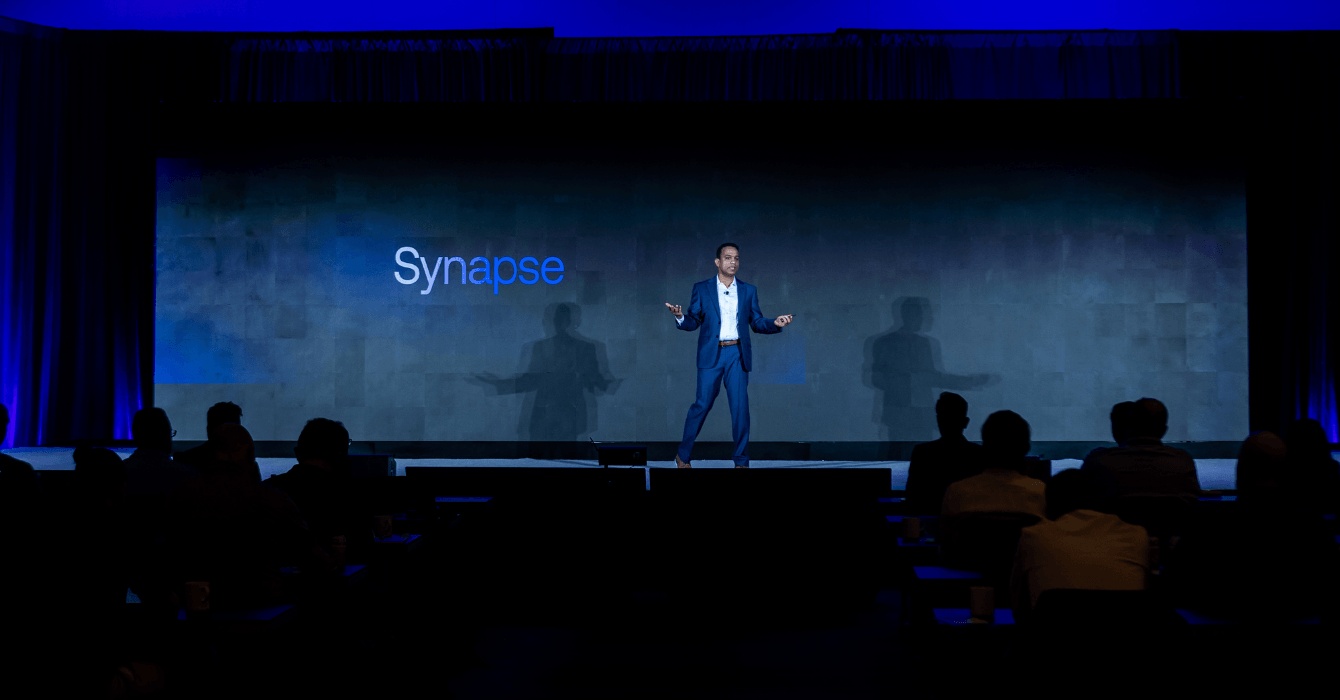
At HexCon26 in Atlanta, Pavithran introduced Synapse, a proposed orchestration layer across IT and security systems. In a September 29 interview, he said an invite-only trial would begin later in the year. The distinction matters: the announcement described a direction and an upcoming trial, rather than a finished account of customers using it at scale.
His example was onboarding an employee. Creating an identity, assigning applications, configuring a device and recording the work can require visits to several consoles. Synapse is intended to coordinate that sequence. Pavithran emphasized defined permissions, human approval for sensitive changes and a record showing what initiated an action, who approved it and what happened.
A discussion with futurist Ramy Nassar, published in October 2026, exposed a more awkward problem: people can become indifferent to approval requests. Pavithran warned that asking for permission constantly can reduce oversight to repeated clicking. The approval button remains on the screen while the judgment it was meant to capture quietly leaves the process.
His proposed starting point was incremental. Decide who owns a workflow, what an agent may access or change, where permission is necessary, how success will be measured and how to stop and recover when something goes wrong. These are management questions as much as engineering questions. The founder selling automation is also describing the work people must do before delegating.
- 01 Name the accountable person.
- 02 Define access and permitted changes.
- 03 Decide what needs approval.
- 04 Measure the result.
- 05 Plan how to stop and recover.
The person behind the permissions
There are smaller clues to Pavithran beyond the product descriptions. Asked to name favorite SaaS products in 2022, he chose Intercom, GitLab and Stripe. His 2021 conference biography also mentions working on his culinary skills. Cooking is an agreeable counterweight to enterprise software: an activity where the person making the decisions may also have to eat the result.
He writes for audiences outside the endpoint-management category. His published subjects include patching, rugged devices, government equipment and supply-chain security. That range gives the same technical concern different human settings. A device can belong to an office employee, a transport operation or a school. Its usefulness depends on somebody doing the administrative work that users usually notice only when it fails.
The career has moved from technical consulting to founding a company, from a small group of colleagues to an international organization, and from device controls to agents that may operate those controls. Each expansion brings him back to a familiar problem: how to make another person’s work easier without making their decisions harder to understand.
That is a more interesting ambition than a frictionless demonstration. Real workplaces contain exceptions, competing priorities and people who have other things to do. Pavithran started by betting that managing their equipment could be simpler. His next bet asks how much of that management they will trust software to perform. The click he wants to remove still has a person behind it.
Keep the conversation going
Interviews, writing and talks from across the journey.