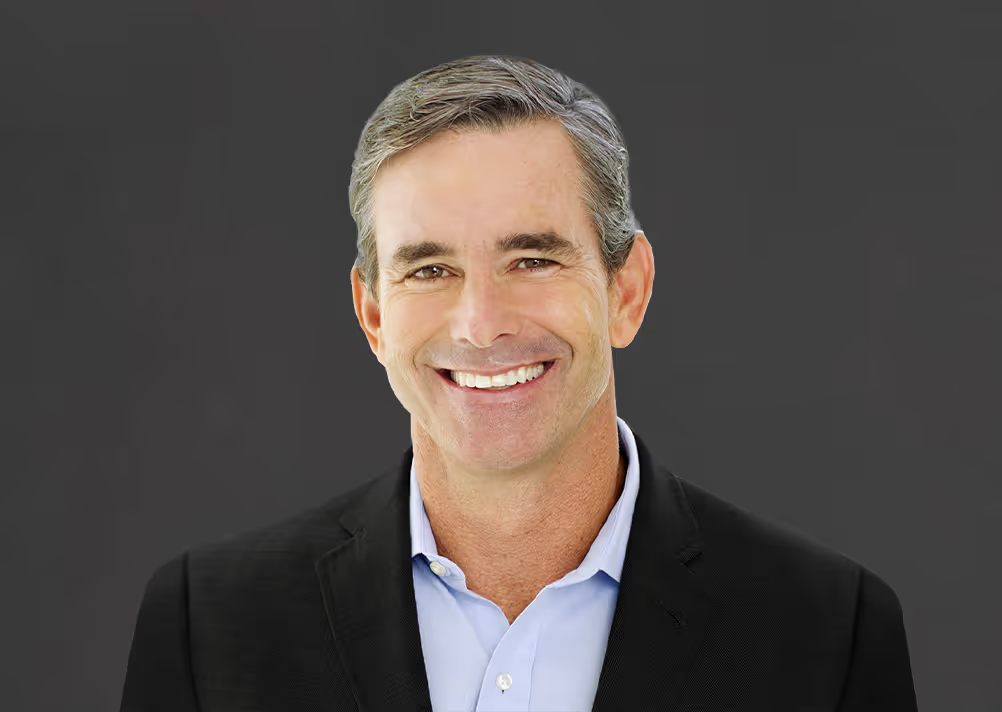
Running the Hardest Race in Enterprise Security
There is a version of Dan Streetman's story that writes itself - Army Ranger, West Point honor grad, Harvard MBA, CEO at three companies, now leading one of the most consequential cybersecurity platforms in the world. That version is technically accurate and entirely misses the point.
The more useful version starts in Baghdad, 2008. Streetman was deployed as Strategist for the Command Group of Multi-National Forces, Iraq - a role that required translating mission intent downward through layers of people operating under severe uncertainty. The lesson he absorbed wasn't tactical. It was architectural: organizations that wait for orders fail faster than adversaries can move. Organizations that understand why they're doing something can improvise, adapt, and execute without being micromanaged.
He brought that insight back and spent the next fifteen years applying it inside enterprise software companies - Salesforce, C3.ai, BMC Software - before landing in the CEO chair at TIBCO Software in 2019. TIBCO was a $1B+ integration middleware company that needed to modernize its cloud portfolio while simultaneously growing revenue. He did both. Double-digit growth in revenue and EBITDA. Gartner Magic Quadrant recognition. Then on to Allvue Systems in private equity-adjacent fintech software, briefly, before Tanium called in late 2022.
If you can't see it, you can't fix it. You can't control it.
Dan Streetman — on cybersecurity visibilityHe took the Tanium CEO role February 1, 2023, succeeding co-founder Orion Hindawi who moved to Executive Chairman. Founder-to-operator transitions at unicorn-stage companies are fraught. Streetman navigated it without drama, which is itself a statement about how he operates - quietly, methodically, with an eye on the mission rather than the optics.
Tanium's pitch is blunt: most enterprises have endpoints - laptops, servers, cloud workloads, IoT devices - that they cannot see, cannot query in real time, and cannot patch without a multi-day change management process. Tanium fixes that, giving security and IT teams sub-15-second visibility and control across millions of endpoints simultaneously. Under Streetman, the company has pushed further into autonomous operations, using AI to identify, prioritize, and remediate vulnerabilities without human intervention at every step.
In May 2025, Streetman was back on NASDAQ's Live from Marketsite, articulating why autonomous endpoint management is the next category in enterprise security - not just a feature, but an operating model. The cybersecurity industry moves through familiar cycles: visibility, then detection, then response. Tanium is making the case that response itself should be automated at scale.
At the California International Marathon and the Boston Marathon, Streetman runs as a guide for visually impaired athletes - literally serving as their eyes through 26 miles. It is a role that requires absolute communication discipline and trust between two people moving at speed. He describes it the same way he describes the CEO job: not about being out front, but about giving someone else the confidence to move further than they could alone.
The military reference point is real and not performative. Streetman often explains his leadership model through the lens of the operations order - the pre-mission document that defines not just what needs to happen but why, so that when the plan meets reality and falls apart, the team can adapt without asking for new instructions. In enterprise terms: set the vision, explain the stakes, trust the organization to execute in the details.
He calls it "lead from the middle" - setting the example from the front, but understanding that leadership is distributed. The best ideas rarely come down from the top. His job is to create the conditions in which the organization can generate them independently.
That philosophy scales. TIBCO had 4,000 people across a dozen time zones. Tanium has 2,200. The math on command-and-control fails fast at those headcounts. Distributed intent - knowing the mission well enough to improvise in its service - is not a soft leadership concept. It is a structural requirement.
Beyond the corporate roles, Streetman sits on the board of Mission Roll Call, an organization working on veteran employment and engagement. He advises VetsinTech. He is an active member of Iraq and Afghanistan Veterans of America. In July 2025, he was appointed as an independent director on SecurityScorecard's board - adding another layer to the enterprise security ecosystem he is helping to build.
Thirteen Ironman triathlons. Each one is a 2.4-mile swim, a 112-mile bike ride, and a 26.2-mile marathon run. Thirteen times. The math there is not about fitness - it is about deciding in advance that you will not quit, and building the systems around that decision that make quitting impossible. Which is, not coincidentally, exactly how he approaches a cybersecurity strategy.