Consider a bottle of medicine. On a pharmacy shelf, it is an object: a label, a dosage, a quantity. Inside a hospital’s purchasing system, it becomes a question. Which account should pay to replace it? The answer can depend on who received the drug, where care happened, and whether the records agree. Macro Helix makes its living in that gap between the bottle and the answer.
- Software and specialists for hospitals, clinics, and contract pharmacies running 340B programs.
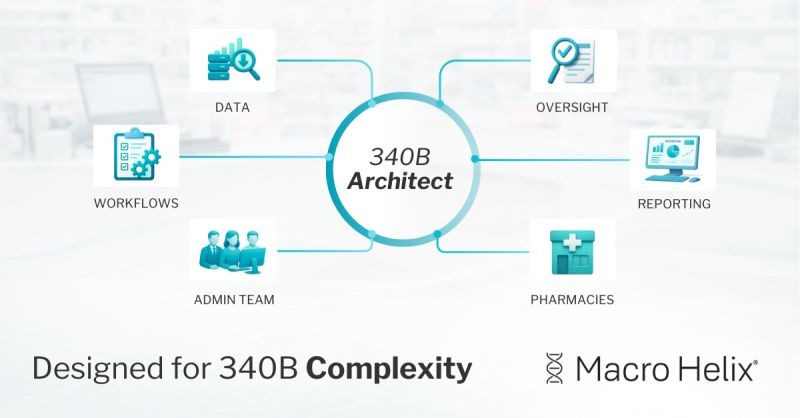
- Architect manages administration; additional tools address analytics, referrals, and centralized purchasing.
- McKesson ownership brings distribution expertise, while product requirements still deserve close inspection.
The federal 340B program lets eligible healthcare organizations purchase covered outpatient drugs at reduced prices. It is designed to help them stretch resources and serve more patients. But an entitlement to buy cheaply does not reconcile a pharmacy’s records. Somebody must connect the clinical event, the dispensing transaction, and the replacement order. Otherwise, an available discount can remain an unrealized opportunity.
The first problem was the missing connection
Macro Helix launched in 2009. Co-founder Andrew Maurer, known as Andy, later recalled starting the business at his dining room table. He had worked in pharmacy consulting, a useful vantage point for noticing work that hospitals repeatedly struggled to perform. McKesson’s account of the company’s origins describes gaps in existing administration tools and missed savings. The opening was operational: make those scattered pieces work together.
McKesson acquired the business in 2012. That put a young software company inside an organization with pharmaceutical distribution relationships and healthcare expertise. Its customers now include hospitals, health systems, clinics, and contract pharmacies. A McKesson company story reported more than 1,000 covered-entity clients across 48 states. That is a company-reported historical footprint, but it explains why an obscure administrative task can support a substantial enterprise.

One shelf. Three different ledgers.
The core product is 340B Architect. It handles administration, inventory replenishment, split billing, and contract pharmacy activity. Its purchasing logic makes the underlying problem unusually clear. Public support documentation describes three accumulations: 340B, group purchasing organization purchasing, and wholesale acquisition cost. A replacement order is evaluated against the relevant balances. Quantities that cannot split to the first two accounts go to the WAC account.
Picture the administrative challenge: the medicine has moved, but the financial treatment still needs to follow the qualifying activity. Architect automates parts of that matching. Central Split extends the ordering workflow to central inventory, allowing accumulations earned at individual pharmacies to support replenishment there. A health system can centralize its purchasing arrangements without treating every location’s eligibility as interchangeable.
Retail chains face another version of fragmentation. Their stores may work with covered entities using different third-party administrators. Gateway consolidates pharmacy workflows while allowing those entities to retain their chosen processor. The appeal is familiar to anyone who has managed several incompatible systems: fewer separate routines for work that should fit together.
The dashboard escaped the meeting
The origin of 340B Impact is more revealing than a feature list. McKesson’s 340B Solutions team had built a customized dashboard to discuss performance with customers. Then came a better question: why should useful information arrive only when somebody presents it? The team approached Macro Helix to turn those insights into something customers could access themselves.
“We knew we could scale it; we just needed the right technology partner.”Chris Shain, McKesson, on developing 340B Impact
Impact became generally available in April 2022. Designed for joint McKesson and Macro Helix customers, it combines purchasing and program data to examine spending, savings, and optimization opportunities. The distinction matters. A screen showing a large total is interesting. A screen helping a pharmacy manager investigate why purchasing and qualifying activity diverge is useful.
There is a lesson here for other businesses. Watch for the explanation your specialists deliver repeatedly. If customers need that explanation between meetings, the presentation may contain a product. Impact’s development followed that logic: move insight closer to the person who can act on it.
A promising match still needs proof
RxCorrelate addresses prescriptions that may result from referrals to outside providers. It identifies potential matches for review; supporting documentation helps preserve the reasoning. Macro Helix says the module is included with Architect without an additional module charge. That is a specific pricing statement about one component, rather than a price for the whole system.
The broader business sells software and services through customer-specific fee packages. For a buyer, the practical calculation includes implementation work, staff review, and the systems already installed. Architect supports multiple wholesalers. Impact serves shared McKesson customers. The contract-pharmacy FAQ specifies a McKesson pharmacy management system. Those distinctions should shape a purchasing conversation before a savings forecast does.
Automation also inherits imperfect inputs. Public ESP submission documentation lists missing identifiers, malformed prescription numbers, and inconsistent dates among reasons records can fail. Sending data and learning whether it satisfies an external system are separate steps. A pharmacy still needs people who investigate exceptions. Software reduces repetitive work; the organization must retain the judgment behind the records.
The discount has to survive the whole journey
Macro Helix competes with Verity Solutions, PharmaForce, Craneware, and RxStrategies. Distribution connections and a broad toolkit make it a serious option, but customer experience deserves its own inspection. The 2025 Best in KLAS report scored Architect at 72.3 out of 100 against a segment average of 82.9, drawing on 23 unique organizations. Scale alone cannot settle a vendor decision.
Its services reach beyond account splitting: audit preparation, pharmacy analytics, revenue recovery, and assistance programs. Community Prescription Assistance offers an auditable way to direct 340B savings to patients. That completes the company’s central argument. A discount acquires practical value through a chain of decisions. Macro Helix sells the tools and expertise to keep that chain connected, from the first qualifying record to the next bottle on the shelf.