The last few feet of a prescription’s journey can involve an impressive amount of searching. There is the medicine, the label, the bag, the shelf and the record of whether anyone has collected it. Cegedim Rx has built its pharmacy business around making those small, consequential jobs fit together. The patient sees a counter. The software supplier sees a sequence that can be organised, checked and followed through.
Its central product, Pharmacy Manager, is a patient medication record system, or PMR. Around it sit tools for clinical consultations, business reporting, remote fulfilment and even shop-window advertising. The ambition is practical: reduce the work attached to dispensing so pharmacists can spend more time delivering services. Whether that happens depends on what a pharmacy changes after the software arrives.
A typewriter problem that kept growing
The company’s product history starts with pharmacist John Richardson developing an early program to print drug labels and count stock. It places that work in the early 1980s, when pharmacies were moving away from handwritten labels. The program developed into an MS-DOS system; a Windows product called Sunrise followed in 1998 and became Pharmacy Manager in 2001.
The corporate history has its own dates. The present legal entity was incorporated in September 1993, initially as Aceidea. Cegedim’s historical account places its entry into British pharmacy software at the end of 2004 through acquisitions of NDC Health and Enigma Health. The registered company took the Cegedim Rx name in January 2009. This is a business assembled through product development and acquisition, with roots older than its current name.
By 2019, familiarity was no longer enough. “Our customers told us that Pharmacy Manager should be easier to use,” the company wrote. Customers wanted help with stock, services, workflows and costs. Their feedback helped prompt a redesign. A program that had grown good at accumulating functions now had to make those functions easier to use.
The barcode gets a longer job description
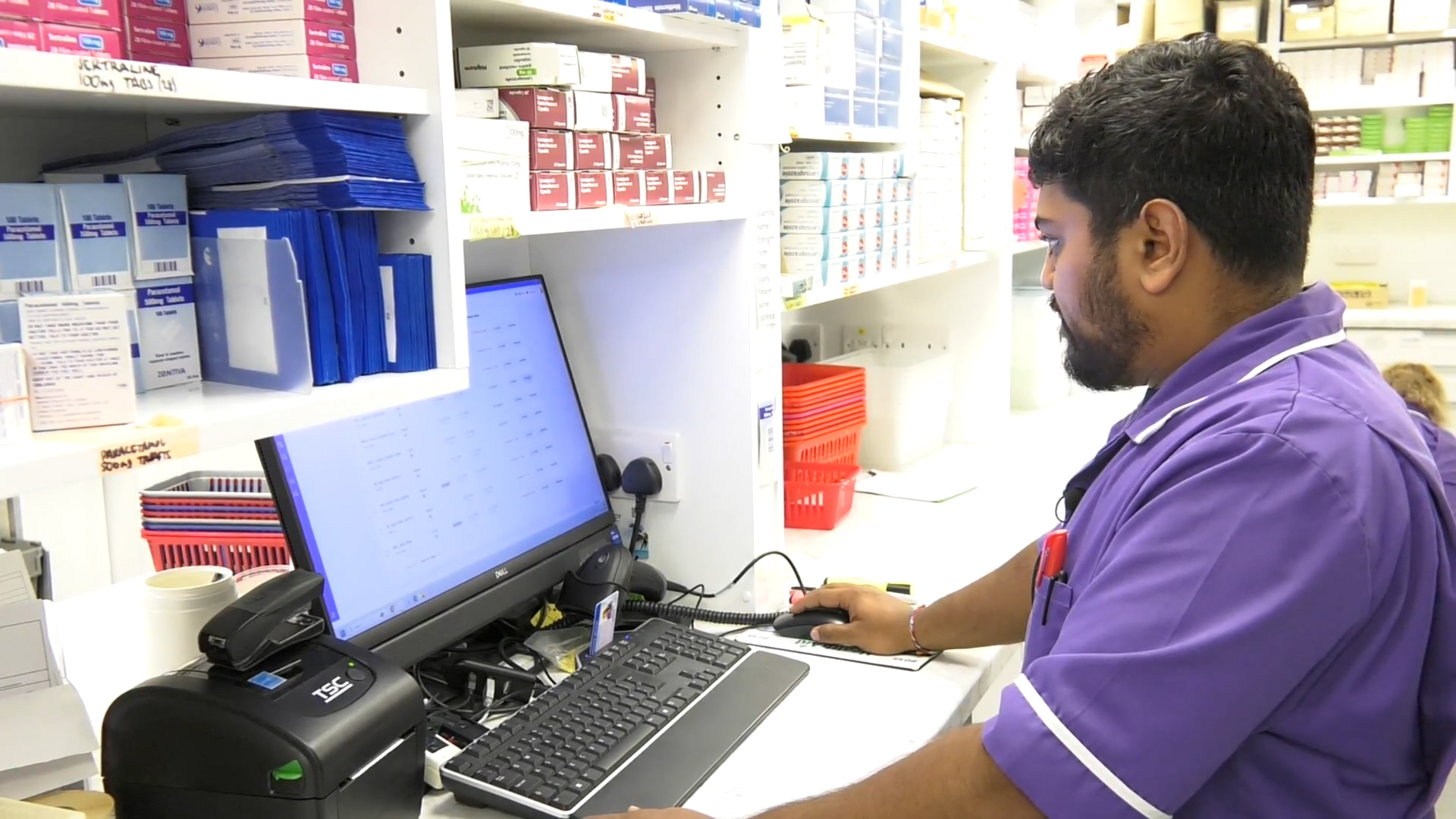
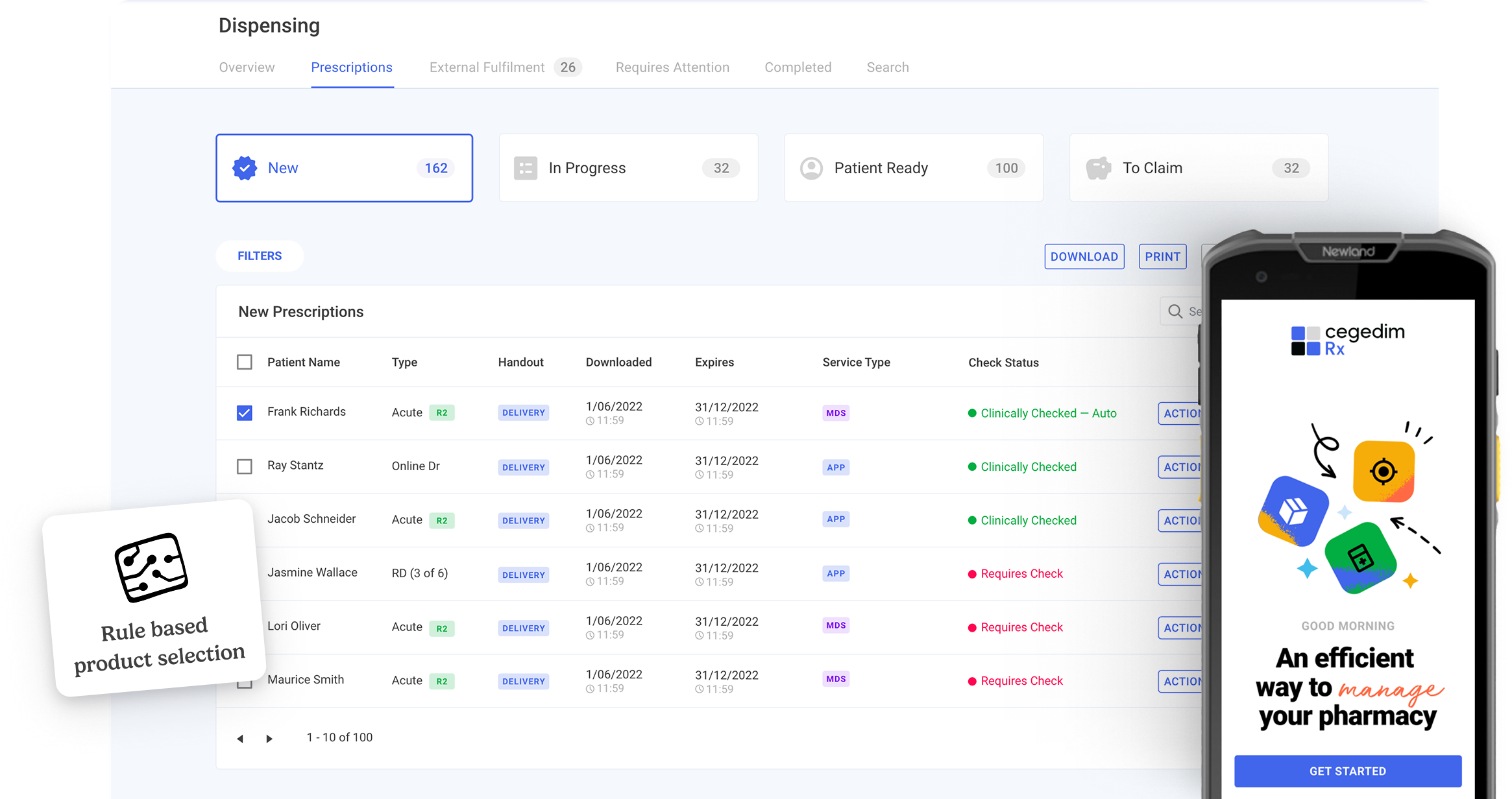
Pharmacy Manager’s current design follows the prescription through successive jobs: organising the workload, clinical checking, producing labels, picking and checking medicines, storing bags and handing them out. Barcode scanning connects parts of that journey. CRx Scan, its handheld device, helps staff set and find bag locations. The attraction is immediate to anyone who has watched a colleague disappear into a thicket of filled prescriptions.
The handout documentation gets pleasingly specific. Locations can include shelves, fridges and controlled-drug cabinets. A prescription split between storage locations can have multiple bag labels. Collection can be recorded, and patient applications can provide notifications. These are small distinctions that matter in a real dispensary, where one patient’s order does not necessarily occupy one bag in one place.
Clinical checking remains a separate part of the workflow, with warnings and permissions that need attention. Automation is a way to organise work and reduce repeated handling. A sensible demonstration therefore follows an awkward prescription through to collection, including an exception, rather than stopping at a tidy dashboard.
- 01Organise
- 02Clinical check
- 03Label
- 04Pick + check
- 05Bag + store
- 06Handout
One prescription, several handoffs. The software’s job is to keep them connected.
£350 buys the starting plan
Cegedim Rx publishes three monthly software prices: £350 for Core, £400 for Advanced and £475 for Ultimate. Licensing is per pharmacy, rather than per computer, with contracts starting at 12 months. Multiplied by twelve, the listed subscriptions come to £4,200, £4,800 and £5,700 a year. Those figures describe software-plan arithmetic, not a complete installation budget.
Core includes the scan-driven workflow and clinical-services software. Advanced adds connections such as third-party apps, messaging and automation partners. Ultimate adds CRx Intelligence. Hub fulfilment, EPOS and digital signage appear separately as paid additions; hardware can also be supplied. For a buyer, the useful comparison is the bundle their branch will actually use.
There is a smaller entry point. The web-based CRx Services product is advertised at £30 a month, with no transaction fees, and can be used with another PMR. That gives a pharmacy a way to adopt the clinical-services tool without first replacing its main dispensing system. Cegedim can sell a component as well as a broader change.
Listed prices checked 7 September 2026. Separate products, hardware and implementation requirements can affect total cost.
A consultation has an administrative afterlife
Clinical services add another set of records, referrals and claims to the working day. CRx Services brings those activities into a web-based system and integrates with Pharmacy Manager. In January 2025, Cegedim announced that Pharmacy Manager users would receive access to the clinical-services suite at no additional cost. It was a clear move to make consultations part of the everyday product offer.
Customers provide a sense of the intended audience. The company features independent businesses such as BSB Pharmacy and Clark’s Chemist alongside groups including Jardines and Weldricks. Its parent’s 2024 annual report described more than 10,000 pharmacy users across the Rx offering. That is a count of people using software, not 10,000 pharmacy branches.
CRx Intelligence addresses the owner’s view of the same work. It shows clinical activity and forecast reimbursements, helping management spot incomplete administration and compare activity across stores. Its product page specifies that stores need Pharmacy Manager. The distinction matters: a standalone clinical-services customer should not assume every other product is equally independent of the PMR.
The training bill includes time away
The Darling’s Pharmacy case study, published in June 2026, makes a useful admission about implementation: releasing staff from branches takes planning and investment. The group adopted Pharmacy Manager, scan-driven dispensing, Services, Intelligence and Display. Dedicated super-user training gave staff time away from daily practice to learn how the pieces fitted together.
That is the detail another operator can copy. Reserve learning time, give colleagues enough understanding to help their teams, and decide how work should move through the branch. A software subscription does not perform those management tasks. Darling’s experience, as presented by Cegedim, links adoption to that investment in people.
At Nimo Pharmacy, an August 2026 customer story describes a relationship lasting more than 20 years and a younger generation joining the family business. Prem, its lead pharmacist and partner, credits the connected tools with releasing time for clinical work. The case study reports 80% fewer near misses. It is a customer-specific result published by the vendor, not a prediction for every pharmacy.
“It’s saved us time and freed the pharmacists to do more and more clinical services.”
Prem / Lead pharmacist & partner, Nimo Pharmacy
In Cegedim Rx’s customer story
The shop window enters the software business
Once a pharmacy has capacity for consultations, patients still need to know they exist. CRx Display takes Cegedim into that other end of the shop. Its combination of screens, scheduling software and marketing support lets pharmacies promote services and health campaigns. The parent dates the product’s launch to 2022.
The display offer ranges from managed content to more direct creative control and multi-site campaign management. Listed packages are £99, £119 and £149 monthly on 48-month terms, subject to site survey and installation. Here, the software supplier is also helping a pharmacist fill a screen without becoming a part-time advertising producer.
CRx Hub and Spoke tackles physical capacity differently, coordinating dispensing away from the branch. Its stated design keeps local clinical responsibility while providing prescription-status visibility and allocation rules. Listed Pharmacy Manager partners include BD Rowa, Centred Solutions, MedPoint and Healthera. Cegedim’s position depends partly on connecting the equipment and applications a pharmacy already uses.
When the messages stopped moving
The importance of those connections became painfully visible in June 2016. A service interruption in Cegedim’s message broker disrupted electronic prescriptions in England. In contemporaneous reporting, the company said an apparently resolved fault recurred and the system was temporarily halted because of the traffic backlog. Some pharmacies continued to face stuck prescriptions after the initial interruption.
The recovery involved reprocessing and instructions for retrieving affected prescriptions. Cegedim subsequently told The Register that remaining incident problems had been resolved. The episode illustrates a specific operational distinction: restarting a service does not automatically settle every transaction interrupted along the way.
Today, Pharmacy Manager’s product page says it requires an HSCN connection and describes managed connectivity and supported mobile backup options. A buyer should include connectivity, equipment and recovery arrangements in the discussion. Those are conditions for the promised workflow to function, alongside staff training and the right integrations.
The next release is about fewer keystrokes
Cegedim faces established alternatives and newer challengers. Its parent’s 2025 annual report names EMIS, Positive Solutions, RxWeb, Apotec and Titan among UK providers. Positive Solutions also promotes a connected, modular offering through Analyst and Hx. Connected software alone therefore does not settle the competitive argument; the useful test is how a system handles a particular pharmacy’s work.
Cegedim’s product culture offers one answer. Senior product manager Simeon Green describes spending time with pharmacy teams to understand their problems and translate them for developers. Managing director Tracey Robertson, appointed in December 2024, previously led product development. The business’s published emphasis is on changing the existing working day through repeated product improvements.
Its 13 August 2026 update fits that pattern: automatic medication details in clinical pathways and mandatory reasons for deleting service episodes. Decision support was announced for a phased rollout, rather than described as universally available. These are modest-sounding changes aimed at work staff repeat.
The business itself also needs to be understood precisely. Cegedim’s current restructuring notice separates pharmacy services from INPS and its Vision GP products following INPS’s administration; Cegedim Rx remains in the group. Its pharmacy proposition stands on a recognisable task: help the team finish the administrative journey so the person at the counter gets more of its attention.