At a pharmacy, a prescription can be ready while the visit remains unfinished. Someone must tell the patient. Someone must record the pickup. The stock count must change, and the payment must find its way into the books. Each task looks small from the customer’s side of the counter. Together, they explain why HCC’s software reached well beyond printing a label.
- HCC supplied the operating software behind independent and multi-store pharmacies.
- Its products joined dispensing, inventory, checkout, and patient communication.
- A 2012 messaging pilot shows how a new service could fit around existing store servers.
The handoffs behind a refill
HCC’s territory was the space between separate jobs that need the same information. Its historical portfolio included RX-1, Visual Pharmacy, Alpha-PC, and Synercom. The names sound like artifacts from different computing eras. The work was familiar: process prescriptions, manage stock, record transactions, and help staff keep the queue moving.
The company’s RX-1 advertising in the 2009 PPSC buyers guide put touchscreen workflow and checkout beside online claims and reconciliation. The 2010 guide added imaging and barcode verification to the pitch. That combination tells you something about the customer. A pharmacist needed clinical information, but also a workable shop: shelves, receipts, staff, and a record of what happened.
Consider prescription imaging. Brad Arthur, pharmacist and owner of Black Rock Pharmacy in Buffalo, appeared in HCC’s January/February 2012 advertisement. He credited RX-1’s workflow with improving efficiency and described scanning prescriptions as useful for audit compliance. It was a customer testimonial in an ad, rather than an independent measurement. Still, it identifies a concrete benefit: the original document could remain connected to the work.
- 01ReceivePrescription + patient record
- 02PrepareWorkflow + inventory
- 03CollectCheckout + signature
- 04ConnectPickup + refill messages
A patient record with a next step
There was an older idea underneath the product list. In January 1996, an application was filed for a system linking pharmaceutical practice management with healthcare management. Granted in August 2000 to Healthcare Computer Corporation, the patent named William Rex Akers and three fellow inventors. It described using information gathered during dispensing to initiate related healthcare processes.
The interesting part is the verb: initiate. A database can remember a patient’s circumstances. A connected system can use that information to prompt another action. The distinction matters when a pharmacy wants the record of a transaction to help organize the next piece of work.
HCC also operated in a market where connections needed shared rules. A January 2007 SureScripts presentation listed Synercom, Alpha PC, and Visual Pharmacy among certified pharmacy solutions. McKesson, QS/1, Computer-Rx, and Datascan also appeared. HCC belonged to a crowded group of specialists; electronic prescribing connectivity was a capability its customers could compare across vendors.
Its expertise extended to that technical plumbing. NCPDP’s 2008 election announcement named Healthcare Computer Corporation’s Teresa Strickland as a Maintenance and Control co-chair. That is an unglamorous credential, and an informative one. Pharmacy software has to communicate with institutions whose systems, transaction rules, and responsibilities sit outside the store.
The server could stay
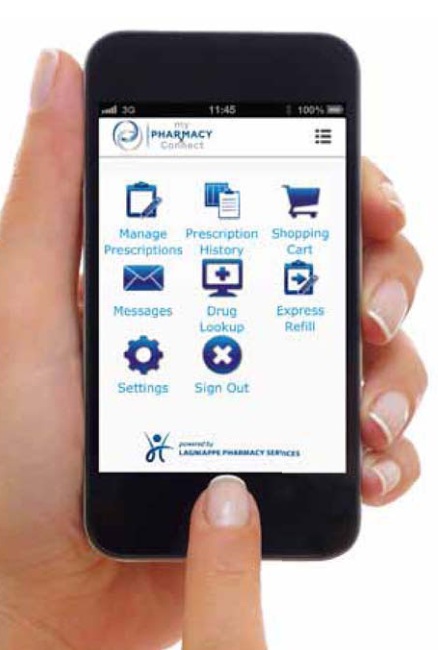
In 2012, Associated Food Stores provided a particularly useful example. ComputerTalk described the grocery operator as having 43 pharmacies and reported that it had tested HCC’s myPharmacyConnect outbound messaging at one location. Expansion was being prepared. Forty-three was the chain’s size, not a count of completed installations.
The service ran off-site while RX-1 remained on store servers. Existing data connections carried information into the messaging service. Pharmacy operations manager Sam Haddadin described central control with location-specific settings, including avoiding Sunday calls. A patient portal was planned too. This was a way to add communication around an installed system.
“It gives us more control.”
Sam Haddadin, Associated Food Stores, 2012
PRODUCT ARCHIVE
The architecture suggests a practical buying principle: locate the change where it can help without disturbing every working component. That principle depends on reliable interfaces and accurate data. A message saying a prescription is ready can only be as useful as the information that triggered it.
The counter changed owners
HCC sold technology to businesses, rather than prescriptions to patients. Its commercial offering covered store applications and related systems; its sister business FDS handled services such as claims processing and reconciliation. The arrangement paired the pharmacy’s internal work with the data traffic leaving the building.
Ownership eventually became another connection to manage. Founder Rex Akers sold his interests in HCC and FDS to Lagniappe Health in August 2011. The announcement described retirement and continuity for employees and customers as objectives. Longtime executives Mike McManus and Tracy Ward took the president and chief operating officer roles.
Lagniappe Pharmacy Services later joined Rx30 in 2016. GTCR’s subsequent account places Lagniappe among Transaction Data Systems’ acquisitions. In July 2023, TDS combined with Cardinal Health’s Outcomes business and adopted the Outcomes name. The combined company announced a network of 48,000 pharmacy locations. That figure belongs to the later organization, with several businesses behind it.
HCC + FDS enter Lagniappe Health
Rx30 acquires Lagniappe Pharmacy Services
TDS merges with Outcomes and takes its name
Start with the handoff
For a pharmacy evaluating this kind of software, the useful questions are specific. Can staff find the prescription image? Does checkout update the right record? Who controls patient notifications? What happens when a connection is interrupted? A demonstration should follow an actual prescription through those handoffs.
The same discipline applies to cost: compare setup, data conversion, training, support, and connected services alongside the application itself. Those are buying considerations, not a reconstructed HCC price list. A system’s fit depends on the store’s workflow and the people who must use it.
HCC’s history offers a modest lesson for anyone building business software. Start where people already work. Find the information they keep passing from one task to another. Then make that passage easier. At the pharmacy counter, a small improvement has many chances to matter.