A software company can begin with an elegant algorithm. Fran Craig’s also needed somewhere to put breakfast. In its early days, the business that became Unanet gathered for Friday staff meetings at her dining room table. It is a pleasingly domestic beginning for a company concerned with the movement of people, projects, and money. Before there was much organizational machinery, there was a regular appointment to sit down together.
The habit lasted. Unanet still describes Friday breakfast meetings held in the office and over video. Growth has changed the furniture and the distance between colleagues. The invitation has survived. For Craig, who retired from regular work in 2019, it offers a useful entrance to a career that can otherwise be buried under the vocabulary of enterprise software.
Timesheets, resource planning, billing: these subjects rarely steal a dinner party. Yet they concern things people feel quite strongly about, including whether their work is understood and whether anyone gets paid. Craig built a business around those practical needs. Alongside it, she developed a persistent interest in who gets the chance to participate.
First, learn what a computer is
Her technical career began with a question. In 1964, after studying mathematics, she was encouraged to become a programmer. “What is a programmer?” she asked. The explanation prompted another question: “What is a computer?” AT&T hired her and sent her to IBM programming school. The gap between a degree and a profession was bridged by an employer willing to teach.
She had graduated with honors from Saint Mary’s College, in Indiana, with a BS in mathematics. That qualification placed her at the beginning of a working life in which computing was finding new commercial uses. Her later roles included Carnegie Mellon University, GTE Telenet, and DHL Courier. The work involved making organizations function through software.
At DHL, she led the design and development of the courier’s first worldwide tracing and tracking system. Her experience also covered distributed applications for orders, billing, and financial operations. A parcel, an order, and an invoice all pose an unromantic question: where has this got to? Building a reliable answer requires attention to the work happening between the beginning and the end.
That background helps explain her eventual choice of business. Craig had seen technology from inside organizations with real operational obligations. Software needed to help somebody complete a task. A clever demonstration could only take the conversation so far.
The surprisingly useful timesheet
In 1988, she founded Computer Strategies in Northern Virginia. The firm provided strategic technology planning, organizational and quality management, and programming services. Consulting put her close to the problems customers were trying to solve. It also gave her a view of where a reusable software product might earn its keep.
The opening arrived through time. In 1997, Craig conceived a web-based timesheet. The business developed into the software products company Unanet, established in that form in 1998. A familiar administrative chore became a route into a larger set of questions about the people doing projects and the economics of their work.
By 2015, Unanet had released ERP software connecting projects, people, and financials. The abbreviation means enterprise resource planning. In everyday language, it is an effort to make the accounts and the work agree with one another. A busy team and a profitable project can look similar from a corridor; the numbers help explain the difference.
Craig’s approach to customers extended past installation. In a 2010 profile of growing professional-services businesses, she described training, webinars, tutorials, conferences, and personal follow-up. Unanet used its own software internally, too. Employees prepared quarterly development scorecards and discussed them with supervisors. The system being sold had a job to do at home.
There is a practical discipline in that arrangement. A company using its own product has repeated opportunities to notice inconvenience. Teaching customers to use it well also makes the relationship longer than a sales conversation. Craig treated the consequences of buying software as part of the business.
A seat, and something to say
The breakfast table belongs in the same story. A recurring gathering makes communication an activity with a place in the week. It asks people to stop, listen, and account for the work around them. In a small company, the calendar can do some of the organizing that larger firms assign to departments.
“If employees are treated well, they will treat customers well.”
Fran Craig
Craig also organized opportunities beyond her own company. At Carnegie Mellon, she started a women’s task force that met monthly and brought in speakers. Later, at Unanet, mentoring became part of employee support. The recurring form is familiar: create a gathering, bring useful experience into it, and give people a way to learn from each other.
She became involved in the business community that surrounded her customers. In 2011, she joined the board of the Small and Emerging Contractors Advisory Forum. In 2017, she joined the advisory board of George Mason University’s GovCon Initiative, linking her experience with a university effort focused on the business of government contracting.
These were places where software, management, and professional education could meet. A contractor buying a system still needs people who understand the business it supports. Craig’s interests kept extending into that surrounding work: how a company learns, how an employee develops, and how practical knowledge reaches someone who can use it.
The room gets bigger
By late 2016, Unanet was preparing a move to a 24,000-square-foot facility in Sterling. The announced $7.3 million investment was intended to provide space for another 100 employees over the following years. Those were expansion plans, rather than a count of jobs already created. They show how far the business had traveled from its home-based beginning.
Another change arrived in June 2019, when JMI Equity announced a growth investment. The company then served more than 1,200 professional-services organizations. The announced purpose was to develop the product and support further expansion. Craig welcomed the investor’s software experience and the opportunities it could create for employees, customers, and partners.
Choosing a partner was itself a piece of work. She credited transaction adviser Lincoln International with helping the management team prepare for the investment process and understand the fit with potential investors. A founder handing over responsibility has decisions to make about more than price. The next organization must be able to carry the work forward.
Craig stepped away from regular work that year. Today, Unanet lists her as an advisor in its board of directors section, while Craig Halliday is CEO. The roles have changed; the company’s account of its beginnings still gives her breakfast table a place. Institutional memory can be surprisingly well served by a meal.
Back to campus, with a purpose
In May 2024, Saint Mary’s awarded Craig an honorary Doctor of Science. The photograph of her receiving the academic hood has the cheerful complication of ceremonies: several people cooperating to get one garment into position. Sixty years after her mathematics graduation, she had returned to the college in another kind of academic dress.

Her connection to the college also took a financial form. A $5 million gift endowed the Frances Bardello Craig ’64 Leadership Program in Mathematics and Computer Science. Its planned support includes research, internships, an endowed professorship, and faculty development, with an emphasis on leadership.
Craig’s gift to endow mathematics and computer science leadership at Saint Mary’s.
The combination matters. A student can be encouraged to pursue a field and still need somewhere to practice it. Research and internships turn interest into work undertaken with other people. Support for teaching helps the opportunity continue beyond a single class. Craig’s contribution gives her interest in women’s participation a durable institutional home.
She is candid about another resource she brings. “I am really good at giving advice,” she has said. It is an agreeable qualification for a mentor to admit. STEM for Her named her its 2025 Woman of the Year, recognizing a career whose educational commitments reach beyond her own college.
U is for Unanet. W is for Wonder.
Her support for science has room for a joke. When Unanet sponsored a periodic-table element at the Children’s Science Center in 2015, it selected uranium. Craig’s explanation was economical: “U is for Uranium. U is for Unanet.” A corporate contribution had acquired a mnemonic, and the periodic table had acquired a software connection.
In December 2022, the Northern Virginia Science Center announced a gallery gift from Craig and her children, Ellen and Chris. The Craig Family Gallery would house an exhibition called Wonder for young learners and their families. Its purpose was to encourage hands-on exploration. The family was backing the beginnings of an interest, before a child needed to choose a course or a career.
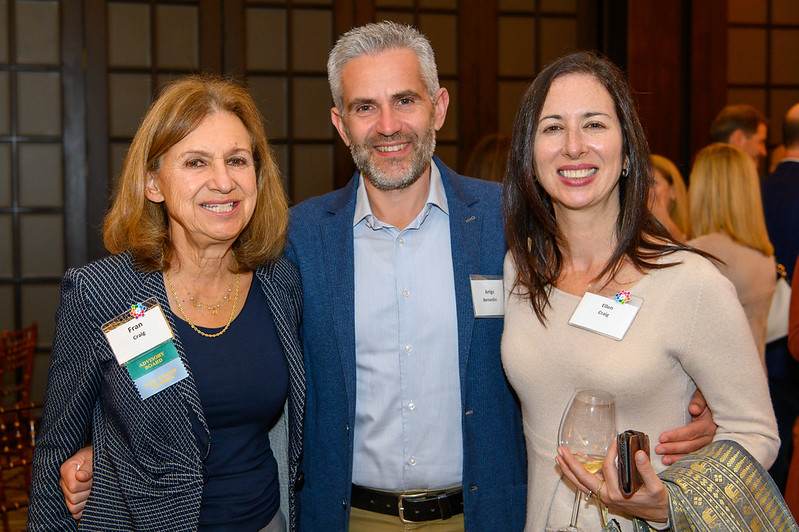
That early encounter deserves attention alongside the later achievement. Someone has to make the invitation, provide the space, and accept that the visitor’s next question may be wonderfully basic. Craig’s own programming career began with just such a question.
In September 2026, she was inducted as a Loudoun Laureate, recognition for her community service and leadership. The distinction adds a local chapter to a working life spent helping organizations see what their people could do. From a breakfast table to a college program to a gallery for families, she has kept finding places to bring people into the room.
Keep the conversation going
- Unanet · the breakfast-table beginnings
- Fran Craig · LinkedIn
- Watch · Craig on the first Champions gathering
- Her 2021 career conversation
- Computer Strategies, Unanet, and her advisory work
- The early technology career · professional biography
- The 2010 customer and staff-development account
- SECAF board appointment · 2011
- George Mason advisory appointment · 2017
- The Sterling expansion plan · 2016
- JMI growth investment · June 2019
- Preparing the investment · Lincoln International
- Unanet leadership and board roles
- The honorary degree · 2024 commencement program
- Saint Mary’s · the leadership program and gift
- STEM for Her · Woman of the Year honorees
- The periodic-table sponsorship · 2015
- The Craig Family Gallery · 2022 announcement
- Loudoun Laurels · 2026 recognition