The original plan had a screen in it. Yanghee Paik came to the United States in her mid-twenties, earned an MBA at Harvard Business School, and headed west because she wanted a career in Hollywood. Her particular dream was to help Korean entertainment travel into the American market. After two years in management consulting, she joined Walt Disney Studios, first in strategy and then in sales and digital movie distribution. It was close to the life she had pictured: global stories, global markets, Los Angeles.
For roughly seven and a half years, Paik learned how a powerful brand moves. She saw the machinery behind a release - decisions, deals, timing, placement, and the work required to turn an object into an event. She enjoyed it. Still, the corporate side of entertainment was not the creative bridge she had once imagined. The longer she stayed, the more she wanted faster decisions and a challenge she could shape directly.
Then an interview did what interviews occasionally do: it changed the subject's life. A Korean newspaper profiled Paik. Aness An, a writer interested in women's leadership, read it and reached out. The two met over dinner. Near the end, the conversation swerved toward the ordinary personal-care products sold in American stores and the sharper product expectations they knew from South Korea. Paik was surprised by how little she had considered a category she used routinely.
The question stayed with her. An brought the editorial instinct and the initial provocation. Binna Won, an architect turned art director, brought a design eye. Paik brought consulting structure, deal experience, and a distributor's feel for how products reach people. In 2017, the three Korean American women founded Rael in Los Angeles.
“I call myself an accidental entrepreneur.”Yanghee Paik
I. Keep the mission
A pivot that was really a translation
Paik's move can look like a sharp left turn: movies to personal care, Disney to a startup, digital distribution to cotton and packaging. But the underlying ambition barely moved. She still wanted to carry Korean ideas into American life. Only the vehicle changed. Instead of translating culture through films, she would translate product expectations through a consumer brand.
That continuity matters because career pivots are often described as rejection stories. Quit the old identity. Start again. Paik's version is more practical. A person can preserve the direction while changing the format. At Disney, she had learned the power of a global brand and the discipline of execution. At Boston Consulting Group, she had learned to break a large problem into workable parts. Neither education became irrelevant when she entered a new aisle.
Structure the choice
Master distribution
Own the outcome
The hardest transfer was authority. In the early days, Paik discovered that becoming your own boss also means losing the boss who checks your logic. Corporate life had surrounded decisions with validation. A startup made her the final layer. She has said it took time to become efficient and confident without someone above her confirming the answer. That admission is more revealing than the standard founder pose. The job was not to feel certain. It was to decide, observe, and get better at deciding.
II. Start with proof
One product, one marketplace, then the shelf
Rael did not debut as a complete lifestyle universe. It began with an organic-cotton-cover pad made by combining U.S. cotton with South Korean manufacturing. The founders chose Amazon as the opening channel. That was not the fashionable direct-to-consumer script of the moment, but it was a sharp way to test intent. Amazon already had shoppers looking for the product. Search behavior could become distribution, reviews could become evidence, and evidence could travel into retailer meetings.
The first item reached the top of Amazon's pad category. In 2018, the company closed a $2.1 million pre-Series A round. A Seoul office followed, giving the business a product-development base near the manufacturing and beauty ecosystem that inspired it. By 2019, Rael entered Target stores nationwide. Walmart and other large retailers followed. The business that began online was becoming something a shopper could pick up during a routine store visit.
The emotional proof arrived in a Target aisle. Paik recalled visiting a store with members of the team when Rael first appeared on shelves. They cried. It is easy to treat retail expansion as a spreadsheet event - doors, velocity, margin, inventory. For founders, a shelf can also be physical confirmation that an idea has escaped the presentation deck. Someone with no prior knowledge of the company can now encounter it between errands.
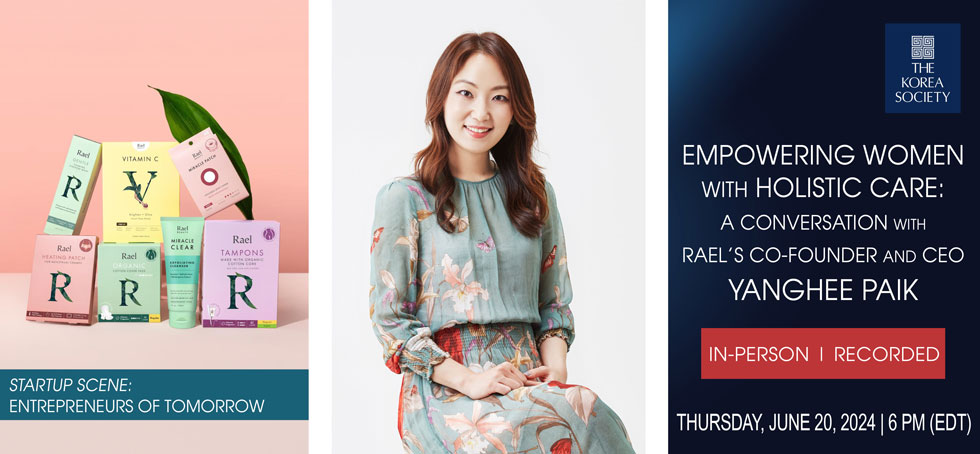
Distribution, in this story, is not a final task handed to sales. It is the plot. Paik spent years distributing movies, then built a company whose early choices were really choices about where trust could form. Amazon supplied demand and feedback. Target supplied legitimacy and reach. Seoul supplied product intelligence. Los Angeles supplied brand and operating leadership. The channels reinforced one another.
III. Run the sun around the clock
Los Angeles sleeps. Seoul starts typing.
The cross-border structure was not merely a brand story. It changed the workday. In a 2019 account of her morning routine, Paik described messaging late at night with Won, who had moved to Korea to build the Asian business. When Paik woke in California, roughly one hundred KakaoTalk messages could be waiting from the team's day in Seoul. They joked about being a 24-hour operation because, in practice, they were.
There is an advantage hidden inside that exhaustion: the company could watch two markets at once. Paik traveled to Seoul to see family and work with product development, looking for trends and new ideas. The Korean team was not a distant vendor. It was part of the company's learning engine. Paik's childhood across Korea, Paris, and New Jersey had made cultural switching familiar. As an adult, that flexibility became an organizational design.
By 2022, investors funded the next phase with a $35 million Series B led by Colopl Next and Signite Partners, with participation from Aarden Partners, ST Capital, Mirae Asset, and Unilever Ventures. Rael said the round brought its total funding since launch to $59 million. The plan attached to the money was clear: more product development, stronger retail partnerships, and broader international reach.
Money makes a growth plan possible; it does not make one coherent. Paik's useful contribution is the connective tissue. The product team in Korea, the brand in Los Angeles, the evidence from ecommerce, and the visibility of mass retail all support the same movement. It is less a collection of channels than a loop.
IV. The distance to the stage
Six years can pass in a single sentence
In 2025, Paik won EY Entrepreneur Of The Year for Greater Los Angeles and became a national finalist in the Consumer Products and Retail category. Her memory of the regional ceremony sharpened the moment. Six years earlier, she had attended the same event and sat in the audience watching other winners. She remembered thinking it must take a lifetime to reach the stage.
Then the distance collapsed. The award arrived after the Amazon launch, the retailer pitches, the store visit, the Korea office, the late-night messages, and the financing. Public recognition compresses those years into a line beneath a name. Paik resisted treating it as an ending. In her own telling, the recognition was fuel.
“This award isn't the destination - it's fuel to keep going.”Yanghee Paik, 2025
Her longer ambition has remained consistent: make Rael a global household brand. The phrase can sound generic until placed beside the actual operating choices. Global, here, is not a flag on a slide. It is a company designed across time zones, a founder who moves between Seoul and Los Angeles, and a product strategy that treats Korean manufacturing knowledge as a living input rather than a decorative origin story.
Paik once described herself in three words: flexible, motivated, candid. The first may explain the whole path. Flexibility let a childhood divided across continents become an advantage. It let a consultant become a distributor, a distributor become a founder, and an entertainment ambition reappear in consumer goods. Her motto adds the necessary tension: “Be bold, be vulnerable.” Boldness makes the leap. Vulnerability admits that the answer is not pre-approved.
The cleanest founder insight in Paik's story is also the most personal. A plan can be wrong about the medium and right about the mission. She did bring Korean ideas into American culture. They simply arrived in a shopping cart instead of a cinema.